DeSantis boasts about Medicaid fraud crackdown efforts
Oct 06, 2026 | 5:14 pm ET

Description
Applied Behavior Analysis encourages positive behavior and discourages negative behavior for autism and other special-needs patients.
(Photo by Jack Forrest/ Indiana Capital Chronicle)
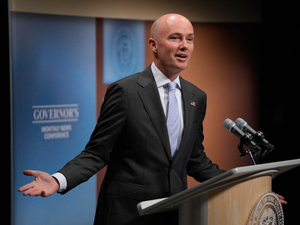
Gov. Ron DeSantis appeared in West Palm Beach Tuesday to announce the fruits of the state’s Medicaid fraud and abuse crackdown efforts, including more than 150 referrals to the state’s attorney general’s Medicaid fraud unit to investigate and potentially prosecute.
DeSantis said the state also has restricted or suspended payments to more than 260 providers suspected of Medicaid fraud and has, since the beginning of the year, terminated 220 providers from the state’s program.
“These actions are focused on bad actors who exploit the program, not legitimate providers delivering necessary care to Floridians,” DeSantis said. He added that the data underscore “exactly why the heightened oversight is essential.”
He said the referrals and suspensions were the first “salvo” and promised more to come.
SentiLink is assisting the state with its fraud and abuse efforts, DeSantis announced in June, and is conducting a “large-scale identity intelligence analysis covering millions of individuals and entities enrolled in the Florida Medicaid program.”
The goal of the contract, according to the press release announcing the agreement between the state and the company, is “to detect sophisticated fraud schemes — not just individual bad actors — including organized networks operating through concealed ownerships, fictitious entities, and compromised credentials.”
The DeSantis administration announced enhanced Medicaid fraud and abuse efforts after the Centers for Medicare and Medicaid Services sent a letter to Florida ( as well as California, Maine, and New York) seeking information about Medicaid integrity and oversight — and after CMS Director Mehmet Oz said on social media that “Florida has been a hotspot for health care fraud for years.”
The Florida Agency for Health Care Administration has conducted more than 400 onsite provider visits with the focus on those that provide people access to durable medical equipment, adult day care, and applied behavioral analysis, a therapy provided to children with autism and people with intellectual and developmental disabilities.
“We’re knocking on more doors, conducting site visits. We’re not leaving if the provider does not produce the records requested,” AHCA Secretary Shevaun Harris said. “We’re not accepting, ‘I didn’t know the requirements,’ as an answer.”
Harris said the agency has required Medicaid providers to verify their credentials and identities as part of its beefed-up fraud efforts.
She acknowledged it can be bothersome but insisted it’s necessary.
“These fraudsters have sophisticated schemes. It’s forcing us to be nimble and agile and to use every tool at our disposal to combat this issue,” she said.
Structured interventions
ABA represents structured interventions to decrease maladaptive behaviors and reinforce appropriate ones. It is common in treatment of children diagnosed with autism spectrum disorder and used for people with attention deficit hyperactivity disorder (ADHD), traumatic brain injuries, and intellectual and developmental disabilities.
Shena Grantham, Florida’s deputy secretary for Medicaid policy and quality, said in August that about 60,000 low-income children in Florida receive ABA, although she didn’t cite the year.
The protocol has been a focus of the state’s fraud and abuse efforts for years, and past efforts to better control costs and detect fraud included pilot programs and a moratorium on ABA provider enrollments. But costs kept increasing.
Then Florida switched its ABA delivery model to require managed care plans to cover services for children. Previously, patients, once authorized, saw the Medicaid ABA provider of their choice and the state paid for the services.
Since 2025, the care must be provided by the state-contracted plans and the ABA providers who want to continue working with their clients are having to negotiate contracts in their regions.
Before the switch to managed care, economists predicted ABA services would reach $3.86 billion in state FY 26-27, the governor said.
ABA expenditures are now projected to come in at $2.88 billion, he continued.
Why does Florida spend so much money on treatment for children with autism and special needs?
Some ABA providers have been dropped from the managed care networks and others have chosen to stop treating Medicaid clients.
Families and providers have been complaining about interruptions in ABA services since the transition to managed care.
When asked about difficulties parents have been reporting in getting care for their children since then, DeSantis was stern.
“You know, to the extent that those services get interrupted, that’s not AHCA’s fault. That’s the providers’ fault for what they’re doing and putting those families in that situation,” DeSantis said. “And, unfortunately, you know, we’ve seen that.”
Harris said state contracted managed care plans “have staff on deck who are providing care coordination services, reaching out to these families, and helping them pick a new provider so there are no gaps or interruption in services.” Parents struggling to secure services for their children can contact AHCA.
“We will help help them ourselves or connect them with with their managed care plan,” she said.
The Florida Legislature this spring created a 10-member task force and directed it to review the delivery model “to improve care experience and service continuity for enrollees and families receiving ABA services, while safeguarding long term program sustainability.”
The panel has met four times and is expected to hold an additional two meetings before finalizing its recommendations.
Tallahassee, FL