New York governor declares measles emergency
Oct 06, 2026 | 4:56 pm ET
Description
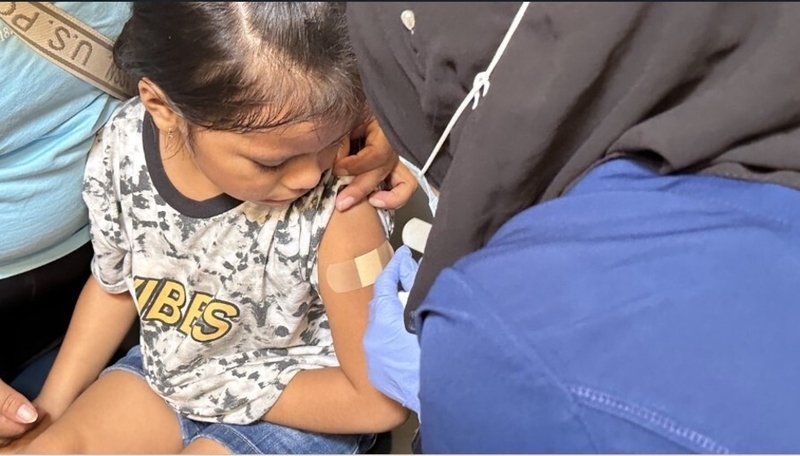
A worker applies an adhesive bandage to a child at a vaccination clinic in Minneapolis’ Corcoran Park in August 2023. Minnesota and other Democratic-led states have sued the federal government over relaxed childhood vaccination standards, and New York has declared a state of emergency as measles cases surge in neighboring Pennsylvania (Photo courtesy of the City of Minneapolis)
NEW YORK — Facing a surge of measles cases in New York state’s rural counties, Democratic Gov. Kathy Hochul issued an executive order on Monday allowing paramedics, pharmacists, midwives and other non-physicians to administer vaccines.
Hochul’s decision to declare a “state disaster emergency” comes amid the nation’s worst measles outbreak in more than 30 years and an eruption in neighboring Pennsylvania that is the largest that any single state has experienced since the early 1990s.
As of Oct. 3, New York had reported 108 total cases, its highest number since 2019. Pennsylvania has recorded more than 1,000 cases this year, and state officials there have attributed five deaths to the disease (so far the federal Centers for Disease Control and Prevention has only confirmed two of them.) There have been no deaths in New York.
As of October 1, the CDC had recorded more than 3,887 confirmed cases this year in the United States.
“No one should get seriously ill or die from a vaccine-preventable disease. That is why I have taken steps to increase the number of health professionals who can vaccinate and test,” Hochul said in a news release.
Also on Monday, New York Attorney General Letitia James, a Democrat, announced that the state would join 15 other Democratic-led states in suing the Trump administration over its decision to scale back the childhood vaccination schedule. Joining in the lawsuit are the state attorneys general of Arizona, California, Colorado, Connecticut, Delaware, Maine, Maryland, Michigan, Minnesota, New Jersey, New Mexico, Oregon, Rhode Island, and Wisconsin, and the governor of Pennsylvania.
Measles is a respiratory virus that leads to symptoms of fever and rash, and can cause serious health complications, such as pneumonia and even death. It’s highly contagious and can be contracted through exposure to contaminated air or surfaces. It is entirely preventable, however, with the two-dose MMR, or measles, mumps, and rubella, vaccine.
Children under a year old, who are typically too young to receive the first dose of the vaccine, are highly susceptible.
Through a robust vaccination campaign, measles was declared to be effectively eliminated in the U.S. in 2000, according to the CDC. But during the COVID-19 pandemic, anti-vaccination sentiment began to rise, and measles cases have surged over the past two years.
U.S. Health and Human Services Secretary Robert F. Kennedy Jr. is an outspoken vaccine skeptic and has opposed vaccine mandates. Under Kennedy, the agency has called into question the safety and efficacy of vaccines and recommended fewer vaccines for children. The move has prompted most states to unlink their vaccine guidance from federal recommendations and form their own health alliances and standards.
Combined with efforts by Republican-leaning states to weaken vaccine mandates, the federal shift has contributed to a decline in the vaccination rate among kindergarteners and a resulting increase in measles cases.
According to health policy research group KFF, 92.4% of kindergartners received the MMR vaccination for the 2025-2026 school year, compared with 95% in the 2019-2020 school year. During the last school year, 39 states had MMR vaccination rates below 95% — the minimum considered necessary to prevent community spread, according to KFF.
Katrine Wallace, an epidemiologist at the School of Public Health at the University of Illinois Chicago praised governors for taking action to stop the spread of measles. But Wallace said it’s critical that the federal government encourage people to get vaccinated to slow the spread of the disease.
“There really isn’t a national promotion of ‘Hey, we’re having an outbreak right now. Please vaccinate your kids. The MMR is safe and effective, and it prevents measles.’ That’s not being pumped out on social media. That’s not being put on TV,” Wallace said. “So this administration is not promoting the best tool that we have to prevent severe disease from viruses.”
Nationally, the CDC reports that 352 people have been hospitalized this year due to measles. Of the 3,887 confirmed cases, 61% are people younger than 19 and 95% were not vaccinated or had an unknown vaccine status.
According to CDC data, Pennsylvania, South Carolina, Utah, Wisconsin, Texas, and Virginia are experiencing the highest number of cases.
The rise in cases under Kennedy’s leadership has prompted Pennsylvania Democratic Gov. Josh Shapiro to call for the secretary’s ouster.
“He’s making it harder for governors to be able to keep people safe in our communities. I’m actually shocked that the president is letting him get away with this,” Shapiro said in a recent NBC News interview. “I don’t know why he’s still allowing him to even serve in the role”.
Stateline reporter Shalina Chatlani can be reached at [email protected].