Poll: Moore sits with a comfortable 2-1 margin over Republican challenger Cox
Oct 06, 2026 | 12:01 am ET
Description
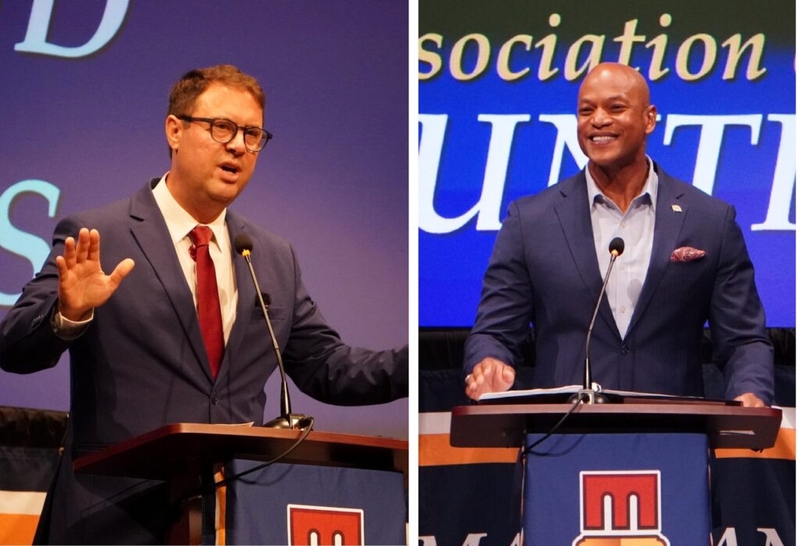
Republican gubernatorial nominee Dan Cox, right, and Gov. Wes Moore (D) will share a stage for their only debate of the election on Oct. 6 on Maryland Public Television. A new poll released Tuesday by the University of Maryland, Baltimore County finds Moore with a comfortable double-digit lead over the Cox. (File photos by Christine Condon/Maryland Matters)
Maryland Gov. Wes Moore (D) would cruise to a second term in office if the election were held today, according to a new poll from the Institute of Politics at the University of Maryland, Baltimore County.
The poll, released Tuesday, finds that Moore would pick up 51% of likely voters while Republican Dan Cox was favored by 24%. Another 14% didn’t know, while 11% was divided between other candidates.
“If anything, what’s notable is that sometimes incumbents will pick up an anti-incumbency bias — people who are just sort of frustrated with incumbents in general,” said Mileah Kromer, director of the UMBC Poll. “You’re really not seeing a lot of that here. The numbers very much look like you would expect, given the demographic characteristics of the state and the disproportionate fundraising numbers between the two candidates.”
The poll comes with four weeks left in the campaign season. Nearly 600,000 voters have already received mail-in ballots. Early voting begins Oct. 22 and ends on Oct. 29.
The survey is based on interviews with 776 Marylanders who said they were likely to vote. It was conducted from Sept. 22-27 and has a margin of error of plus or minus 3.5%.
The roughly 2-1 margin is reminiscent of the 2022 race between Moore and Cox. Four years ago, Moore, who had never held public office, trounced Cox by 32 percentage points to become Maryland’s first Black governor.
Third-party candidates decry exclusion from only debate of the governor’s race
Moore and Cox are scheduled to square off Tuesday afternoon in what is expected to be the only head-to-head debate of their rematch. But Todd Eberly, a political science professor at St. Mary’s College of Maryland, said the UMBC poll casts doubt on how much the debate will matter to voters.
“It would be hard for me to imagine anything that could happen in that debate that would alter the trajectory of this race,” Eberly said. “Even if Cox had a fantastic debate performance, I don’t see how he closes that gap, or in any way really improves the clear problem he has winning over Democratic voters.”
Two third-party candidates on the ballot are not included in the Maryland Public Television debate. Green Party nominee Andy Ellis and Working Class Party nominee Cathy White each got 3% in the UMBC survey, below the 10% threshold set by MPT to qualify for the debate.
Moore does best among Democratic voters, 72% of whom said they support the incumbent. Cox picked up three out of every four Republican voters in the UMBC survey, along with 4% of Democratic voters and 14% of the unaffiliated voters.
In Maryland, where Republicans are heavily outnumbered, a GOP candidate running statewide needs to pick up about 90% of the voters in their party, along with roughly three in 10 Democratic voters and more than 55% of unaffiliated voters. It’s a formula that has cracked the door for some successful statewide Republican candidates over the last 20 years.
“Our poll suggests that Dan Cox is not rebuilding the Larry Hogan coalition,” Kromer said, of the Republican governor who served from 2014-2022. “It’s very clear. He’s getting most, almost all the support from Republicans that are his party base. Unaffiliated voters are the required pathway to victory for a Republican statewide candidate.”
Republicans are “running against an incumbent who is polling at 51% in this poll in a Democratic state — an incumbent that, at least according to this, is currently only winning over about three quarters of Democrats,” Eberly said. “That would normally be the recipe for the potential for a Republican to be competitive, and yet they are not competitive at all.”
“Look, Moore is not in danger of losing, but he’s an incumbent Democrat polling at 51%, and the cross tabs show that he’s got 72% of Democrats,” Eberly said. “This is the kind of environment where Larry Hogan showed us Republicans could be competitive in Maryland, and they’re not. I really do wonder, will they get the message, or will they continue to move away from a Larry Hogan-type or even a Bob Ehrlich-type nominee.”
Voter perceptions of Cox and his party appear to be factors.
Cox spent four years in the House of Delegates as a conservative firebrand. He once brought articles of impeachment against Hogan for the governor’s handling of the COVID-19 pandemic. Cox also opposed closures and restrictions on restaurants and other businesses and filed lawsuits on their behalf.
He also closely aligned himself with President Donald Trump, organizing a bus trip to Washington on Jan. 6, the day that turned into a violent political protest at the U.S Capitol.
Efforts by Cox to separate his history from his current political incarnation have not been successful, according to the UMBC poll. Three voters in five identified Cox as conservative or very conservative. Just 11% identified him as a moderate candidate.
In 2018, 47% of those surveyed in another poll conducted by Kromer identified Hogan, in his bid for a second term, as a moderate.
“He’s just not perceived as the type of Republican that Maryland Democrats and frankly a lot of unaffiliated voters are willing to cast the ballot for,” Kromer said. “He doesn’t have the campaign funding to try to make the case that he is a moderate. That’s the path to victory. He doesn’t have the money to do that statewide, or frankly the record to claim political moderation.”
Eberly added that there’s reasons for Democrats to be cautious in the days after the Nov. 3 election.
“Let’s assume Democrats win big,” he said. “The worst thing Democrats could do is interpret a big win as some big endorsement for the Democratic Party. What they should do is realize this is a rejection of the Republican Party, and Democrats were the only other choice on the ballot.”
Annapolis, MD