Six years ago, Maryland changed how some electric rates are set. It went poorly, officials say.
Oct 05, 2026 | 7:37 pm ET
Description
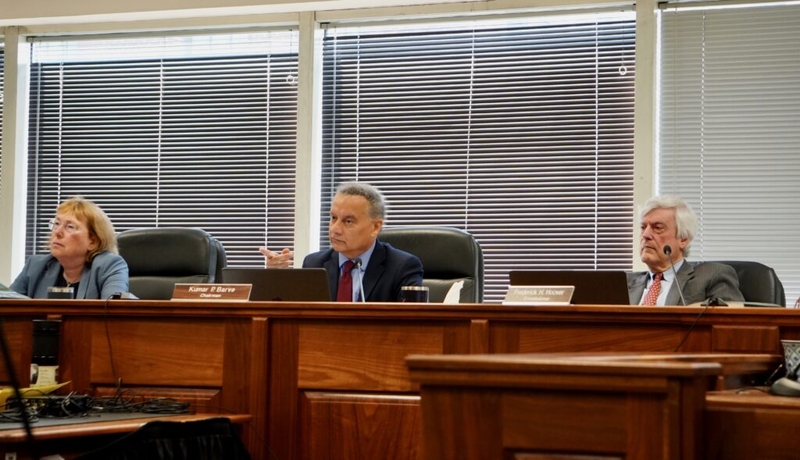
Commissioners on the Maryland Public Service Commission hear a case involving a rate increase request from Baltimore Gas & Electric on Aug. 11, 2026. (Photo by Christine Condon/ Maryland Matters)
Maryland regulators say they’re concerned about a rate-setting practice that electric utilities have been using in the state since 2020. But they aren’t ready to abandon it altogether.
The Maryland Public Service Commission ended a pilot program Thursday that had allowed utilities in the state to file “Multi-Year Rate Plans,” during which the companies could project their future spending on the electric system and ask that customers’ rates be increased accordingly.
The pilot program was a big change compared to traditional ratemaking, wherein utilities completed work on the electric system and then asked for regulators’ permission to charge those costs to customers.
The commission had hoped that the pilot program would lead to more transparency about utilities’ planned spending, make customer rates more predictable, spread rate increases out over several years and make rate proceedings less burdensome. But it found that those goals were “largely unachieved.”
Under the model, the utility companies were able to recover their costs more quickly, and they did provide more information about planned capital spending. But “the Commission did not find that those changes produced clear, measurable benefits for ratepayers,” according to a commission news release.
In its order, the commission wrote that it “generally agrees” with the idea that, “The current [MRP] process doesn’t need a little tinkering up or down, it needs a major rehaul or a complete elimination.”
Maryland officials say changes to electric grid governance aren’t enough
The commission ordered a working group to make recommendations for a possible “substantially reformed” multiyear rate plan procedure by June 30.
Maryland’s consumer advocate, People’s Counsel David Lapp, argued in a statement Thursday that the order from the commission “makes clear that MRPs have failed to deliver for customers.”
In a March analysis, Lapp’s office determined that customers’ rates increased at a more rapid clip under multiyear rate plans, compared to the six-year period prior.
His office has argued that utilities do not contain costs as much as they would have previously, because of the specter of possible rejection from the commission. Instead, the utilities submit long lists of construction projects that regulators and watchdogs must spend a considerable amount of time and effort vetting.
In his statement, Lapp lamented the fact that some form of multiyear ratemaking could continue in the future.
“Unfortunately, despite the PSC’s findings, new ratemaking practices based on utility forecasts are still possible in the future, which will require putting more resources into a fundamentally flawed approach,” Lapp said.
In a joint statement, Maryland’s three Exelon utilities, which used the multiyear ratemaking process, applauded the commission’s willingness to continue allowing forward-looking ratemaking.
“The Maryland Public Service Commission affirmed that forward-looking ratemaking does have a place in Maryland’s regulatory future. We support efforts to strengthen the process and place more focus on customer value,” wrote Nick Alexopulos, a spokesman for Baltimore Gas & Electric.
In its order, the five-member commission, whose members are appointed by the governor, admonished utilities for providing insufficient information up front about their planned projects, forcing watchdogs to make a high volume of requests for additional information.
“The Commission finds that, from their initial filing, utilities should have taken a proactive upfront approach to sharing detailed information with parties, similar to how a person applies for a grant,” the order said.
And while the commission wanted utilities to have some flexibility after their projects were approved, it noted that the utilities sometimes made significant changes to their work plans after the fact, diminishing the benefits of early review.
“There appears to have been significant variations in what projects were added or removed such that the benefit of a preliminary review afforded by an MRP is lessened,” reads the order.
Although the commission hoped that utilities recovering their construction costs more quickly would place them on stronger financial footing, which could provide benefits to the customers, the order said there’s no evidence customers saw any upside.
“It is unclear if or how that translated into a financial benefit to ratepayers as there was no indication of improved debt ratings, measurably lower financing costs, or that it was in the ratepayers’ interest to see their rates increase earlier than would have occurred under traditional ratemaking,” reads the order.
The commission also evaluated the pilot program on a few other grounds, and found that it did not demonstrably increase the utilities’ innovation, or advance Maryland’s energy policy goals.
The Maryland General Assembly has intervened repeatedly in the multiyear ratemaking debate — but has so far allowed the practice to continue.
In 2025, lawmakers added criteria that utilities must meet in order to have their multiyear plans approved. The legislature also prohibited utilities from coming back to the commission for “reconciliation,” after cost or revenue variances.
Earlier this year, the legislature modified the law again, noting that utilities could return money to customers if they under-spend, but could not request more money from consumers if they overspend, relative to their projections.
Even with sweeping utility reform legislation in place, regulators fight rising rate requests
In the same bill, lawmakers temporarily prohibited “forecast test years,” a general term that includes multiyear rate plans. The legislature commissioned a study from the commission comparing forecasting with traditional ratemaking, or a potential hybrid model.
The commission has asked its working group to deliver that study by Feb. 1, so it can be sent to the legislature by the April 1 deadline.
House Speaker Joseline Peña-Melnyk (D-Anne Arundel and Prince George’s) supported ending forecasted ratemaking altogether, and that provision passed the House of Delegates this year. But it faced opposition in the Senate, and she ultimately reached a compromise with Senate President Bill Ferguson (D-Baltimore) establishing the pause on forecasted ratemaking.
In a statement, Peña-Melnyk said she appreciates the commission’s “willingness to acknowledge where the model fell short.”
“The Public Service Commission’s findings reinforce why the General Assembly required a closer examination of how utility rates are set in Maryland,” Peña-Melnyk wrote. “If a ratemaking model asks families to pay today based on what a utility projects it will spend tomorrow, we need strong evidence that those investments are necessary, that the projections are accurate, and that customers are actually receiving the promised benefits.”
Consumer group Maryland PIRG wrote that the commission’s findings about the multiyear rate process “align with what consumer groups have been arguing for years: forecasted ratemaking means Marylanders are paying more and getting less.”
“Until our state leaders permanently end forecast ratemaking and other profit guarantees, ratepayers will continue to be at risk. Experimenting with anti-consumer ratemaking pilots once is a mistake. Twice is a choice.”
Annapolis, MD