Bank of North Dakota announces stablecoin pilot program with local partners
Oct 05, 2026 | 7:50 pm ET
Description
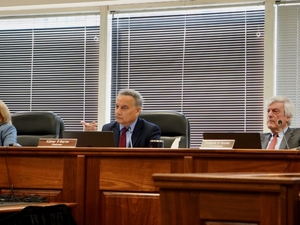
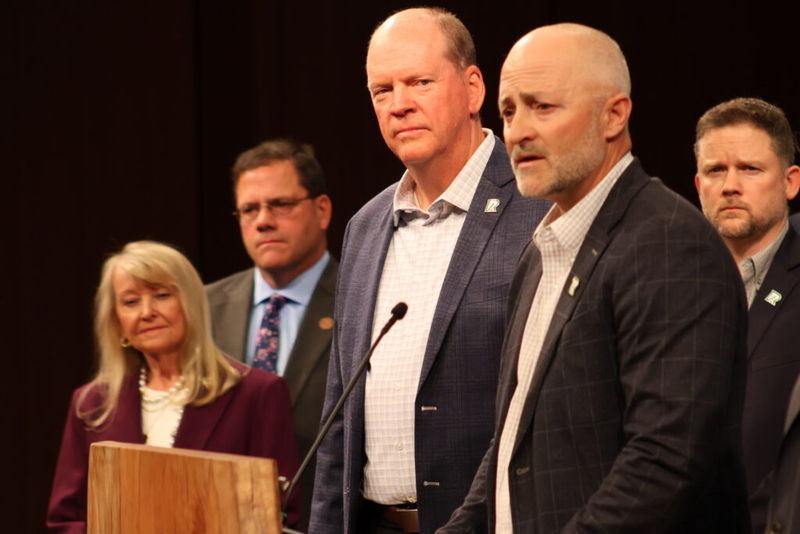
Don Morgan, center-right, CEO of the Bank of North Dakota, announces the launch of a stablecoin pilot program with four local partners during a banking forum at the Theodore Roosevelt Presidential Library in Medora on Oct. 5, 2026. The chair of the state-owned bank's advisory board, Karl Bollingberg, center-left, joined Morgan on stage alongside nearly two dozen people who have been involved in the Roughrider Coin's development. (Photo by Jacob Orledge/North Dakota Monitor)
MEDORA, N.D. – The Bank of North Dakota announced Monday it has launched a pilot program for its Roughrider Coin.
Four local banks and credit unions are using the state’s unique banking model, led by the Bank of North Dakota, to learn about possible benefits and pitfalls of the stablecoin financial technology.
“The way money moves is drastically changing, and we are utilizing our incredibly powerful financial tool to be on the forefront of that change,” said Don Morgan, CEO of the Bank of North Dakota. “We believe it will benefit the state over the next decade in huge ways.”
Bank of North Dakota to launch state’s first stablecoin known as Roughrider coin
The state-owned bank will partner with Gate City Bank, First International Bank, Capital Credit Union and North Star Community Credit Union on the pilot program to test stablecoin in a controlled environment. Fiserv, a Fortune 500 technology company that already provides services for the Bank of North Dakota, is also part of the partnership.
Roughrider Coin is North Dakota’s branded stablecoin. Stablecoin is a form of cryptocurrency because it uses blockchain technology to complete transactions. But it doesn’t experience the same value fluctuations of cryptocurrencies like Bitcoin because stablecoins are tied to the value of the U.S. dollar.
“Stablecoin at its very foundation is pegged to the dollar, and $1 of stablecoin is going to be worth $1. It won’t be worth $1.10 the next day,” said Bob Herrington, CEO of North Star, a credit union that started in Benson County and now has 13 locations. “Its use, because of that, is not one of investment and appreciation but it’s a transactional use and it is more secure because of the blockchain technology.”
Herrington said North Star wanted to be part of the pilot program because the credit union wants to be prepared down the road if stablecoin becomes an essential tool in the world of financial technology.
“Right now, the impact to everyday member or customer base transactions is very, very far down the time horizon,” Herrington said. “If you don’t start here, you’re not going to be prepared for the next phases of stablecoin.”
Ryan Goellner, executive vice president of Gate City Bank, said he hopes the Roughrider Coin will create efficiencies in how the bank operates. But he and bank leaders are still evaluating its potential uses and view the pilot program as a learning opportunity.
“Participating in the Rough Rider Coin pilot really gives us an opportunity to learn firsthand in that controlled environment, rather than kind of just waiting on the sidelines,” Goellner said. “The focus right now is just really for us to get that understanding of the stablecoin and then how we can actually utilize it internally.”
North Dakota bankers cautiously optimistic about stablecoin announcement, though future risks exist
The pilot program’s announcement was made at the Theodore Roosevelt Presidential Library in Medora during a three-day forum the Bank of North Dakota is hosting for the state’s banking leaders to learn more about financial technologies like stablecoin.
Morgan said the bank has completed its first live transactions outside of a test environment by using the stablecoin to move a penny almost instantly between two partners. He said the occasion is the start of a foundational change in the banking world, similar to the moment when an automobile first replaced a horse-drawn carriage.
“That’s the importance of today because North Dakota is on the forefront of that,” Morgan said.
Karl Bollingberg, chair of the Bank of North Dakota’s advisory board, said he believes stablecoin could have ramifications on a similar scale to the advent of internet banking.
Bollingberg said he remembers how complex it was when the bank’s leaders first approached him about what would become Roughrider Coin.
“It was a bit like listening to someone speak underwater. You knew that they were saying something. Just had no idea what,” Bollingberg said, adding he’s grateful the Bank of North Dakota is providing education for banking leaders.
North Dakota moves forward with stablecoin as local banks express interest in pilot project
The Roughrider Coin is not available for use by the general public or merchants. The pilot program is designed to test bank-to-bank transactions behind the scenes. Morgan said the Bank of North Dakota chose to limit the scope of the pilot program to minimize the potential risk of the new financial technology early on. The bank’s internal and external risk assessments concluded the initial Roughrider Coin program would be considered low risk.
Banks typically use existing systems like ACH or wire transfers to move money from one bank to another. But these systems take time to complete a transaction, especially when crossing international borders. The systems also have daily deadlines that can create difficulties and cost money.
“If we miss the cutoff by even a few minutes, it’s going to have to go out the next morning. Whereas if I used Roughrider Coin to do that same transaction, they’re gonna get it while I’m on the phone with them, telling them it’s coming,” Herrington said.
The Bank of North Dakota hopes the Roughrider Coin will become a faster and cheaper alternative to traditional payment methods. But to what extent it will complement or replace those existing payment methods depends on a lot of factors. It’s something the bank hopes to learn more about during the pilot program.
“I’d be shocked if this doesn’t have a high rate of adoption and a high rate of transactions fulfilled within it,” Morgan said. “But there are a lot of unknowns still.”
North Dakota banking customers should not see any immediate changes or impacts even if their financial institution is involved in the pilot program. Long term, Morgan said one of the first benefits customers could potentially see is pushing daily transaction deadlines later in the day.
“There could potentially be quicker transaction times when that gets rolled out to the client level,” Morgan said. “You could see that as one of the first kind of benefits to occur.”
Ag commissioner lukewarm on Bank of North Dakota’s foray into stablecoin
Morgan said the Bank of North Dakota plans to add more banks and credit unions in the state to the program over time. There is no set deadline for the pilot program.
“We’re not getting in any hurry. We have no rush to market. We’re not trying to meet shareholder return expectations. We’re trying to build this very safely, thoughtfully,” Morgan said. “If this pilot went on for a whole ’nother year of simply just testing and working out kinks and bugs, I would be OK with that.”
The Bank of North Dakota will provide regular updates to the North Dakota Industrial Commission, a three-person board chaired by Gov. Kelly Armstrong, which oversees the bank. One member of the commission, Agriculture Commissioner Doug Goehring, has urged the bank to proceed with caution.
North Dakota Monitor reporter Jacob Orledge can be reached at [email protected].
Bismarck, ND