Republican gubernatorial nominee Gregg Hull announces plan to phase out New Mexico’s income tax
Oct 05, 2026 | 3:37 pm ET
Description
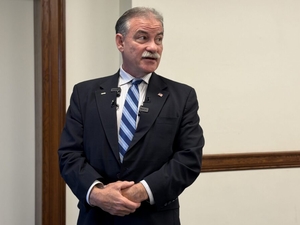
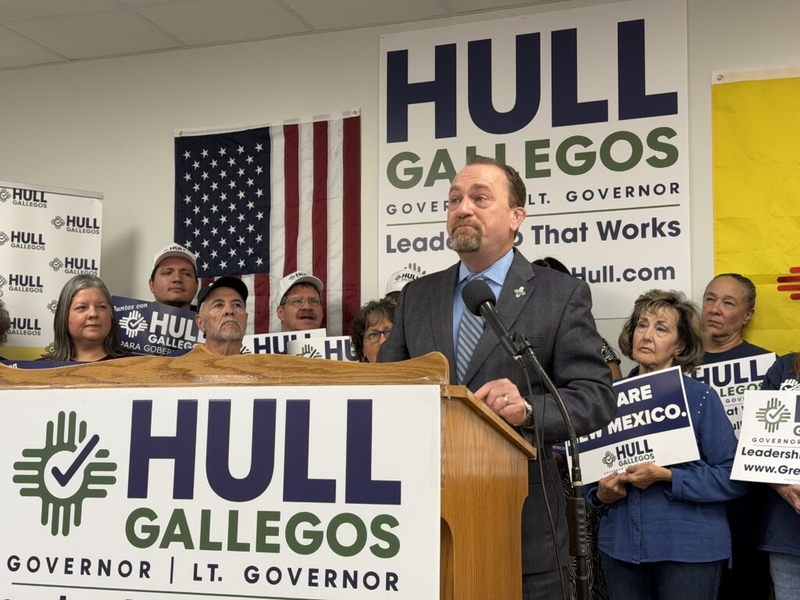
Gregg Hull, New Mexico's Republican gubernatorial nominee and former Rio Rancho mayor, on Oct. 5, 2026, announced his plan to phase out the state's income tax if elected governor. (Photo by Joshua Bowling/Source NM)
New Mexico’s Republican gubernatorial nominee, former Rio Rancho Mayor Gregg Hull, on Monday announced his plan to gradually phase out the state’s personal income tax if elected governor on Nov. 3.
Speaking from his Albuquerque campaign headquarters, Hull said he hopes to accomplish the four-step plan over the course of four years. The plan’s first step would reduce income tax for a single filer with a $40,000 salary from $1,471 to $671, he said. Similarly, it would reduce annual income tax for a married couple filing jointly with a $200,000 income from $8,989 to $7,250.
In the plan’s fourth and final step, no New Mexicans would continue to pay a state income tax.
“If you want to raise people out of poverty, the best way to do that is improve their personal wealth,” he told reporters at a news conference.
While New Mexico ranks high nationally in terms of poverty and low in terms of wages, the state manages a sovereign wealth fund that’s on track to be the largest in the nation by the end of the decade.
“Right here in one of the highest-poverty states in the country, we’re sitting on that type of wealth,” Hull said.
Hull said he and his team crafted the plan while assuming that the state’s social services, such as the Supplemental Nutrition Assistance Program and Medicaid, would continue at their current levels. Moving from one step of his plan to the next would require approval from the Legislature and would have to meet several benchmarks to ensure the reduction in income tax revenue doesn’t adversely affect the state’s ongoing programs.
For example, Hull said the plan cannot progress from one step to another if the state’s general fund reserves dip below 25% of the state’s current expenses. If the Legislature were to block his proposal, Hull said he would prioritize legislation to eliminate the remaining state income tax on Social Security benefits and qualifying military retirement pay.
He said he would not seek to institute additional taxes to replace the state’s lost income tax revenue and that he would seek to limit state spending.
“What we’re doing, first and foremost, is looking at controlling spending. We’ve seen the spending growth far exceed personal income growth. We need to bring that back into check,” he said. “That, really, is creating an imbalance in the ability to pay for these programs.”
While Hull said he wants to rein in the state’s spending, he added that he is not “looking to target” or cut programs — although he said he wants to rectify the state’s high SNAP error rate. He said his income tax plan would help state leaders ensure “that our existing programs can be appropriately funded before we add additional programs.”
Hull will face Democrat Deb Haaland, a former U.S. Department of the Interior secretary and member of Congress, in the Nov. 3 general election. Early voting begins Tuesday at county clerk’s offices across the state and will expand to alternate voting locations on Oct. 17.
Santa Fe, NM