Trump drops longtime aversion to mail-in voting with GOP trailing in polls
Oct 05, 2026 | 5:36 pm ET
Description
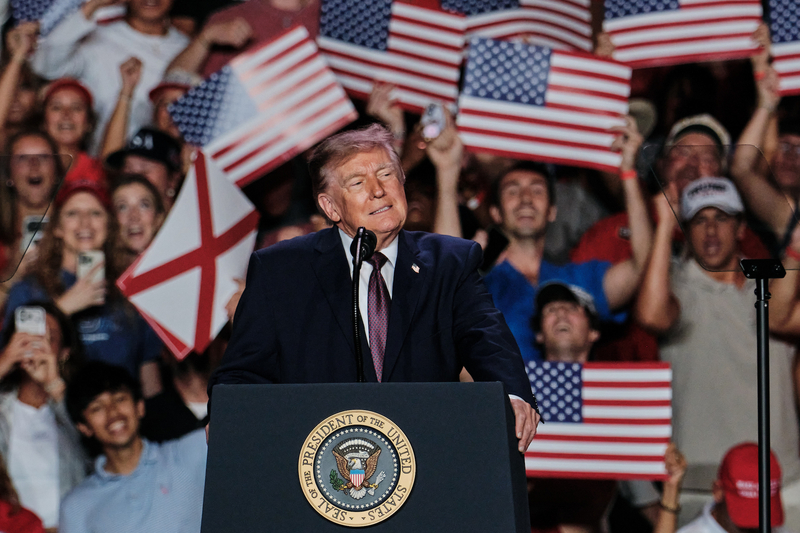
President Donald Trump speaks at the Mitchell Center at the University of South Alabama in Mobile, Alabama on Oct. 2, 2026, as he campaigns in GOP-leaning states ahead of the midterms. (Photo by Dan Anderson/Alabama Reflector)
President Donald Trump wants to sharply curtail mail ballots. He’s called them “inherently corrupt” and baselessly condemned them as a major source of fraud.
But with Republicans falling behind in the polls, the president is now urging his supporters to vote in the midterm elections any way they can, including by mail.
The White House has also sent emails through a government account promoting voter registration in recent days and Trump is continuing a string of campaign rallies in typically conservative states, including Nebraska on Monday night. Defense Secretary Pete Hegseth has directed that members of the military, who tend to support Republicans, have a day off to vote.
“If your state has early voting, do not wait. Go out and vote. Vote early, vote by mail, or vote in person on Election Day, November 3rd, so we can defeat the radical left ‘Dumocrats’ in a midterm victory that is too big to rig,” Trump said in a social media video over the weekend, using a derogatory term for Democrats.
The about-face by the president is familiar. Trump encouraged his voters to cast their ballots by mail in 2024 and has repeatedly voted by mail himself, despite a long record of attacking the practice.
Republicans battle against loss of majorities
The latest comments — along with the red-state rallies — underscore the political peril that analysts see facing Republicans and Trump.
If Republicans lose control of either the House or Senate, Democrats are likely to launch investigations into the White House that could complicate the president’s final two years in office. A Democratic House would face pressure from the base to pursue impeachment against Trump or other administration officials.
Democrats enjoy an 11-point advantage over Republicans on the generic congressional ballot, according to a nonpartisan September national poll by Emerson College. The poll also found Democrats more enthusiastic, with 78% “very excited” to vote compared to 66% of Republicans.
A poll by The New York Times and Siena College, released Saturday, found Democrats ahead or tied in Senate races in several GOP-leaning states, including Alaska, Kansas, Ohio and Texas.
Several of those same states — including Alaska, Kansas and Ohio — allow voters to cast a ballot by mail without providing an excuse. Iowa also features a highly competitive Senate race and has no-excuse absentee voting, according to the National Conference of State Legislatures.
Vice President JD Vance was visiting Alaska on Monday to campaign for the Republican Senate candidate, while Trump was scheduled to hold a rally in Grand Island, Nebraska, where the incumbent Republican Sen. Pete Ricketts faces a competitive challenge from independent Dan Osborn.
‘We seem to have no choice’
Republicans are scrambling to find ways to turn out their base voters, said Brandon Rottinghaus, a political science professor at the University of Houston. The immediate objective for the party is maximizing voter turnout among their supporters, he said, adding that discouraging them from using legal methods to vote would be an obvious electoral disadvantage.
“The overriding concern for the White House is turnout, not consistency,” Rottinghaus said. “The political messaging has been inconsistent on this. But all of that aside, the need to get Republicans to come vote is paramount for Republicans.”
Trump at the White House on Monday said that he prefers voters to cast their ballots in person but that they can “vote by mail if they want because we seem to have no choice.” Without offering evidence, he alleged significant cheating in voting by mail.
Pressed by reporters for evidence, the president pointed to California. The blue state, where all voters receive a ballot in the mail, has drawn his ire in the past for a vote-counting process that can last weeks, in part because of ballots that arrive in the mail after Election Day. But a slow count isn’t evidence of fraud.
When asked about Trump’s shifting stance, the White House referred States Newsroom to the president’s Monday remarks.
Supreme Court blocked Trump
Trump’s decision to again tout voting by mail — while also attacking it — came after he spent months pursuing a high-stakes effort to impose restrictions on mail ballots.
In August 2025, Trump promised to lead a movement to eliminate mail-in voting.
Less than a year later, he signed an executive order directing the U.S. Postal Service to require states, at least 90 days before a federal election, to notify the Postal Service whether they intended to allow ballots to be sent through the mail. States would have then had to submit to USPS a list of voters planning to vote by mail at least 60 days before the election.
Postmaster General David Steiner had said that the Postal Service wouldn’t deliver ballots for states that refused to comply with the rule. Democrats and other opponents said it would have given the Postal Service unprecedented and unconstitutional authority over elections, which are administered by the states under the Constitution.
The U.S. Supreme Court blocked the rule from taking effect in a one-paragraph order that upheld a lower court decision halting it. Election officials and voting rights advocates had warned that implementing the requirements so close to the election would have caused chaos.
Trump railed against the decision at the time, calling it a “big loss” for Republicans and alleging it would make cheating by Democrats on mail-in ballots much easier. “And now they have open field to do so,” he wrote on social media when the order was issued in mid-September.
On Monday, League of Women Voters President and CEO Celina Stewart emphasized that the Trump administration had spent months attacking voting by mail. She said in a statement that while Trump sought to impose restrictions through an executive order — which the League sued over — “the President does not have the authority to unilaterally dictate how states administer elections.”
“A shift in rhetoric does not undo those actions, nor does it erase the need for the League to take this fight to court. We will judge this administration by its actions, not by its latest statement,” Stewart said.
Trump’s attacks on voting by mail
Trump’s attacks on voting by mail stretch back to the 2020 election, when mail voting surged amid the pandemic.
At that time, he characterized mail ballots arriving after Election Day as fraudulent, even though late-arriving ballots must be postmarked on or before Election Day — indicating that voters made their choices before the close of polls. The Supreme Court this year upheld the authority of states to count mailed ballots that arrive after Election Day.
Six years later, mail-in voting remains a major way for Americans to cast their ballots. Nearly a third of U.S. voters cast a ballot by mail in 2024, according to the U.S. Election Assistance Commission.
This year, nearly 1 million people have already voted by mail in the general election, with more than 52 million mail ballots requested, according to data compiled by the University of Florida Election Lab.
For campaigns, every ballot a supporter casts by mail represents a “bird in the hand,” said Rottinghaus. By contrast, voters who wait until Election Day remain potential voters, with the risk that something will come up that keeps them from voting.
Campaigns build whole persuasion operations around mail voting, he said, adding that demonizing the practice takes away a weapon some campaigns rely on.
“This is a top-down effort from the most vocal and visible Republican that can create a lot of complications for Republicans down ballot who may rely on mail voting for a big part of their strategy,” Rottinghaus said.
All States Newsroom content is free to republish. Read our republishing policy for more information.