Risch campaign says rumors of using 1917 Idaho law to avoid Senate election are ‘completely false’
Oct 02, 2026 | 1:25 pm ET
Description
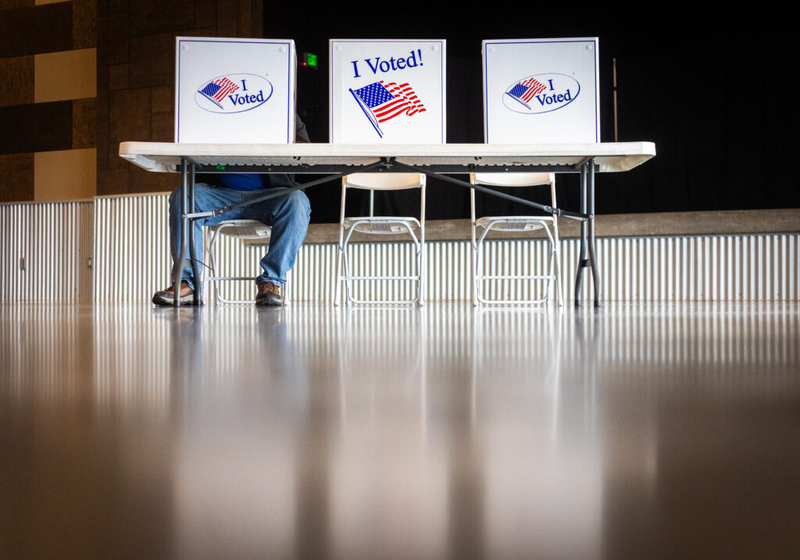
Bonneville County residents cast their votes during the May 21, 2024, primary election at The Waterfront Event Center in Idaho Falls, Idaho. (Photo by Pat Sutphin for the Idaho Capital Sun)
As the Nov. 3 general election nears, rumors have cropped up that a never-used, 1917 Idaho state law could be used to circumvent the race for U.S. Senate.

The campaign for incumbent Republican U.S. Sen. Jim Risch strongly denied these rumors.
The more-than-a-century-old law states that if a U.S. senator from Idaho resigns or dies within 30 days of the general election, then the governor could appoint a replacement and “no election for United States senator to fill said vacancy shall be held at such general election.”
Risch is running against Todd Achilles, who has taken heat from from Risch’s campaign for running as an independent after serving in the Idaho Legislature as a Democrat.
“This rumor is completely false,” Risch’s campaign manager Marc Kilmer told the Idaho Capital Sun in an email. “Jim Risch is leading in the polls. He is running an aggressive campaign. He will be victorious on November 3. This conspiracy theory is being perpetrated by our desperate opponent to take attention away from his liberal record. The only people who gamed the system this election were our opponent’s supporters who coerced Democrat David Roth to drop out and clear the field for Todd Achilles.”
A spokesperson for the Achilles campaign denied the rumors started with the independent candidate’s campaign.
“What’s concerning is that Jim Risch is pointing fingers instead of assuring voters that he won’t use the law in a way that would bypass the will of the voters,” Achilles’ Communication Director Crispin Gravatt wrote in an email. “He should clearly state that he will remain in the race through Election Day and, if elected, intends to serve the full 6-year term until he is 89 years old.”
U.S. Senate candidate Democrat David Roth won his primary election in May, but withdrew from the race and removed his name from the ballot in September, citing a lack of support from his party.
The Idaho Capital Sun reached out to the governor’s office for comment, but did not receive one.
How are the other Idaho U.S. Senate candidates responding?
At a candidate forum held Wednesday evening in Caldwell, Risch’s opponents addressed the possibility of the law being put to use. Risch wasn’t in attendance at Wednesday’s forum.
“This has bubbled up recently. I don’t know if you guys have seen this,” moderator McKay Cunningham, a director of the master of applied public policy at College of Idaho, told candidates Wednesday. “Is this conspiracy theory? … What is the likelihood of this sort of thing happening? Maybe you haven’t even heard of it, but I’d like to get the candidates’ impressions on this question,” Cunningham said.
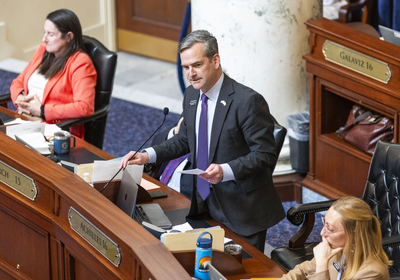
Independents Achilles and Natalie Fleming, and Libertarian Matt Loesby, each said they thought the law’s use wouldn’t be well-met with Idaho voters. Most expressed doubt that it would be.
“I think if it were tried, it would be challenged in courts, and it would be a whole big mess,” Loesby said.
He said a more likely situation would be for Risch, who is 83, to retire after winning the election at some point into the six-year term.
Fleming said the idea was “frightening,” but that she is “not predicting that would happen.”
“If they were to try that, it would cause, I think, great outrage within the state of Idaho,” Fleming said.
Achilles said he thought the move would be unconstitutional.
“It creates, I think, a very dangerous situation where you’re getting into a never-ending loop of never electing another senator in the state of Idaho,” Achilles said. “… I don’t think Idahoans would stand for that.”
What are the legal considerations of the law?
Cunningham in a Thursday interview with the Idaho Capital Sun noted that constitutionality of the law has never been put to the test because it’s never been used. Courts have not had the chance to weigh in on the law.

“I think the arguments (against the law) would stem from provisions in the Idaho Constitution as well as in the U.S. Constitution that provide qualified citizens the right to vote,” he said. “There are a lot of Supreme Court cases that talk about this constitutional right.”
He said he could imagine candidates bringing another claim against the law over potential violations to their due process rights for their candidacy if no election took place.
“It would create such a mess,” Cunningham said. “I think at the heart of it, and this is not a legal argument necessarily, but the heart of it is representational democracy and the right to vote is preservative of all other rights.”
In 2025, Idaho state legislators proposed House Bill 324, which would have amended this law to allow the governor to select a day for a special election in the case of a U.S. Senate vacancy within 30 days of the general election, rather than appoint the replacement.
The bill was introduced by then-Rep. Kevin Andrus, R-Lava Hot Springs, and Rep. Josh Tanner, R-Eagle. The legislation never received a hearing and did not advance.

Boise, ID