Ballot measure to ban youth gender-affirming surgeries could disrupt other forms of healthcare
Oct 02, 2026 | 3:08 pm ET
Description
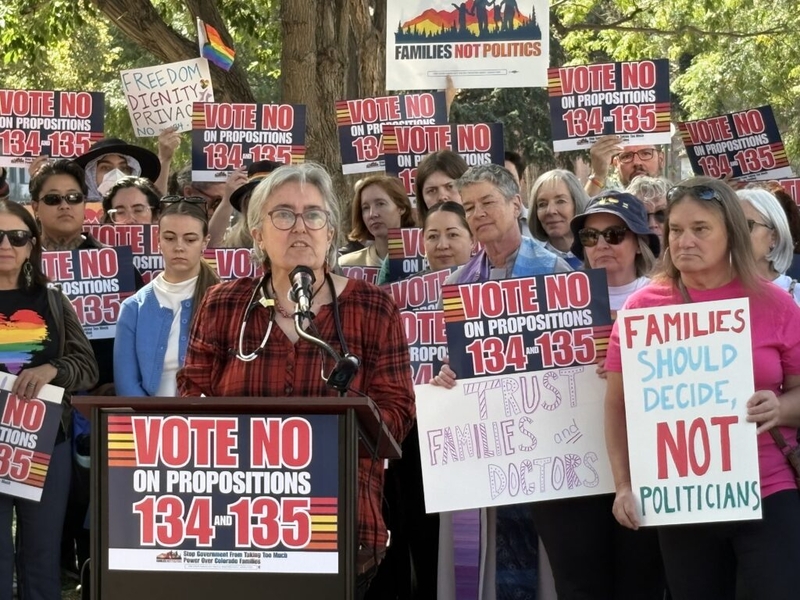
Dr. Mary Fairbanks speaks at a Families Not Politics rally opposes two anti-trans ballot measures outside of the Colorado Capitol on Sept. 15, 2026. (Photo by Lindsey Toomer/Colorado Newsline)
Colorado voters in November will decide if the state should ban gender-affirming surgeries for minors.
Proposition 135 would prohibit health care professionals from knowingly performing any surgery on a minor “for the purpose of altering biological sex characteristics.” The measure would also prohibit state and federal funding including Medicaid from being used to pay for gender-affirming procedures.
It’s one of two ballot measures seeking to restrict the rights of transgender children that are backed by Protect Kids Colorado, an organization led by prominent anti-LGBTQ+ activist Erin Lee. Lee did not respond before publication to Newsline’s questions about the goals of the measure and how it could prohibit non-transgender children from receiving surgeries related to gender. The other measure would ban transgender youth from playing on gendered sports teams.
Families Not Politics, which opposes Proposition 135, is led by LGBTQ+ advocacy organizations including One Colorado, Rocky Mountain Equality, the Transgender Law Center and Inside Out Youth Services, as well as Planned Parenthood of the Rocky Mountains and Cobalt, an abortion-rights organization. Dozens of other organizations from around the state and Democratic elected officials also oppose the measure.
Jax Gonzalez, political director at One Colorado, said providers are afraid the measure would make the provision of care too complex for them to know what is permitted. The meaning of language in the measure related to a minor’s “perception of sex or gender,” for example, is unclear.
“All of us have gender and have lots of ideas about that, and so, does that mean that if a patient brings up a conversation about their own gender, regardless of their general identity, does that mean that that provider can’t treat them anymore?” said Gonzalez, who is trans.
Few trans students play school sports in Colorado. A 2026 ballot measure would ban them.
Gender-affirming surgeries for minors happen very rarely, Gonzalez said, and only in extreme cases where the affected minor is experiencing suicidality. They said surgery is only discussed as an option “after years of therapy and consultation with the family” as well as several doctors and medical experts.
A 2024 Harvard study found that higher rates of cisgender people, both minors and adults, received the surgeries that transgender and gender diverse individuals receive for gender-affirming purposes. For example, it found that 97% of breast reduction procedures performed on teenagers were for cisgender boys.
The study reviewed insurance claim data from 2019, and found that no trans youth age 12 and under received surgeries as part of their gender-affirming care. This aligns with medical guidance that says transgender youth should not receive medical or surgical intervention prior to puberty. For teenagers age 15-17, the rate of gender-affirming surgeries was 2.1 per 100,000 transgender or gender-diverse individuals.
Providers weigh in
The Colorado Medical Society’s board voted to oppose Proposition 135 because it would interfere with the independent clinical decisions physicians make based on the needs of each patient, according to board president Dr. Sean Pauzauskie. The nonprofit organization is the largest organization of physicians in Colorado, including more than 6,000 members in various healthcare specialties.
“Our CMS members have diverse political views, but share one core principle, and that’s that medical decisions belong in the exam room,” Pauzauskie said.
The board’s opposition is based solely on the fact that it would interfere with a medical provider’s ability to use their own medical judgement, not because the measure relates to gender-affirming care, Pauzauskie said. The organization would oppose any interference by government or third parties intended to compromise that ability.
The two major hospitals that historically provided gender-affirming care to minors do not offer surgeries. Children’s Hospital Colorado, which has never provided gender-affirming surgeries for minors, does not have a position on the measure. Families of several transgender children sued the hospital for its cessation of care in late 2025 due to threats from the Trump administration, and a trial is set for January.
Someone who's transgender really isn't trying to impact other people. They just want to live their lives.
Denver Health, which does not take positions on ballot measures, stopped offering gender-affirming surgeries for youth in early 2025. The hospital also paused all other forms of gender-affirming care for minors following “escalating actions” from the U.S. Department of Health and Human Services.
“These changes, which are made necessary by the actions of HHS, substantially affect access to critical health services,” spokesperson Deydra Bringas said in a statement. “We also are concerned that the important relationships built between our providers and patients to help make informed decisions about their care are being disrupted.”
A December declaration from U.S. Health and Human Services Secretary Robert F. Kennedy threatened to pull Medicaid funding from any facility that provided gender-affirming care to minors. Colorado joined several other Democratic-led states in suing over that policy, and an Oregon judge ruled the declaration was unlawful in March.
Dr. Mary Fairbanks, a retired family physician, worked with transgender patients at various points throughout her career, though mostly with adults. She said she’s “baffled” by the negative political attention on trans people, in part because they represent such a small percentage of the population.
“Someone who’s transgender really isn’t trying to impact other people,” Fairbanks said. “They just want to live their lives.”
Many trans people do not seek gender-affirming surgery at any point in their lifetime, Fairbanks said, in part because of how cost-prohibitive it is. She worked with trans people who didn’t seek medical gender-affirming care at all, and instead just socially transitioned — meaning they dressed and used a name and pronouns that aligned with their gender identity.
When she prescribed trans women gender-affirming medications, many times Fairbanks said her patients told her that they felt normal for the first time in their lives.
“To be able to make someone feel normal is an amazing gift, and so I’m grateful that I’ve been able to do that for some folks,” Fairbanks said.
Proposition 135 doesn’t name specific procedures, Fairbanks said, but would instead ban surgeries based on approach, creating confusion for providers. She worried it could disrupt the ability for young transgender patients to receive any kind of surgery if discussion of their gender-identity comes up in a conversation with their provider.
Any policy that interferes with the practice of medicine will cause trouble, Fairbanks said.
Election Day is Nov. 3. The proposition needs approval from a majority of Colorado voters to become law. County clerks began mailing out ballots to voters Friday.

Denver, CO