Indiana AG Todd Rokita sues disciplinary officials, alleging retaliation over political speech
Oct 02, 2026 | 10:42 am ET
Description
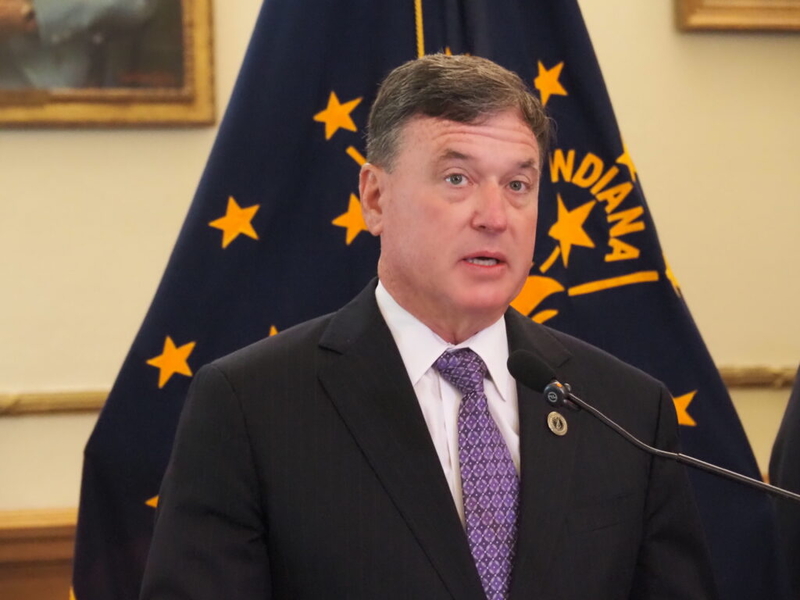
Indiana Attorney General Todd Rokita speaks at a news conference on Tuesday, Sept. 15, 2026. (Photo by Leslie Bonilla Muñiz/Indiana Capital Chronicle)
Indiana Attorney General Todd Rokita sued current and former members of the state’s attorney disciplinary commission Thursday, alleging years of retaliation and asking a federal judge to block a demand that he answer an ethics grievance tied to his personal jet ski transaction.
The 34-page complaint, filed in the U.S. District Court for the Southern District of Indiana, alleges disciplinary officials have targeted Rokita over his public statements on abortion, immigration and other issues since 2022.
The latest trigger, however, is a grievance questioning whether Rokita used his office to pursue a personal dispute with a jet ski seller — an allegation that Rokita denies.
The lawsuit names nine current members of the Indiana Supreme Court Disciplinary Commission, five former members and Executive Director Adrienne Meiring.
The commission is an arm of the Indiana Supreme Court responsible for investigating and prosecuting allegations of attorney misconduct. Its nine members — seven attorneys and two nonlawyers — are appointed by the court.
The Republican attorney general is seeking an order to block what he alleges is a pattern of retaliation, along with compensatory and punitive damages over alleged disclosures of confidential disciplinary proceedings.
“General Rokita does not forfeit the freedom of speech by serving as Attorney General or by holding a law license,” his attorneys wrote. “The First Amendment forbids government officials from retaliating against a speaker for protected speech, and it does not permit a disciplinary bureaucracy to be turned into an instrument for punishing an elected official’s participation in public debate.”
In a Friday news release, Rokita accused the commission of political bias and singled out member Bernard Carter, the Lake County prosecutor, for supporting his election opponent while the commission was investigating him.
“The First Amendment does not disappear because someone holds a law license or is in an elected office,” Rokita said in the release. “This commission has used the discipline process itself, time and time again, to burden the work Hoosiers elected me to do, and most certainly has had a chilling effect on other elected officials who are attorneys.”
Jet ski grievance
This latest dispute centers on a grievance filed by Jess Sampson, a Rochester man Rokita’s office is separately suing over alleged consumer protection violations following a personal jet ski transaction by the attorney general.
Sampson questioned whether Rokita was using his office to pursue a personal grievance. Rokita denied misusing his authority and argues that reporting suspected wrongdoing to his office’s Consumer Protection Division was constitutionally protected.
A Fulton County judge rejected Sampson’s motions to dismiss the case and disqualify the attorney general’s office in June, finding the action and claims did not violate professional conduct rules. The judge noted, however, that the disciplinary commission has ultimate authority to determine whether a violation occurred.
Indiana judge rejects challenge in lawsuit over AG Todd Rokita’s jet ski purchase
The federal complaint says Rokita brought concerns about Sampson to the division as a consumer. His office’s investigation, the lawsuit alleges, uncovered broader violations involving unlicensed vehicle sales, vehicle titles and misrepresentations about repairs and vehicle quality.
The state is seeking restitution for Rokita, but his attorneys emphasize that he is not counsel of record in the consumer protection case. One of the state’s 11 counts concerns only his transaction, according to the federal complaint.
Sampson’s account, included in the exhibits, disputes Rokita’s characterization of their dealings. He said he sold the jet ski as is for $3,000 and maintained that Rokita failed to follow instructions for breaking in its engine.
Sampson filed his disciplinary grievance in December 2025. Along with his narrative and court documents, he included what he described as an AI-generated response to a question about whether a state attorney general could use the office to resolve a personal debt or grievance.
Rokita’s lawsuit argues that neither the grievance nor the commission’s demand identified a professional conduct rule violated by the transaction. The commission’s letter did cite a separate rule under which failing to respond could itself constitute misconduct.
Rokita wants the federal court to declare that he need not respond to Sampson’s grievance, according to court filings.
A July 29 letter attached to the lawsuit shows the commission demanded a written response and warned that failure to cooperate could lead to suspension of Rokita’s law license or other discipline. The letter said a preliminary investigation would determine whether to dismiss the grievance or pursue further investigation.
Rokita’s federal lawsuit says the Sampson grievance had not yet been formally docketed by the commission. His attorneys argue that filing before the matter advances allows him to seek federal intervention without asking a judge to halt an ongoing state disciplinary proceeding.
Broader retaliation claims
Rokita’s lawsuit frames that demand as the latest in a series of retaliatory investigations dating to 2022. His disciplinary history includes a 2023 public reprimand from the Indiana Supreme Court over his televised comments about Dr. Caitlin Bernard, who provided an abortion to a 10-year-old rape victim from Ohio.
Rokita admitted to two professional conduct violations in resolving that case. The court found his comments were likely to prejudice related proceedings and had no substantial purpose other than to embarrass or burden Bernard.
A second disciplinary case focused on whether his public statements after the reprimand contradicted his acceptance of responsibility. The Supreme Court dismissed that case in October 2025 after Rokita and the commission reached an agreement reaffirming his earlier admissions.
The new federal complaint also points to grievances involving his warnings to companies about diversity, equity and inclusion policies, his office’s brief supporting Donald Trump’s eligibility for the presidential ballot and his criticism of state Sen. Liz Brown over immigration legislation.
Rokita alleges the commission repeatedly demanded responses under threat of discipline, prolonged investigations and damaged his reputation even when it ultimately declined to bring charges.
The lawsuit specifically accuses Carter, a Democrat, of endorsing Rokita’s 2024 opponent, Destiny Wells, and hosting a campaign event for her while serving on the commission investigating Rokita. It alleges Wells then highlighted the disciplinary matters in campaign advertising.
Rokita also claims the commission sent copies of its correspondence with him to the people who filed grievances, who then shared those communications with reporters.
The complaint does not identify which particular defendants disclosed confidential information.
Rokita is seeking to hold current and former commissioners and Meiring personally liable for damages over the alleged disclosures. He also wants a court order barring current commission officials from retaliating against him or disclosing confidential proceedings.
The lawsuit argues that requiring him to answer Sampson’s grievance under threat of discipline violates his right to due process. He has requested a jury trial.
The lawsuit cites $491,508 in taxpayer-funded legal expenses for his disciplinary defense between 2022 and 2025 — a total previously reported by the Indiana Capital Chronicle. That amount covered four outside law firms and at least six disciplinary matters.
Rokita is represented in the federal case by Paul Mullin and E. Ryan Shouse of Indianapolis-based Lewis and Wilkins, along with Gene Schaerr, H. Christopher Bartolomucci and Justin Miller of Washington, D.C.-based Schaerr Jaffe.

Indianapolis, IN