Michigan Senate committee considers requirement for state funding in special legislative elections
Oct 02, 2026 | 7:00 am ET
Description
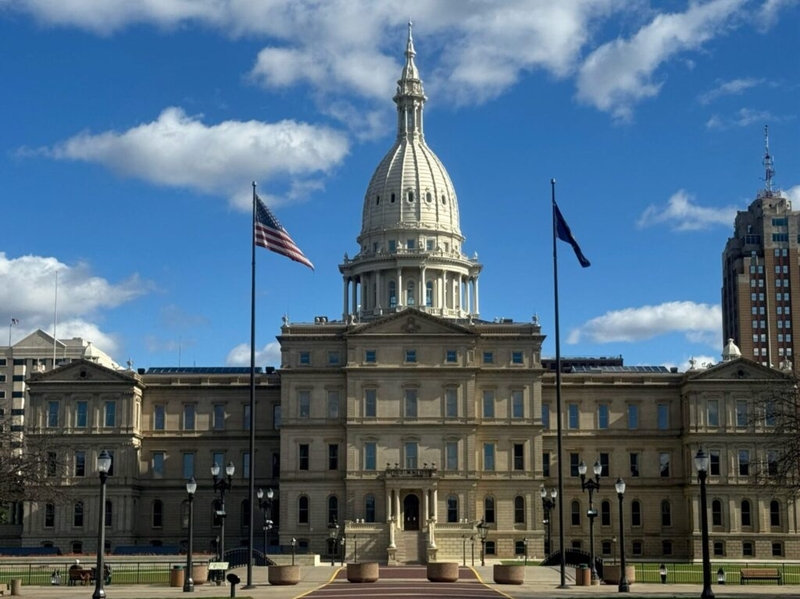
Michigan Capitol building. (Photo by Susan J. Demas
Michigan Sen. Chedrick Greene (D-Saginaw) is no stranger to special state legislative elections — he took office in May as a result of one in the 35th Senate District.
On Thursday, he presented a bill to the state Senate Elections and Ethics Committee that would require Michigan to reimburse county, city and township governments for the cost of conducting a special election.
The legislation, Senate Bill 1186, would cost the state an estimated $4,500 per voting precinct in a given special election based on reimbursements made to local governments for the 2024 presidential primary election, according to a Senate Fiscal Agency analysis of the bill.
Sen. Paul Wojno (D-Warren), expressed his support for the legislation during Thursday’s hearing.
“Being a former municipal clerk, I think every clerk around the state would be supportive of this legislation,” Wojno said.
Sen. Ed McBroom (R-Waucedah Township), however, raised concerns about the wide range of elections that a municipality might have to hold outside of regular election dates.
“There’s some differences in the causes of these special elections. If the locals decide to vote somebody into a different office, I’m not sure why that’s the state’s responsibility then to pay for that local election,” McBroom said. “If the locals decide to initiate a recall election, I’m not sure why that should be the state’s responsibility to pay for that.”
Greene clarified that the bill does not cover any election date where there are already scheduled elections for ballot proposals, bond proposals for schools or any other vote occurring.
“If there’s any local municipality that is having a special election for once again recall of a trustee or something to that effect, they cannot submit to the state for the purpose of a special election reimbursement in this bill,” Greene said. “It is only for single issue state legislative purposes that are in the jurisdiction of the executive branch of the state of Michigan.”
McBroom also noted concerns that such a bill could incentivize the governor to delay calling a special election. The district which Greene now represents sat vacant for 16 months after it became open following the election of U.S. Rep. Kristien McDonald Rivet (D-Bay City). Gov. Gretchen Whitmer was heavily criticized for leaving the seat unfilled.
“Does this then give the governors pressure, actual genuine pressure, not just political pressure, to not call elections? And what if we don’t fund it? What if the legislature won’t fund it? What if we won’t approve that money?” McBroom asked. “Then these people are going to sit without representation for even longer periods of time.”
Saginaw County Clerk Vanessa Guerra testified in support of the bill on behalf of the Michigan Association of County Clerks, explaining that in Saginaw County, the total cost of both the special state Senate primary and the special state Senate general, including costs incurred by local jurisdictions, was $437,543. In Midland County alone, not including local jurisdictions, the elections cost $97,042.
“The special election was called by the governor at the end of August of 2025, so that did not leave a lot of time for local and county clerks to financially prepare for two unscheduled elections. Fortunately, of course, we made the necessary adjustments and we administered very successful elections in all three of our counties, but not without significant cost,” Guerra said. “I also want to be very frank that the burden to finance elections primarily falls on our local clerks, and I want to emphasize that because I think that there is an assumption that counties can easily absorb these unscheduled elections. Obviously, the county budget is much larger.”
Mary Clark, the Delta Township Clerk, urged a change to shorten the amount of available time for the submission of reimbursements, but said that she supported the bill.
Greene’s bill would require each local clerk to submit its verified account of actual costs to the department of treasury not later than 90 days after the date of the special election, though Clark suggested it could be shortened to 45 days.
“No matter which number you land on, we are in support of the concept because local jurisdictions that did not create the vacancy, and did not create the situation requiring the election, should not be the ones funding the bill,” she added.
On Greene’s legislation, the committee heard testimony only and did not vote on the bill.
In other business, the committee also unanimously passed a package of three bills, House Bills 4793, 4794 and 4795, which would eliminate certain administrative requirements for those elected to school board, intermediate school board or community college board of trustee positions.
Lansing, MI