Michigan lawmakers, state leaders announce $89M for Detroit and Kalamazoo River cleanup
Oct 02, 2026 | 8:30 am ET
Description
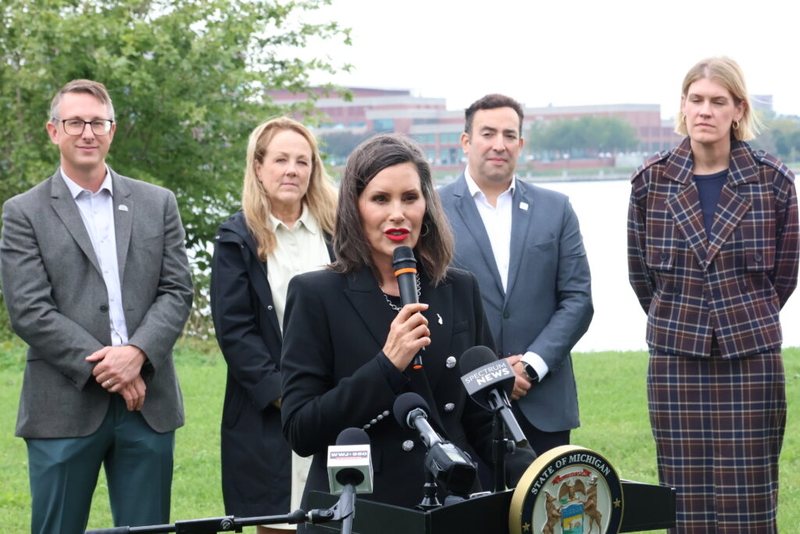
Michigan Gov. Gretchen Whitmer announces $89 million in funding to clean up the Detroit and Kalamazoo rivers during an event on Belle Isle, Oct. 1, 2026. (Photo by Kyle Davidson/Michigan Advance)
DETROIT — Overcast skies and a sprinkling of rain that fell over Sunset Point on Belle Isle on Thursday afternoon failed to dim the excitement from government officials as Gov. Gretchen joined the heads of the Department of Natural Resources and the Department of Environment, Great Lakes and Energy to announce a substantial investment into the cleanup of two major waterways.
Alongside EGLE Director Phil Roos and DNR Director Scott Bowen, Whitmer unveiled the state’s Reclaim the Rivers initiative, which is committing $89 million in environmental settlement funds for the clean up and restoration of the Detroit and Kalamazoo rivers.
“This is a big deal,” Whitmer said during the announcement in Detroit. “Together, we will continue our work to protect wildlife, reduce pollution, and ensure every Michigander can enjoy beautiful places just like this all across our great state, our state is defined by water. It’s who we are, and it’s up to us to protect it, all of it, from our Great Lakes to our local rivers.”
The two bodies of water each carry their own legacy of industrial pollution, with Superfund sites — some of the most contaminated areas in the nation — located on each waterway.
Of the $89 million investment stemming from environmental settlement dollars, $50 million will be dedicated to cleaning up polychlorinated biphenyls, or PCBs, in the Detroit River. The chemicals were used in manufacturing until 1979 and have been tied to several harmful health effects including cancer, harm to the immune system and neurological effects.
Roos explained that the $50 million would be used to secure hundreds of millions in additional dollars from the federal government and the private sector to help cover the cost of cleanup.
Another $25 million will be used for river restoration initiatives in the Kalamazoo River, while the remaining $14 million will be put into a strategic fund for river restoration projects across the state, including dam removal, wetland restoration and habitat improvements.
Roos emphasized that the cleanup initiatives would not start from scratch, but would rather build upon the efforts of federal agencies, tribal governments, state employees, community members and leaders, as well as members of the private sector and philanthropic organizations.
Roos pointed to the initiative as a hallmark of Whitmer’s environmental work during her time as governor, and noted that the effort reflects their shared belief that environmental protections and economic opportunities are not opposed and can work in tandem.
“This project’s about certainly cleaning up PCBs and other contaminants, but it’s a lot more than that,” Roos said. “It’s about truly reclaiming, and transforming our rivers.”
Economic growth doesn’t just relate to jobs, Roos said — it’s about people looking to stay and build their lives in Michigan. Having beautiful places to swim, paddle and play is part of that equation, Roos added.
“That’s what we are building here with this Reclaim the Rivers initiative,” he said. “At the end of the day, the work of our agency is about people, protecting public health, ensuring clean water, creating healthier communities, and improving quality of life.”
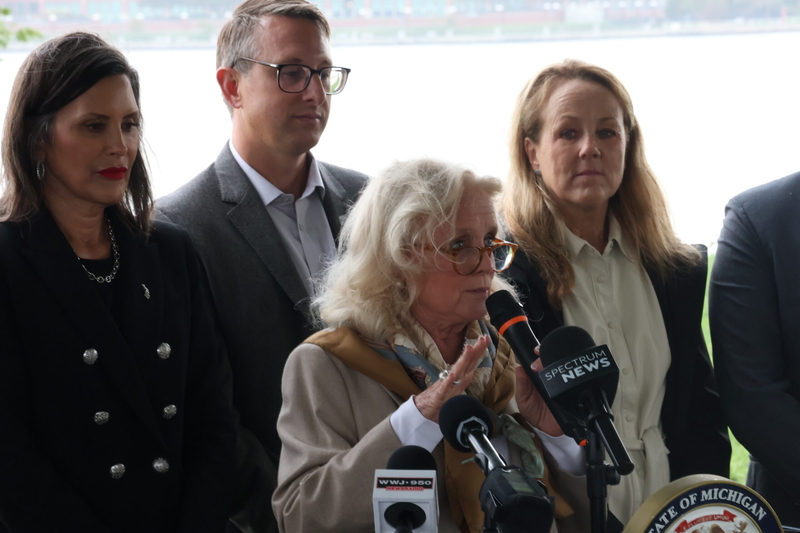
Rep. Debbie Dingell (D-Ann Arbor) also attended the announcement. Dingell noted that while the Detroit River supported the industries that built the state’s middle class, that same legacy has also left behind pollution that officials have spent decades trying to clean up.
“We’ve made tremendous progress, and we’re celebrating that, but there’s still a lot of work ahead,” Dingell said. “Our goal must be more than cleaning up the pollution of the past. It must be ensuring that every Michigan family can enjoy these rivers for generations to come.”
Detroit City Councilmember Scott Benson spoke to reporters following the announcement, and said that the cleanup for the Detroit River carries a price tag of roughly $1 billion. Benson called the newly announced investment as an incremental investment toward getting the historical contaminants out of the river.
“One bite at a time, that’s how you eat the elephant,” Benson said.
Lansing, MI