Spanberger’s energy plan keys in on clean energy to meet growing demand and VCEA goals
Oct 01, 2026 | 3:05 pm ET
Description
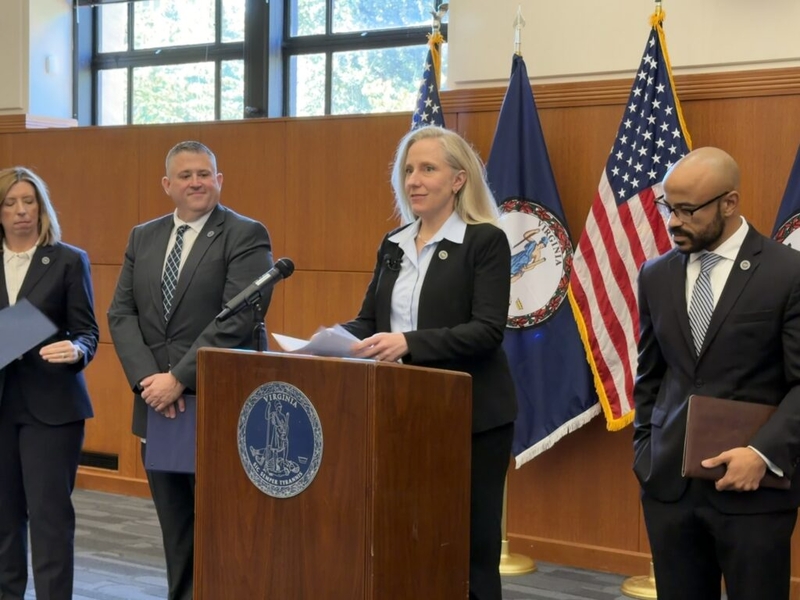
Gov. Abigail Spanberger unveils energy plan that models how the state can meet energy demands while meeting clean energy goals. (Photo by Shannon Heckt/Virginia Mercury)
Gov. Abigail Spanberger released the commonwealth’s latest energy plan on Thursday, marking the first long-range blueprint of her term for how Virginia can meet its growing energy demands and achieve the Virginia Clean Economy Act’s decarbonization and energy goals.
As she announced the plan in Richmond Thursday morning, Spanberger said it “models four primary pathways to explore the costs, benefits, and realities of each potential energy mix,” citing a mix of power sources that all keep the state on the path of net-zero carbon emissions by 2050.
State law requires the governor and energy leaders to develop a plan every four years that outlines a 10-year roadmap on how to achieve a net-zero carbon economy.
In a shift away from the last plan released in 2022 under former Gov. Glenn Youngkin, Spanberger’s plan acknowledges that the state’s growing power demands require a mixed portfolio of energy sources, including natural gas, but prioritizes cleaner energy sources like community solar and battery storage.
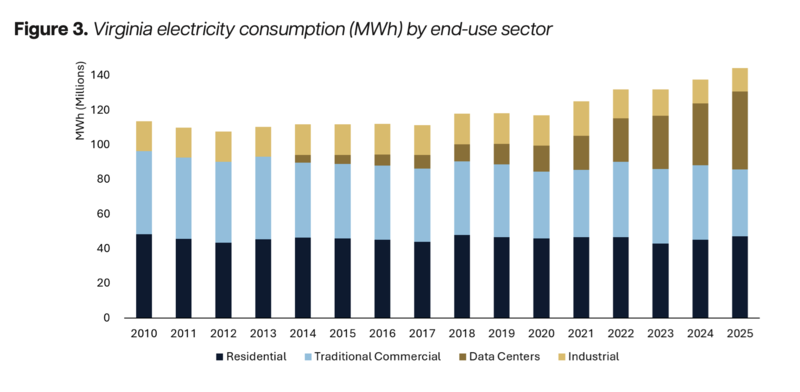
It also suggests demand flexibility strategies for data centers, “whose rapidly growing electricity consumption far exceeds new consumption from the electrification of homes and vehicles,” the plan states.
The administration created the plan compiling public comments and feedback from stakeholder meetings that were held across the commonwealth.
Many of the ideas in the varying paths laid out in the plan will need legislative approvals and the cooperation of the utilities and the State Corporation Commission, which oversees many sectors of energy regulation.
A key point of focus in the document is how to get electrons on the grid in small ways now to ease big strains later. The plan also explores new technologies to bridge the gap of phasing out carbon-emitting generation.
“Understanding the complexity of this moment, we knew that this year’s Energy Plan needed to do more than present a prescriptive path forward, it needed to analyze the options before us,” Spanberger said.
PJM, the regional grid operator for most of the East Coast including Virginia, projects that the load forecast for Dominion Energy and Appalachian Power Company could reach up to 68.8 gigawatts in peak demand.
Dominion has reported a connection queue of projects requiring 25 gigawatts worth of power that have an electrification date, and noted an additional 75 gigawatts are in the line without a set power up date.
That will require a massive amount of energy to be generated for use in Virginia, and the administration’s plan four models lay out a roadmap of how to make it possible.
One of the modeled options laid out in the plan puts an emphasis on distributed energy resources (DER), such as community and rooftop solar. The state will need to ramp up its deployment of solar energy and battery storage to meet the VCEA goals and bring enough power on the grid to sustain the retirement of fossil fuel power sources.
The state needs about 1.8 gigawatts of solar and roughly 1 gigawatt of battery storage annually over the next two decades to meet demand, according to calculations for all the scenarios that take VCEA benchmarks into account.
The administration suggests the state focus on more adding solar to brownfields, former mines, parking lots, and rooftops to bring power onto the grid and reform siting and other policies to help localities make decisions on larger solar projects.
Under this version of the plan, the state would implement a demand flexibility for data centers.
This means that utilities would deploy on-site clean energy, local battery storage and other methods to offset power flow to data centers on the hottest and coldest days of the year.
This would also eliminate the need to build peaker plants that are designed to fire up when the grid requires temporary extra power, the plan suggests.
As part of the governor’s data center framework announced earlier this month, the administration wants to move away from data centers using fossil fuels as their own behind-the-meter power or as a backup power source.
“Instead of having the data center need to have on-site generation, they can contract with this fleet of batteries that they’ll help to finance to have basically the battery fleet doing that same thing on site during those peak hours,” Spanberger said
Additionally, this route recognizes that some gas power generation must serve as a “bridge” between current power generation methods and cleaner energy strategies, to fulfil the VCEA’s mandate that utilities decarbonize by 2045.
On that front, Spanberger’s plan recommends fuel cell generation and linear generators – gas power sources that release fewer toxic particulates into the air but don’t eliminate carbon emissions.
Fuel cells and linear generators also have a shorter lifespan, putting their retirement much closer to the deadlines of the VCEA compared to traditional combustion gas plants, which usually have multi-decade lifespans.
“So fuel cells have like a five year lifespan, linear generators have a 20 year lifespan. So even if we’re building them in the next 5 years, by 2030, they’ll basically be reaching the end of their useful life,” Chief Energy Officer Josephus Allmond said.
While these methods are more expensive, Allmond said it would be an example of putting the cost of some energy infrastructure onto the industries that are driving the demand, such as data centers.
It’s important for Virginia to be a leader in pushing for new technologies, the governor added.
“Virginia is a place where we want this type of in a nation and we want these newer growing technologies, that is part of making them more widely available” Spanberger said.
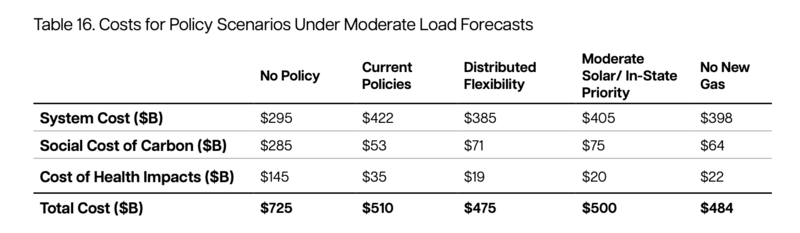
The governor’s plan not only calculates the cost to build the infrastructure, but also the social and health costs that could be attributed to combustion gas power sources. The SCC typically looks at other factors when determining if a project is in the public’s best interests.
“I think it is the responsibility of Virginia leadership… to look at the holistic impact because it does have a cost for Virginia. Even if that might not be the central lens (of the) SCC… we’re going to continue to advocate for a holistic view of the cost to Virginia, when we’re talking about balancing impacts and benefits to ratepayers, companies and Virginia citizens,” the governor said.
Another version of the plan calculated how the state would meet power demands if less solar and battery storage were implemented in the coming years. It explores the impact of more offshore wind, nuclear investments, and less-polluting gas technologies.
This showed that even if solar infrastructure can’t be built to the extent the administration modeled, the state’s energy demands can be met with cleaner energies.
The plan modeled what the state’s energy profile would look like if the VCEA was repealed and if the state left the Regional Greenhouse Gas Initiative.
That path would result in a heavy reliance on gas power and although it’s one of the cheaper options, building enough gas plants to meet the current load forecast would stretch into the next decade, leading to potential grid unreliability, according to Allmond.
“Across all net zero aligned modeled scenarios, Virginia will need to more than double its existing generation capacity to meet its projected growth and clean energy goals,” the plan states.
Lawmakers, energy and environmental advocacy organizations and utilities began responding to the Spanberger administration’s plan by Thursday afternoon. The Mercury will provide continuing coverage of those views and the energy plan in the coming days.
Richmond, VA