Colorado commission seeks economists for next phase of racial equity study
Oct 01, 2026 | 3:04 pm ET
Description
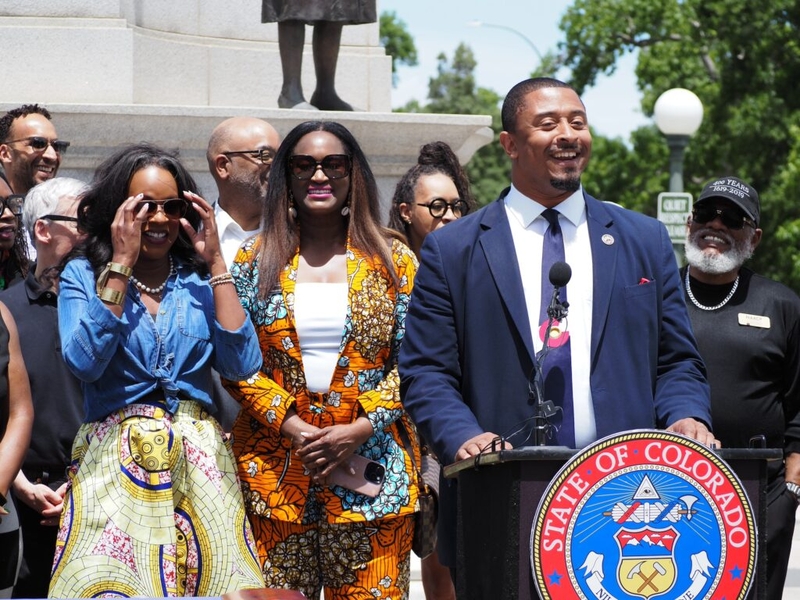
Sen. James Coleman, a Denver Democrat, speaks at the June 4, 2024, signing of a bill to require a racial equity study in Colorado. (Photo by Sara Wilson/Colorado Newsline)
The Colorado legislative commission tasked with studying the effects of historical racism on Black Coloradans faces a funding gap as it seeks an economic contractor.
The Black Coloradan Racial Equity Study Commission could need to raise around $215,000 to pay researchers to analyze a nearly-complete historical study and determine how racist policies and attitudes impacted Colorado’s economy.
The group has raised around $1.3 million over the last two years, Jarrod Gibbons, History Colorado’s budget director, told the commission Wednesday. It still needs about $75,000 to finish the historical study, though it has $60,000 in pledged donations.
There is also $100,000 pledged for the economic analysis, which had a $300,000 estimate in the fiscal note for the bill that created the commission. The commission has not yet picked a group to do that work, however, so the actual cost could be much lower. Legislative staff Thursday published a request for qualifications for the economic analysis, essentially a call for organizations to pitch their plan for the job, and will decide on a contract in January.
Under the 2024 bill that created it, the commission has to pay for its work using donations instead of state money.
The notion that we had to fundraise ourselves to look into the harm caused by the state, I think, is quite frankly causing some dissonance.
“There was a little bit of frustration that we wrestled with when we were bringing the bill forward, of figuring out how we can get this work done and the notion that we would have to support ourselves in doing it rather than asking for support from the state,” Rep. Jennifer Bacon, a Denver Democrat, said. “The research that’s being done, I believe, is critically important to all Coloradans and all of the people who look into our history.”
Historical research for Colorado racial equity study nearly complete
“The notion that we had to fundraise ourselves to look into the harm caused by the state, I think, is quite frankly causing some dissonance,” Bacon added.
Evidence of slave sale
There might be an opportunity, she said, to partner with universities to complete the analysis for below cost or as a donation.
But Sade Cooper, a commissioner and the executive director of the nonprofit Collaborative Healing Initiative within Communities, said she is confident that the money will be raised.
The commission is overseeing a two-part project — the historical research into a range of policies and systems that harmed Black Coloradans and the upcoming analysis into the economic impact of that systemic racism. The final report, due next fall, will have policy recommendations to address the effects of discrimination.
So far, historians have shared research about prominent Coloradans who owned slaves, including Joel Estes, and towns like Fruita that were once “sundown towns” that banned Black people in its boundaries after dark.
On Wednesday, researchers presented evidence of a potential sale of a Black person in the San Luis Valley near Fort Garland. Mill operator Harvey Easterday wrote a letter in 1860 to a business partner and inquired about purchasing a woman. In it, he asked the partner to “buy us a good, strong Negro woman that can do all kinds of housework.” Commission members had an opportunity to look at the letter in person on Wednesday.
“This is a private letter that gives voice to the casual transactions of people,” researcher Melissa Jones said.
“Even though we are not certain that such a woman was ever purchased, it gives evidence to all the other incidents of people we know were either owned or trafficked in the region, and the private ways in which — whether they were publicly referred to as servants — some of these individuals of African descent were talked about,” she said.
Denver, CO