A $350M upgrade of USC stadium is only the latest big spend by SC athletic programs
Oct 01, 2026 | 1:55 pm ET
Description
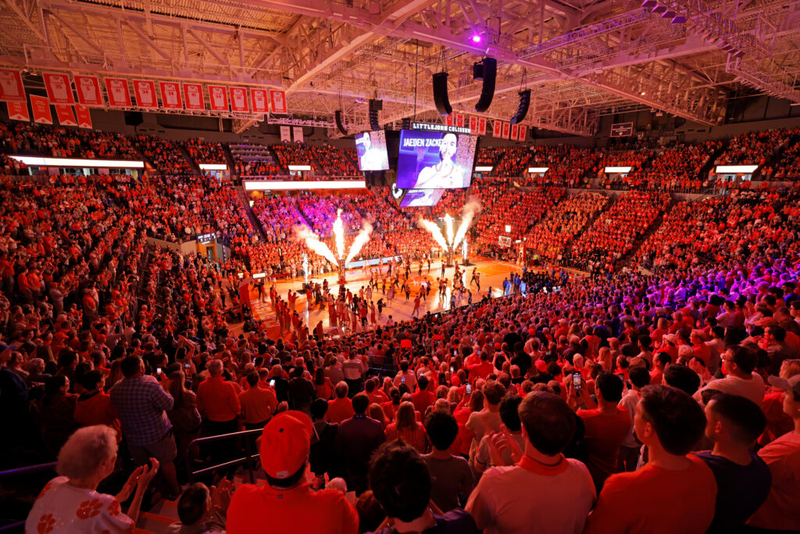
A packed Littlejohn Coliseum comes alive as players are introduced before the Duke game in Clemson, S.C. on Saturday, Feb. 8, 2025. (Photo by Travis Bell/SIDELINE CAROLINA/Special to the SC Daily Gazette)
COLUMBIA — South Carolina fans have navigated cordoned off areas and construction supplies piled up around the building this season as the university continues its $350 million “reimagining” of Williams-Brice Stadium.
Projects like this remain essential to fans, team personnel, players and prospects, even in an era where sponsorship contracts and court-mandated revenue sharing for players has reshaped the sport.
“I don’t know any fans who want less,” Coastal Carolina athletic director Chance Miller said recently, referring to comfortable seating, easy access to concessions, smooth entry and exit and other amenities that can make the difference between becoming a season-ticket holder and staying at home watching the game on a large-screen TV.
“Gone are the days of opening a facility right now and people want to sit on metal bleachers when it’s 100 degrees outside,” said Miller, who has led the Chanticleers’ sports programs since 2024. “They want something a little better.”
Miller spent 11 years in South Carolina’s athletic department and saw first-hand the race the Gamecocks and just about every other Division I school took part in to have the best, most modern and innovative facilities.
New restrooms, no spiral rampway: Here’s what’s new for Gamecock football fans this season
The push has revamped the state of South Carolina’s three schools who compete in the biggest level of college football, the Football Championship Subdivision.
Clemson, in the Atlantic Coast Conference, and South Carolina of the Southeastern Conference, play in Power 4 conferences.
Coastal Carolina, of the Sun Belt Conference, is among schools in the nicknamed “Group of Six” leagues that compete for a spot in the 12-team College Football Playoff that determines a national champion.
All three must go through multiple approvals from school and state fiscal oversight panels before undergoing major projects.
For the longest time, facilities were among the main drivers in attracting the best recruits in all sports to play for your favorite college team. Payments to players were against NCAA rules, led to lengthy investigations and, if provable, led to sometimes substantial penalties that could set a program back for years.
But with the NCAA’s $2.8 billion settlement in the House v. NCAA case in 2025, Division I schools distributed as much as $20.5 million to its athletes last academic year.
Allowing players to benefit off their name, image and likeness also means players and their representatives — another new wrinkle in college sports — make money in advertisements.
South Carolina quarterback LaNorris Sellers, receiver Nyck Harbor and Clemson defensive end Will Heldt are among several area college athletes in a TV commercial for a prominent auto muffler company.
Sellers, a junior, earns about $2 million this season, according to NIL evaluations by On3.com, which tracks such deals.
Clemson upgrades
Clemson coach Dabo Swinney believes it’s even more important to have the best facilities to attract players to add to a school’s success.
“”Everybody’s got money,” Swinney said of the power programs.
“The environment they’re going to be in, especially for a young kid who’s going off to college. Locker room, the environment that they’re in, the resources that are there,” said Swinney, who’s won two national titles in his 18 full seasons as Tigers coach.
Swinney was also part of a revitalization of Clemson’s sports facilities, including a $55 million football operations center that had other schools scrambling to match.
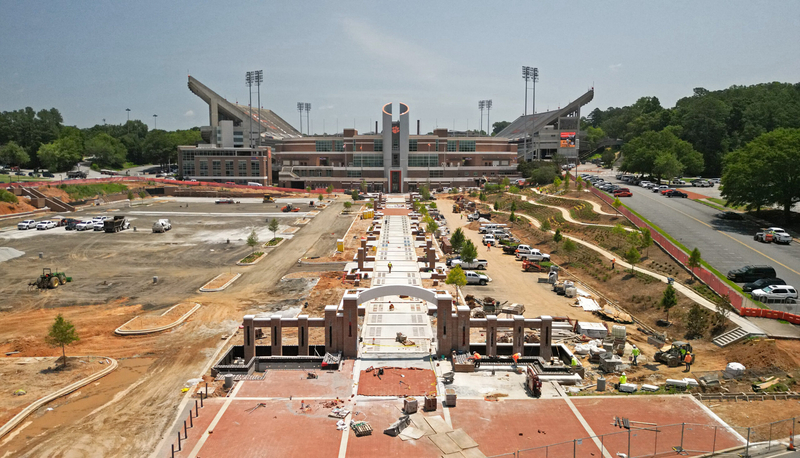
The school spent $3.7 million to upgrade its Tiger Walk path in entering Death Valley.
The improvements included statues of leaping Tigers and bronze plaques honoring football captains through the years. The effort was part of a $69.5 million improvement project at the stadium that included its video board and new lighting.
The Tigers, under now-retired athletic director Dan Radakovich and current athletic director Graham Neff, upgraded facilities for most of its sports.
It opened a performance and wellness center for $50 million in April 2025. That followed McWhorter Stadium, home to Clemson softball since 2020, a $13 million expense.
Basketball’s Littlejohn Coliseum had a $63.5 million renovation that opened before the 2016-17 season. An additional $40 million upgrade is underway to improve practice gyms, team areas including strength and conditioning, nutrition and sports medicine spaces for men’s and women’s basketball and women’s gymnastics.
Is it a worthwhile investment?
At Clemson, men’s basketball has made four of the past six NCAA Tournaments while the women’s team reached the Big Dance last season for the first time since 2019.
As for the $55 million football center, Swinney calls it Clemson’s football home for “a hundred years” and was grateful administrators had the vision to take advantage of the moment.
“If we hadn’t built this facility when we built it, it would’ve been a real challenge for Clemson with the timing,” he said.
A similar facility would’ve cost close to $78 million to build today, according to a calculation based on the U.S. Bureau of Labor Statistics Consumer Price Index.
‘Better and better’: World Cup could grow SC’s soccer successes
Swinney recalled when the land the center sits on was for practices for many teams or areas of tailgating on Clemson football Saturdays.
He joked how men’s soccer coach Mike Noonan wouldn’t talk to him after losing practice areas. But an $8 million soccer operations center opened in 2020, and the Tigers have since won men’s national soccer titles in 2021 and 2023.
“And Noonan was not happy,” Swinney said. “But now he’s the happiest guy.”
Williams-Brice ‘reimagined’
That lesson was also put in place at South Carolina, where second-year athletic director Jeremiah Donati has led the building renovation that will be fully completed in time for the 2028 season.
Phase one created a Cockaboose Club near the iconic, tailgating train cars along the stadium, removed one of the spiral walkways, created a new visitors locker room and improved restrooms and concession areas throughout the building.
Phase two, ready before the 2027 season, will concentrate on club level seating, increasing luxury suites from 18 to 43 and adding escalators.
Phase three, the school says, focuses on player areas like improved locker rooms, team rooms and recruiting space for future Gamecocks.
“You’ve got to make sure that your investment, as best as you can, is future proof,” Donati said the construction expenses.
“All these projects are expensive and getting more expensive, so you’ve got to be careful” with plans, he said.
Other USC upgrades
South Carolina has spent more than $200 million over the past two decades to transform its athletic footprint. It spent about $20 million on the Rice Athletic Center as sports administration’s headquarters and the Dodie Anderson Academic Enrichment Center.
There’s been a new baseball and softball facilities, and upgrades to the Stone Soccer Field that helped the women’s team win SEC titles in 2019 and 2021l and the men’s team reach No. 1 in the country this year.
Improvements to the basketball’s Colonial Life Arena and the old Carolina Coliseum have been essential in the women’s program keeping coach Dawn Staley, landing centerpiece players like WNBA stars A’ja Wilson and Aliyah Boston and winning three national titles (2017, 2022, 2024).
‘It could be the edger’: USC’s Dawn Staley launches leadership program for students
The school has spent between $5 million and $6 million on Coliseum updates to set up men’s and women’s basketball offices and practice courts.
Like Clemson, South Carolina’s biggest expenses go to football. The Long Operations Center across from Williams-Brice opened in 2019 with a price of $50 million.
The adjacent Indoor Practice facility, named for ex-Gamecocks coach Steve Spurrier and wife Jerri, cost close to $15 million.
South Carolina coach Shane Beamer believes you can’t compete for the best players without modern, updated facilities.
Beamer tells his players the adage, “Even if you’re on the right track, you’re going to get run over if you just sit there.”
He says the school is on the right track in investing in athletics. But schools like Auburn and Florida have opened improved buildings since the Gamecocks’ center came on line seven years ago.
Beamer said fresh paint and carpet, improvements in training rooms and the players’ lounge show current Gamecocks, “We’re going to continue to do these things for you.”
Improvements, though, need money and the best way to ensure the financial flow is win.
“Every coach here at Carolina certainly has a wish list of what they want,” he said. “And I know the importance of us back in that stadium and winning football games to help everybody here at Carolina.”

Columbia