Community groups lose HIV-prevention money as feds redirect dollars to states
Oct 01, 2026 | 4:14 pm ET
Description
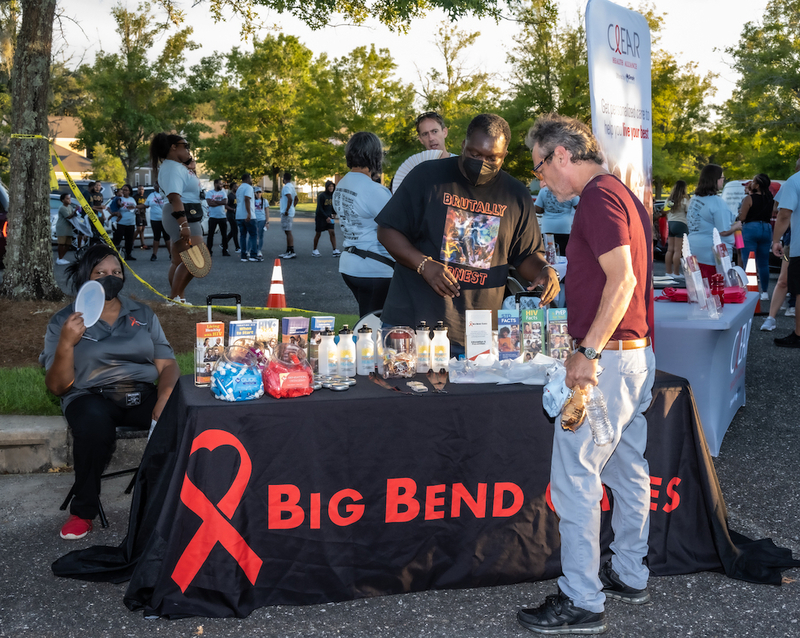
Participants take part in an HIV/AIDS awareness event held by Big Bend Cares in Tallahassee, Florida. Nearly 100 community-based organizations in 31 states have lost HIV-related funding after federal officials decided not to renew their grants and instead directed money to state and local health agencies. (Photo by Bob O’Lary/Courtesy of Big Bend Cares)
Nearly 100 community-based organizations have lost their federal HIV-prevention grants this week as the Trump administration redirects dollars to state and local health departments.
The funding change represents a departure from the decades-old national HIV prevention strategy favored by most public health organizations.
President Donald Trump launched the Ending the HIV/AIDS Epidemic Initiative during his first term in office. Since 2021, the program has disbursed a total of nearly $240 million to 96 community-based organizations in 31 states, the District of Columbia, Puerto Rico and the U.S. Virgin Islands.
Those groups have used the money to pay for testing and pre-exposure prophylaxis (PrEP), a medication that people at high risk for HIV can take for protection during sex or injection drug use. Preventing new HIV infections and preserving access to treatment for those who have HIV helps prevent further transmission of the virus.
By prioritizing areas with the highest number of HIV diagnoses, the initiative sought to reduce HIV incidence by 75% in five years and by 90% by 2030. It continued under the Biden administration.
But now the Trump administration has shifted course.
Instead of granting money directly to community-based organizations, the administration is offering one-time grants to state and local health departments. It is encouraging the jurisdictions with the most HIV diagnoses to funnel at least 25% of the money to community groups, but there is no requirement that they do so. Health departments in areas with fewer diagnoses are being encouraged to send 10% of their money to community groups.
The state and local health agencies are required to spend whatever dollars they don’t pass on to community groups on HIV surveillance and PrEP access.
When the federal Centers for Disease Control and Prevention announced the availability of the original grants in 2020, it noted that since the late 1980s, it had partnered with community-based organizations to fight the spread of HIV because of “their accessibility, history and credibility in the community,” especially among Black and Hispanic people, gay and bisexual men and people who inject drugs.
“CDC has done this for a very long time, specifically because they know that community-based organizations are important players in the community,” said Lindsey Dawson, associate director for HIV policy at KFF, a nonprofit health research group.
“They’re a voice in the community that people trust, and these programs really are able to reach people who are at greatest vulnerability to HIV in a way that the state or federal or local government (would) not be able to do.”
When asked for an explanation of the change, the U.S. Department of Health and Human Services referred Stateline to the Office of Management and Budget. Neither OMB nor the White House press office responded to multiple requests for comment.
The National Alliance of State and Territorial AIDS Directors told Stateline that under the new grant program, the federal government will disburse approximately $90 million to state health departments through May 2027. Though that amount is nearly twice as much as the roughly $48 million per year that was handed out under the old grant program, community-based organizations are going to see less money, public health experts say.
In August, KFF estimated that overall, community-based organizations would need about 35% of the new money to match what they were getting before. The National Alliance of State and Territorial AIDS Directors estimates that percentage to be closer to 50%.
In Texas, health officials said the state plans to send about 23%, or about $1.2 million, of its $5.24 million grant to community-based organizations.
Jeffrey Campbell, chief executive officer of Allies in Hope — formerly called AIDS Foundation Houston — told Stateline that he expects his federal funding to be cut by $441,000, which could force him to lay off at least three staff members.
Under the old grant structure, half of all funding had been channeled to organizations in the South, which accounts for more than half of the nation’s HIV diagnoses.
But already, one organization in that region has announced it will have to shut down as a result of the funding change: PowerHouse Charlotte in North Carolina announced in August that it will close. For 16 years, that organization has provided free HIV and STD screenings, prevention services and community resources geared toward gay Black men.
In at least two states, Minnesota and Oregon, state health agencies wouldn’t be able to match the amount of money their community-based organizations were getting under the old system even if they gave 100% of their state grants to those groups, according to KFF.
“These community-based organizations are on the ground doing the work with the populations that need it,” said Carl Schmid, executive director at the HIV+Hepatitis Policy Institute, a public health nonprofit that tracks policies related to HIV prevention.
“Some states may have relationships with some of the existing grantees and may be fine, but others, they may not. And so there’s definitely going to be a lapse of funding.”
Emily Schreiber, senior director of policy at the National Alliance of State and Territorial AIDS Directors, said that under the new rules, states don’t have much time to establish new contracts with community-based organizations.
“(States) are trying to turn around things as fast as possible. But simply there (was) not enough time to get that funding through the contracting process and all of that by September 30th, which was really unfortunate,” she said.
“It’s not easy for a health department to create a whole new contracting process overnight. Even in the best-case scenario, this is not a perfect solution.”
Many health departments take between 45 and 90 days to scale new contracts and grants, said Toni Young, executive director and founder of Community Education Group, a nonprofit offering HIV community engagement, testing and outreach across rural West Virginia and the broader Appalachian region.
“We don’t have an infrastructure in many rural communities to address HIV,” she said.
Another challenge for community-based organizations is that because they won’t be getting money directly from the federal government, they will no longer be eligible for discounted drugs under the federal 340B program.
“When you took away this grant, you also took away their 340B status, which is the reason some have had to potentially close or at least stop this entire side of operations,” said Maximillian Boykin, manager of the Save HIV Funding Campaign.
“It leaves a lot of these places very fragile.”
Stateline reporter Nada Hassanein can be reached at [email protected].