Republican AGs sue abortion ‘shield law’ states in US Supreme Court
Sep 30, 2026 | 3:27 pm ET
Description
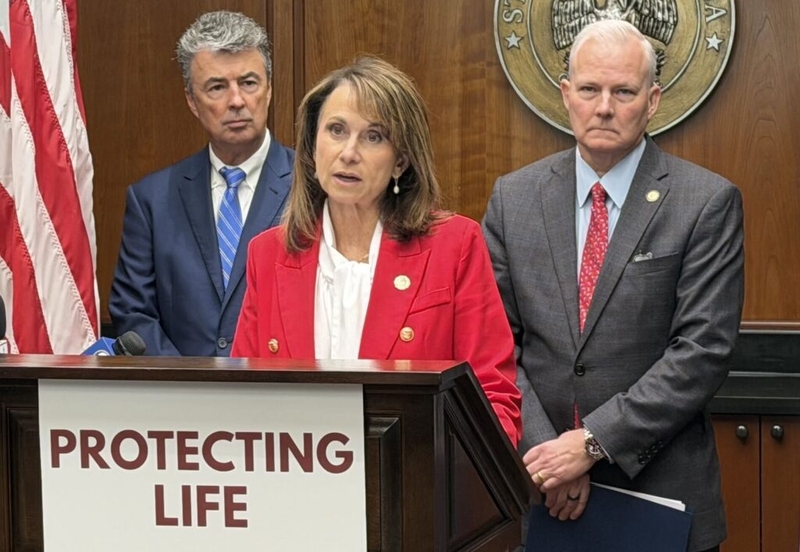
Louisiana Attorney General Liz Murrill speaks at a news conference in Baton Rouge, Louisiana, on Wednesday, Sept. 30, 2026, announcing a lawsuit challenging abortion shield laws in Democratic-led states. Joining Murrill were Attorneys General Steve Marshall of Alabama, left, and Tim Griffin of Arkansas, whose states are also plaintiffs in the case. (Photo by Piper Hutchinson/Louisiana Illuminator)
BATON ROUGE, La. — Louisiana Attorney General Liz Murrill and the attorneys general in Arkansas and Alabama filed a lawsuit Tuesday in the U.S. Supreme Court, suing California, Massachusetts and New York to invalidate the so-called “shield laws” that have allowed providers in those states to send abortion medication to people in states with abortion bans.
The state officials, all Republicans, also filed a lawsuit in federal district court against individual abortion providers in the same three states.
“We will not allow activist states, activist providers or distributors profiting from killing babies to threaten Louisiana’s sovereignty, violate Louisiana’s laws and endanger Louisiana women and Louisiana babies,” Murrill said at a news conference on Tuesday. Arkansas Attorney General Tim Griffin and Alabama Attorney General Steve Marshall also were present.
The lawsuit filed in the Western District of Louisiana seeks to stop the individual providers named from being able to prescribe and send abortion medication to those states, while the Supreme Court complaint asks the justices to find the shield laws are a constitutional violation of state sovereignty..
“Today, plaintiff states filed a lawsuit against as many organizations and individuals as they have been able to identify notwithstanding the shield laws intended to thwart such litigation,” the Supreme Court complaint reads. “To fully obtain relief, however, they must also eliminate other contributing causes for the harm that they are suffering, including … the shield laws.”
The district court suit names 30 defendants, including the Massachusetts Medication Abortion Access Project and its founder, Dr. Angel Foster, Dr. Remy Coeytaux in California and other telehealth providers around the country.
The complaint compares the mailing of abortion medication to anthrax, mail bombs and chemical weapons, despite studies since 2000 showing that abortion medication is safe and effective to use.
“(Defendants) think themselves invincible because their agents swear to never step foot in plaintiff states (thereby avoiding arrest), and their home states have enacted so-called ‘shield laws’ intended to thwart legal liability for individuals perpetrating this interstate abortion scheme,” the complaint says.
Following the U.S. Supreme Court’s decision in 2022 allowing states to ban abortion at any stage of pregnancy, 13 states now have near-total bans, while others have expanded abortion access. The U.S. Food and Drug Administration allowed the drug mifepristone, one of two commonly used to terminate a pregnancy in the first trimester or to treat miscarriages, to be dispensed without a visit to an in-person provider in 2023, after years of safety studies.
Providers in states with access can prescribe and mail the medication to states with bans, and Murrill, along with other state AGs, has tried to extradite those providers to Louisiana to face legal charges for violating the ban. One of the providers Murrill tried to extradite in January was Coeytaux in California. Governors in those states have refused to comply with the extradition requests.
To protect those providers, California, Massachusetts and New York were among the 22 states and the District of Columbia that passed shield laws to block out-of-state investigations and prosecutions against providers dispensing for abortion medications to patients in other states.
Murrill is also leading a lawsuit against the FDA to reverse the 2023 provision allowing telehealth access to mifepristone, and two other lawsuits of a similar nature are ongoing in Missouri and Texas. The 5th U.S. Circuit Court of Appeals heard arguments in Louisiana’s case earlier this month and is expected to issue a decision in the coming weeks about the future of nationwide access to the drug.
Stateline reporter Kelcie Moseley-Morris can be reached at [email protected].
Louisiana Illuminator reporter Piper Hutchinson contributed to this report.