Rhode Island road and bridge repairs only scratched the surface, RIPEC report finds
Sep 30, 2026 | 5:20 pm ET
Description
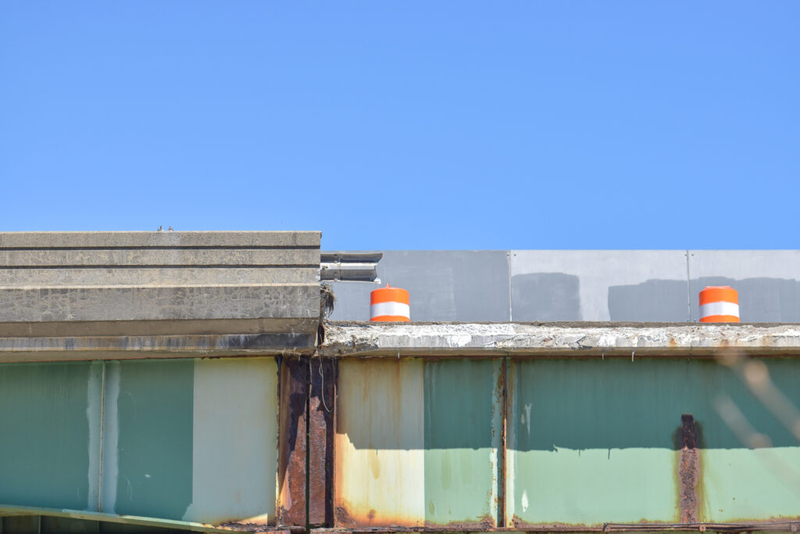
A section of the the ramp connecting Route 10 to Interstate 95 North was closed for over a week after a concrete barrier collapsed on to the train tracks below on the evening of April 24, 2026. (Photo by Christopher Shea/Rhode Island Current)
Rhode Island spent billions of dollars over the last several years to repair the state’s highways and bridges, once ranked among the worst in the nation.
They’re better, just not good.
A new analysis by the Rhode Island Public Expenditure Council (RIPEC) found overall infrastructure improvements were largely from bridges moving out of the poor category and into fair condition, meaning their primary structural elements remain sound despite some wear and tear to the road’s surface.
In 2024, 66% of Rhode Island’s bridge deck was rated fair, the highest share in the country. Just 19% were rated good.
But other state roads maintained by the Rhode Island Department of Transportation (RIDOT) are still the worst in the nation, according to the 44-page report released Wednesday by the business-backed research group. RIPEC found that the state had the nation’s largest gap between spending on major capital projects and routine maintenance, putting an additional $8.40 toward capital projects for every $1 spent on maintenance.
“Routine maintenance has to become a much higher priority,” RIPEC President and CEO Michael DiBiase said in a statement. “While the state has focused heavily on major capital construction, it needs to do a far better job of preserving and maintaining these assets once built.”
RIPEC’s findings follow the commissioning of a third-party audit of the state’s transportation department by global accounting firm Baker Tilly as part of the state’s fiscal year 2027 budget. The London-based company was awarded a $108,800 contract by the state on July 20, with the audit due March 1, 2027.
RIDOT spokesperson Heidi Gudmundson said Rhode Island has made significant progress in reducing poor-rated bridges.
“In fact, just two weeks ago, the state received official notification that for the first time in more than a decade, the percentage of Rhode Island’s bridges in poor condition was less than 10%,” she wrote in an email to Rhode Island Current, with an attached letter from the Federal Highway Administration.
Gudmundson added that RIPEC’s analysis does not reflect more recent road improvements including 80 pavement projects totaling $297 million since 2024 and 860 local road projects funded through RhodeRestore, the state’s municipal road grant program.
Rhode Island’s transportation spending over the past decade has been shaped by RhodeWorks, the multibillion-dollar program to repair highways and bridges signed into law by then-Gov. Gina Raimondo in 2016.
RhodeWorks was financed through a combination of state transportation revenues, federal funding and borrowing backed by future federal aid. The program also relied on tolls on large commercial tractor-trailers traveling through 13 highway gantries, which charged an average toll of $3.
Trucking companies challenged the toll program in federal court in 2018. A Rhode Island federal judge halted the tolls in 2022, cutting off an estimated $40 million in yearly revenue. The First Circuit Court of Appeals in Boston partially overturned the district court’s ruling in 2024, allowing the state to resume tolling under a revised structure.
RIDOT selected a company in June to restart the tolling system, with transportation officials targeting July 2027 to begin collecting revenue again.
RIDOT picks the company that will restart Rhode Island’s truck tolls
Losing toll revenue added to RhodeWorks’ financial pressure, according to RIPEC’s report. The state ultimately used $70 million in general revenue to replace the lost toll money in fiscal years 2023 and 2024, while also directing gas tax revenue and other funds toward highway projects.
Rhode Island also faces a projected $278.9 million shortfall in matching funds needed to secure federal transportation dollars between fiscal years 2027 and 2031, according to the report. That comes as RIPEC estimates demolition and reconstruction of the westbound Washington Bridge will cost $572.1 million.
Financing includes $221 million in competitive federal grants, up to $334.6 million in Grant Anticipation Revenue Vehicles (GARVEE) borrowing approved by the state in 2024, along with other state funds including $67 million from the Rhode Island Capital Plan Fund and $35 million in unspent federal pandemic relief money.
“Rhode Island should pursue a more balanced approach to its transportation investments going forward: less reliance on debt, more dedicated state revenues, and more investments in roads,” DiBiase said.
A spokesperson for RIDOT acknowledged a request for comment, but did not have a response as of Wednesday afternoon.
Senate President Valarie Lawson and House Speaker Christopher R. Blazejewski said in a joint statement to Rhode Island Current that they are reviewing RIPEC’s report and its findings on the state’s transportation spending.
“We share their concerns, which, in addition to our committee hearings, is why we passed a requirement for an efficiency and performance audit of RIDOT as part of the state budget,” they said.
Providence, RI