Michigan secretary of state hopefuls discuss election security, office priorities
Sep 30, 2026 | 5:50 am ET
Description
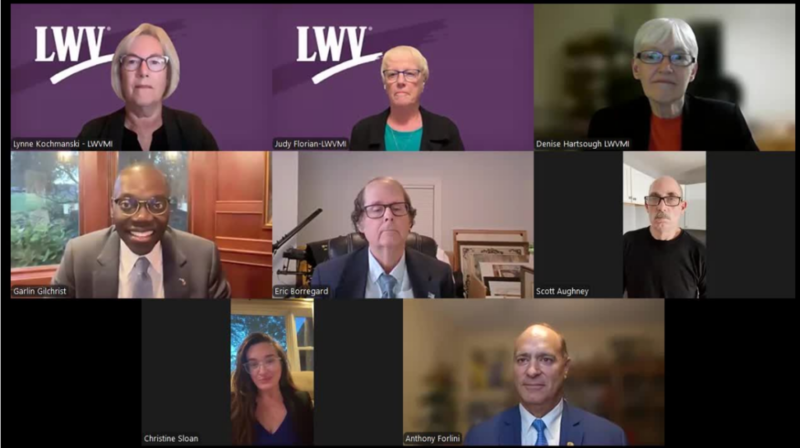
Candidates for Michigan Secretary of States participated in an online forum Tuesday, Sept. 29, 2026, conducted by the League of Women Voters of Michigan. (Screenshot)
The five Michigan Secretary of State nominees from across the political spectrum appeared together for a virtual forum Tuesday hosted by the League of Women Voters, parsing questions on election security, battling misinformation and the role of the office in the modern age.
Lt. Gov. Garlin Gilchrist and Macomb County Clerk Anthony Forlini, the Democratic Party and Republican Party nominees, were joined by their counterparts nominated by the minor-party candidates, including the Green Party’s Eric Borregard, the Libertarian Party’s Christine Sloan and the U.S. Taxpayers Party’s Scott Aughney.
Questions included the nominees’ views on the secretary’s role, the steps they would take in their first year if elected and their philosophies on maintaining safe and secure elections. Questions about misinformation, and how to combat it, also cropped up, which detailed how the ideologically diverse panel would take the office in different directions.
Here’s how each of the nominees tackled those questions, with responses edited for clarity and space.
What would be your priorities as secretary and what specific steps would you take to enact them?
Gilchrist said he sees the role’s first and foremost goal as protecting voters and their data, and that means standing up to President Donald Trump and refusing to hand over election-related data to the federal government. He added that his administration would make it a policy and a practice not to provide voter data and information in cases of what he considers apparent federal government overreach.
Forlini said that election integrity would be top of mind for his administration, and that his first year would focus on making elections believable again. He said he would examine election processes that he deemed as archaic and shed light on local clerks’ Election Day protocols and make them viewable to the public.
Borregard said he would like to address voter apathy, and would push to reduce the state’s voting age to 17, or as low as 16. He said that would create a powerful new voting bloc that could stand up to corporate interests in politics and fight back against a new “social dystopia.”
Sloan said she would work to remove Michigan from its involvement with the Electronic Registration Information Center, or ERIC, a nonprofit organization composed of state election officials that helps states maintain accurate voter rolls and identify potential instances of illegal voting. She would also embark on an audit of the state’s voter rolls and look into chain of custody issues raised by election skeptics over the past decade.
Aughney said that, in his view, the practices and processes implemented by current Secretary of State Jocelyn Benson do not currently comply with state statute — an opinion he said he formed by investigating those processes over the last six years. Aughney was convinced that those processes need to be changed to comply with the U.S. and Michigan constitutions.
How would you maintain safe and secure elections?
Clerks do the hard work of election administration because they believe in it, Gilchrist said. The lieutenant governor said that he sees his role in securing elections as being a shield between clerks and attacks against them, as election-denier conspiracy theories have led to threats of violence toward public officials. He would also bolster communication lines so that threats can be relayed quickly and so the office can respond to those threats swiftly.
As one of those clerks, Forlini said he did his best to listen to election skeptics’ complaints and concerns, while also pushing back against unfounded claims. Forlini said he made sure those with concerns were heard while also maintaining the laws governing elections. The Macomb clerk added that he has had ongoing meetings with local sheriffs and residents alike to make sure that everyone knew their rights before the Nov. 3 election — whether they were law enforcement, voters or election observers.
For Borregard, concerns about election integrity and the need for tighter security were overblown, and he would advocate for processes or measures that further expand the freedom to vote — and against policies that would close it off. Borregard also said that he would lower the threshold of what counts as proper identification, including allowing student IDs or utility bills.
Sloan said she would also partner with local sheriffs’ offices as a way to fast-track reporting of threats and concerns, taking cues from both Gilchrist and Forlini. However, Sloan disagreed with Borregard by adding that the public has legitimate concerns about the integrity of the state’s elections, its processes and how the office verifies the results of elections big and small.
Aughney proposed taking the state away from electronic voting systems and ending the use of electronic pollbooks. He would, instead, return the state to a manual hand count of votes.
How would you make sure rural residents and those with difficulties getting online can access services?
As a computer systems expert, Gilchrist said that work was dear to him and that he’s seen firsthand the struggle of communities lacking internet connectivity. Gilchrist said it would be important for the Department of State to bring as many services to those individuals instead of having to drive out to distant Secretary of State offices.
Forlini said he’s held forums with rural clerks to hear their concerns, and those meetings have led him to believe that the current system for service deployment took a one-size-fits-all approach that needed to be tailored to individual community needs. He also advocated for reducing wait times even further than Benson had during her tenure. In Macomb, Forlini said he was able to get 20-minute wait times down to 10 minutes “out the door.”
The state needs more Secretary of State offices and workers, Borregard said, while advocating for the state to stop spending money on complex computer systems, software or on large corporations that contract out voting equipment. While the question focused on bringing services to rural and low-connectivity residents, he said that clerks should be given time to tally the state’s elections and that residents didn’t need to know the results right away. Borregard said they should be able to take until the next morning to report results, or a week or two if necessary.
Expanding services to rural areas was worth considering, Sloan said, as well as adding more self-service stations across the state that expanded during Benson’s tenure. As a Libertarian, Sloan also said she viewed annual vehicle registration renewals as a hidden tax, and she would partner with the Legislature to institute a one-time registration fee that did not have to be renewed annually.
Aughney said he prefers humans to computers even though he has a fascination with computer systems. He said he would look at the state’s budget in any given year to see if the department had the resources to reopen closed Secretary of State offices, noting that Jackson had seen a decrease in the number of available locations. Aughney also called on all of the department’s public-facing offices to not reject walk-in appointments in favor of pre-scheduled visits.
How would you balance data privacy with the government’s need for maintaining and reviewing vital records?
Gilchrist said he would only share voter data or sensitive vital records information as far as the law allows, or if there was a legitimate reason, like a law enforcement investigation. He would also review records requests as they came in to understand what is being requested, and who is asking for it. And if it appeared that it was the federal government making inappropriate or intrusive requests, Gilchrist again said he would act as the “people’s shield” against those potential abuses.
Forlini said one of his concerns was public voter registration drives run by political organizations or other non-profit groups, preferring that those public drives be run by the state. Forlini’s main issue was for voter information — including addresses and sometimes portions of Social Security numbers. Forlini said Benson’s office has been negligent in allowing those types of voter registration drives to flourish.
The people’s personal information was already everywhere and especially available in some sense on the internet, Borregard said, and it was already difficult to hide it from what he called the “surveillance state”. The government, in his view, wasn’t doing much to protect that information if it was already giving it away to companies and corporations.
Sloan, who has a background in hospital administration, said her background speaks to how she would make distinctions between voter data and things like driving records, putting an emphasis on protecting voter data. She also shared Forlini’s concerns about public, non-state-organized registration drives, adding that registration and voter recruitment should be a function of the state.
Aughney was concerned about the significant increase in voter registration and a parallel increase in driver’s license registrations, claiming that there was a “1 million”-person “discrepancy” between what the state reports to the Federal Highway Administration, but without detailing his reasoning behind the claim.
Lansing, MI