Alabama Public Television survey shows majority support for continuing PBS affiliation
Sep 30, 2026 | 6:01 am ET
Description
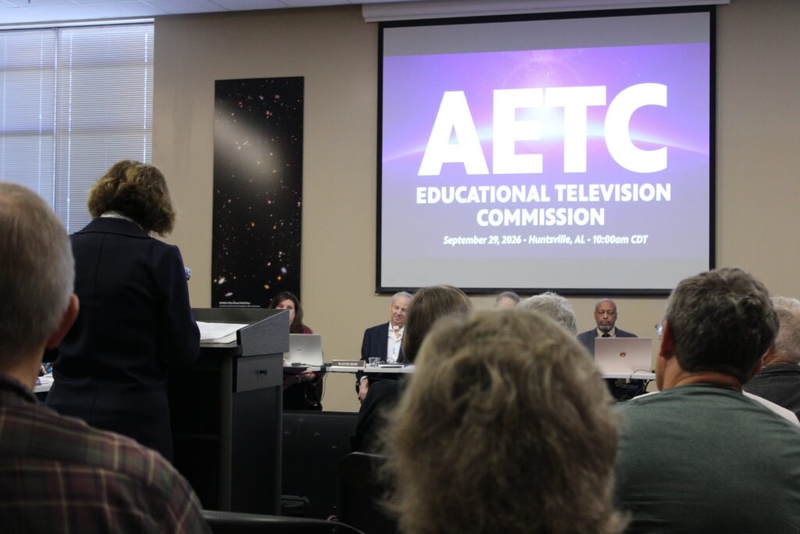
Rep. Marilyn Lands, D-Huntsville, speaks before the Alabama Educational Television Foundation Authority in Huntsville on Sept. 29 in support of maintaining Alabama Public Television's affiliation with PBS. (Ben Sessoms for Alabama Reflector)
HUNTSVILLE — After nearly a year of discussion among the governing body for Alabama Public Television to drop Public Broadcast Service programming, a survey released Tuesday showed majority support from the public to continue its affiliation with PBS.
The survey — conducted by Cygnal, a Republican-aligned polling firm that has worked with U.S. Sen. Tommy Tuberville’s gubernatorial campaign, at a cost of $39,500 through APT’s emergency fund — found that 54% support maintaining PBS programming; 18% were against, and 28% were unsure.
The results were released after a push from some members of the governing body, the Alabama Educational Television Foundation Authority, for disaffiliation. Last year, commissioners Les Barnett and Ferris Stephens floated the idea after congressional Republicans cut $1.1 billion from the Corporation for Public Broadcasting.
Previously, 330 PBS and 246 NPR affiliates across the country had relied on that funding. Those stations have turned to fund drives and other philanthropic efforts to continue operating.
At an AETFA meeting last October, Barnett said his opposition to PBS programming wasn’t necessarily a matter of funding, but due to the public network’s alleged political bias.
“PBS has made themselves an atma to the president and a sizable chunk of the state legislature, and probably a sizable chunk of the 65% of people who voted for Trump, and I’m one of those people in both categories,” he said. “I just, I don’t want to fund it, PBS has made themselves the enemy of what I stand with, and so I do not like them. I don’t follow the philosophy of feeding the beast.”
But the survey found that 62% said they wanted officials to stay out of programming decisions, versus 16% who supported such conduct.
In addition, 48% said tying funding to whether or not politicians approved of the content gives them too much power; 23% were for elected officials restricting public dollars in this way.
At an AETFA meeting in Huntsville on Tuesday, commissioners announced the public release of the survey but took no action based on its results. The authority’s next meeting is scheduled for Feb. 2.
Public pushback
As with other AETFA meetings over the past year, dozens turned out on Tuesday to oppose Alabama Public Television disaffilating with PBS. In Huntsville, local public radio station WLRH ended its NPR affiliation last year following the congressional cuts to CPB.
Many in attendance criticized that decision being made without public input, including Rep. Marilyn Lands, D-Huntsville.
“In 2025, after federal funding through the Corporation for Public Broadcasting disappeared, this commission and its chosen management made a unilateral decision to disaffiliate from NPR and impose a new hyperlocal format,” Lands said during Tuesday’s public comment period. “That decision was made without input from the community, without input from long-term station staff, and without input from the donors who had sustained this station for decades.”
Stephens, the chair of the commission, attempted to only allow those in attendance to speak if they had not made comments during prior meetings. After pushback from the audience, all 24 who signed up for public comment on Tuesday were allowed to speak. The meeting lasted well over an hour.
“I urge this commission to remember who you serve, all of the people of Alabama,” said Pam Caruso, a Huntsville resident who spoke in support of PBS programming and reinstating NPR to the local radio station. “Protect WLRH, protect PBS and protect the principle that citizens in a democratic society should be trusted with information and trusted to think for themselves.”
For some on the commission, the issue taken with PBS and NPR was a perceived lack of balance and fair reporting among their coverage.
“Obviously there’s a quantum divide here fed by all the algorithms on the social media that have caused us to get to the point where it’s almost like the North and the South back in the Civil War. It’s like you can’t talk to each other,” said Commissioner Bebe Williams. “I love the PBS kids. I love so much of the programming, and I don’t want to get rid of it, nor have I ever wanted to get rid of it. I wanted a balance. And I know how many people say News Hour is balanced, but the conservatives I talked to, they can’t handle it.”
At times throughout the meeting, especially when commissioners suggested NPR and PBS programming lacked balance or illustrated bias, Stephens hit his gavel to control what he called “outbursts.”
Only two people among about the 40 in attendance when asked raised their hands to say they backed the decision to disaffiliate from NPR, both of whom echoed concerns over perceived anti-conservative bias.
Most others in attendance viewed the commission as acting to block off information, not create political balance.
“Sadly for some, facts are seen as having a liberal bias,” said Susan Stewart, a resident who spoke during public comment. “I want to support WLRH, but I just can’t at this time without supporting what amounts to censorship.”
Montgomery