Official vetoes proposed new regulations on data centers in Arkansas’ most populous county
Sep 28, 2026 | 1:38 pm ET
Description
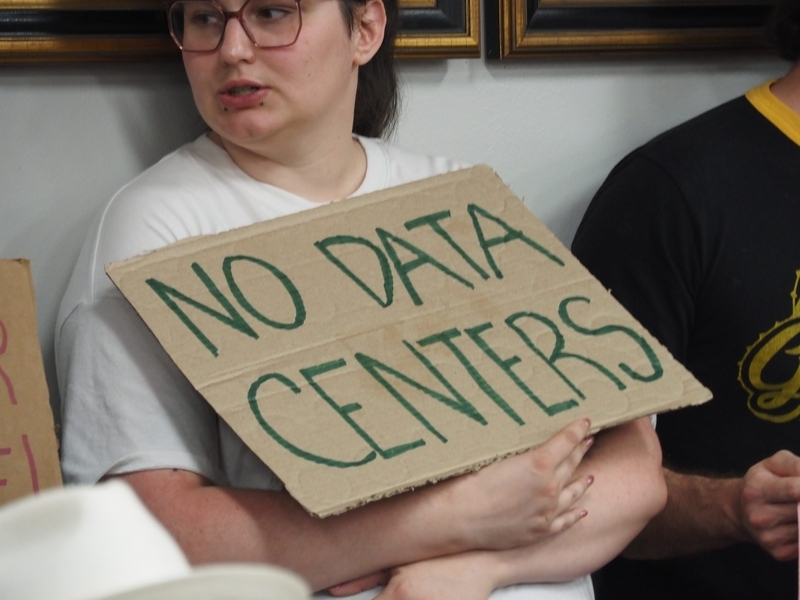
An audience member attending a Pulaski County, Arkansas, Quorum Court agenda-setting meeting holds a sign opposing data centers on June 9, 2026. (Photo by Ainsley Platt/Arkansas Advocate)
Supporters of an effort to place new regulations on data centers in Arkansas’ most populous county are expected to seek an override after an official vetoed the proposal last week.
Pulaski County Judge Barry Hyde on Friday vetoed the new rules for data centers approved by the quorum court earlier this month. The measure was written by Wendell Griffen, a former circuit and appeals court judge and current Democratic nominee for county judge, and sponsored by Justice of the Peace Julie Blackwood, a Democrat.
Hyde, a Democrat who Griffen defeated in the primary earlier this year, raised questions about the legal risks of enacting the new regulations.
“The question is whether this particular ordinance, in its present form, can be lawfully, fairly, and effectively administered without exposing Pulaski County to unnecessary legal and financial risk,” Hyde wrote in his veto. “After reviewing the ordinance, the applicable statutes and case law, the attorney general’s guidance, and the resources that would be required to administer it, I do not believe that it can.”
The regulations require prospective data center projects to submit to the county electrical load analyses, water and wastewater plans, land-use suitability studies and a decommissioning plan, among other requirements.
Arkansas Explained: Understanding the data center boom and debate
Prospective data center projects would also be required to demonstrate that the development won’t “materially impair” utilities and other public infrastructure that serve surrounding properties under the new regulations, but do not limit the amount of water or power a project can use.
Data center projects have faced bipartisan backlash in communities across Arkansas and the nation over concerns about their energy and water usage and lack of transparency surrounding such projects. Several Arkansas counties have approved moratoriums on new data center projects.
Overriding Hyde’s veto would require at least nine votes on the 15-member quorum court. The ordinance passed on an 11-4 vote. Blackwood told the Arkansas Times she planned to seek an override vote.
Griffen on Friday said that if Hyde thinks the ordinance needs to be corrected, he should identify specific changes. Griffen said he supports the quorum court seeking an override.
“The question now is not whether Pulaski County should regulate high-intensity digital infrastructure. Judge Hyde’s own veto statement acknowledges that it should,” Griffen wrote in a statement on his Facebook page. “The question is what protections Pulaski County residents should have — and whether those protections will be in place before covered development proceeds.”
Two data center projects have been announced in the region. AVAIO Digital plans to construct a center in Pulaski County and Google has announced a project in the Port of Little Rock.
Little Rock