Denny Hoskins’ terrible, horrible, no good, very bad month
Sep 28, 2026 | 6:50 am ET
Description
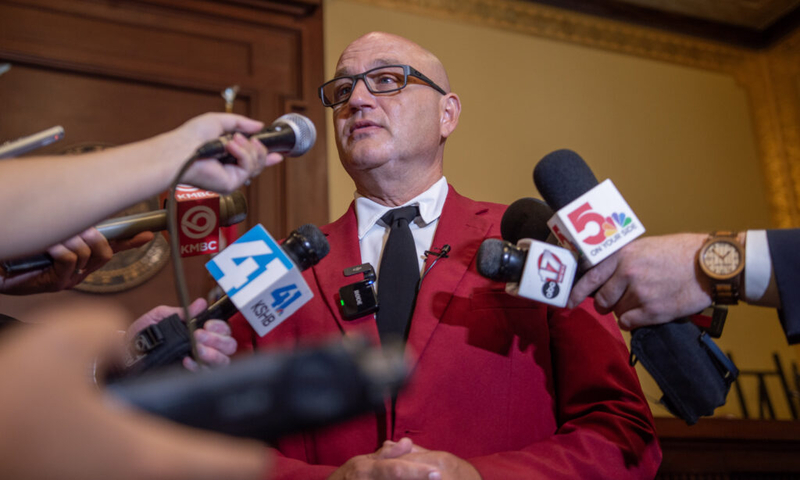
Missouri Secretary of State Denny Hoskins speaks to reporters following Missouri Supreme Court arguments Sept. 2 (Annelise Hanshaw/MissouriIndependent).
There are rough months in politics.
And then there are months when you get summoned before the Missouri Supreme Court, found in contempt, sued repeatedly, accused by a former employee of retaliating against him for raising concerns about misconduct and singled out for criticism by the highest court in the nation.
Denny Hoskins had the second kind.
For Missouri’s secretary of state, September brought one setback after another, most of them tied to the GOP push to gerrymander the state’s congressional map.
Opponents gathered enough signatures to force a referendum. Hoskins waited until an hour before a statutory deadline and then refused to put it on the ballot.
September began with the Missouri Supreme Court ruling unanimously that the referendum was lawful, ordering it onto the ballot and declaring that the November election should be held using the 2022 congressional map.
From there, the legal fight became a blur.
Hoskins asked the U.S. Supreme Court to intervene. Justice Brett Kavanaugh declined.
A federal judge in St. Louis sided with Republicans and ruled the gerrymandered map was the only one that could be used in November. The U.S. Supreme Court intervened and once again blocked use of the map, just as the Missouri Supreme Court held Hoskins in contempt for not following its orders.
Meanwhile, the lawsuits kept coming.
Five voters filed a proposed class action seeking roughly $80 million over Hoskins’ handling of the referendum. Days later came a second class action, filed on behalf of voters who cast primary ballots in congressional districts different from the ones they’ll vote in come November.
Then, unrelated to the map, Hoskins’ former director of election integrity filed a lawsuit alleging Hoskins fired him after he raised concerns about misconduct inside the office.
Three lawsuits in less than a week. A contempt finding. Two trips to the U.S. Supreme Court.
And the map fight still wasn’t over.
US Supreme Court again blocks Missouri’s gerrymandered congressional map
Last week a federal appeals court sided with Republicans. It was the best news Hoskins had all month.
It lasted four days.
On Friday, the U.S. Supreme Court stepped in again. Unanimously, it ruled that the gerrymandered map was done for this year.
In that ruling, the U.S. Supreme Court also addressed the question hanging over this entire mess:
Who bears responsibility for the electoral chaos?
Weeks of competing maps. Fears about absentee and military ballots being tossed out. Voters in 28 counties facing the prospect of casting general-election ballots in different congressional districts than they had in the August primary.
Missouri Republicans, Hoskins included, pointed the finger at the state Supreme Court.
The U.S. Supreme Court laid the blame at Hoskins’ feet.
Months before the August primary, Missouri’s Supreme Court warned Hoskins that the 2025 map would never take effect if the referendum petition held up.
Hoskins, the U.S. Supreme Court wrote on Friday, “was well aware” that using the new districts in the primary carried “significant risks.”
“The secretary nonetheless chose to proceed.”
So after all of that, Missouri wound up exactly where it started.
The old map. The same eight districts.
Hoskins did not.
After helping put the system through a yearlong stress test, he ends September as the one official a unanimous U.S. Supreme Court held responsible for it.
Jefferson City, MO