Michigan is burning. Here’s what the next governor can do to extinguish the blaze.
Sep 28, 2026 | 8:00 am ET
Description
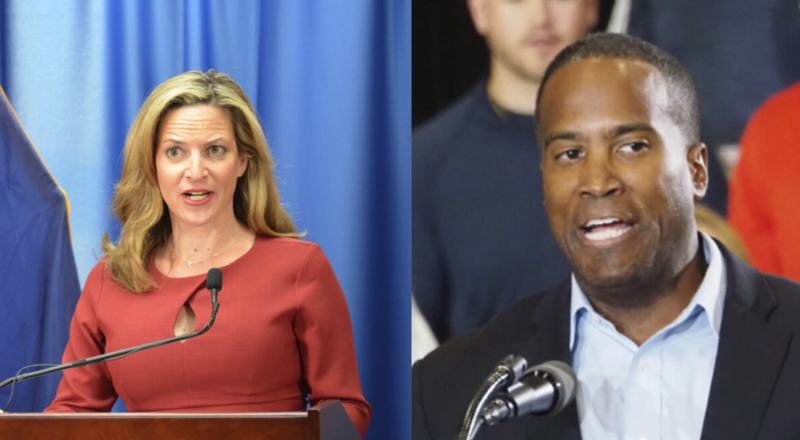
Michigan Secretary of State Jocelyn Benson (left) and U.S. Rep. John James (R-Shelby Twp.). Photos by Ken Coleman and Kyle Davidson
On the eve of his group’s posh Mackinac Policy Conference earlier this year, Detroit Regional Chamber President Sandy Baruah sounded an economic alarm.
“Michigan’s house is on fire,” he said, reeling off statistics showing Michigan mostly is in the bottom 10 states in per capita income, educational attainment and fourth-grade reading scores.
“No state has fallen as far or as fast as Michigan,” the chamber said on a website it has created, houseonfiremi.com.
The fire is still raging, but the chamber has apparently decided that neither candidate for governor, Democrat Jocelyn Benson and Republican John James, is equipped to extinguish the blaze.
Without further explanation, the chamber said on September 17 that Benson and James failed to get the two-thirds majority of votes needed to win an endorsement from the chamber’s political action committee.
Last year, the chamber PAC enthusiastically endorsed former Detroit Mayor Mike Duggan, who launched a quixotic gubernatorial campaign as an independent. But Duggan dropped out of the race in May, leaving the chamber without its favored candidate.
Call the chamber’s non-endorsement a cop-out, if you will, but it reflects what some pundits see as a lack of enthusiasm for the governor’s contest.
The race has been greatly overshadowed by the U.S. Senate contest pitting Republican Mike Rogers against Democrat Abdul El-Sayed. That contest is seen as being key to determining which party will control the Senate for at least the next two years.
The Detroit chamber endorsed Rogers for the seat being vacated by Sen
. Gary Peters, who is retiring and taking a job at the University of Southern California.
But next governor has the power to do far more to lift Michigan out of the economic basement than a single U.S. senator can accomplish.
Unfortunately, with less than two months to go before the Nov.3, neither candidate is talking much about how they would deal with some of Michigan’s thorniest economic problems: an aging workforce, retaining and attracting young talent and making communities more attractive places for current residents and newcomers among them.
James has called for a “retention and relocation tax credit” to boost employment in certain in-demand occupations. But he also wants to eliminate the state’s personal income tax, which would seem to make those credits meaningless.
Benson says she‘ll work to bring down the costs of housing, healthcare, energy and groceries.
She and James are focused primarily on driving down living costs, not boosting incomes.
Affordability and the overall economy have become the top issues for Republicans and Democrats alike in the midterm elections, thanks mostly to President Donald Trump’s damaging trade policies and his military “excursion” in the Middle East.
His war with Iran has sent the prices of gasoline and diesel soaring. Trump’s tariffs have cost Michigan households more than $5,000 each since January of 2025, according to a new study by the National Taxpayers Union Foundation. Michigan residents have paid the third-highest tariff costs in the nation.
Understandably, the focus on more immediate pocketbook issues has overshadowed longer-term threats to Michigan’s economy.
But the power of governors to tame high consumer costs is limited. They can’t eliminate tariffs, cut mortgage rates (which have hit 7%) or stop costly wars.
However, there are levers governors can pull to boost their constituents’ incomes and make their states more desirable for badly needed new working-age residents.
The most powerful lever is education. Michigan’s next governor must work to boost the percentage of adults with post-secondary credentials and degrees, particularly those with four-year degrees.
Thirty-three of the “Hot 50” jobs expected to be the most in demand and pay the highest wages in Michigan over the next eight years will require a bachelor’s degree or above, according to the latest state projections.
Yet Michigan’s public policy focus has long been in promoting skilled trades and other occupations that don’t require a four-year degree. Those jobs certainly need to be filled, but candidates for public office rarely talk about the critical need for more residents with bachelor’s degrees.
There’s a strong connection between a state’s wealth and the percentage of adults with bachelor’s degrees or above. And the connection is likely to grow more robust in an economy increasingly shaped by artificial intelligence and other rapid technological advancements.
Michigan’s next governor also needs to lead a fundamental change in the state’s economic development strategy.
The current system, which offers businesses cash and tax breaks to invest in the state, is antiquated. Businesses, especially those requiring highly skilled workers and paying the highest wages, move to where they can find the best talent. They also tend to locate in areas with strong quality of life attributes.
Here’s an idea for the next governor: transform the troubled Michigan Economic Development Corp. from a business attraction agency to one that pursues talent and invests in making Michigan’s communities more attractive places to live.
The economic fire consuming Michigan’s economy can’t burn forever without dire consequences.
Lansing, MI