Lou Ann Linehan and Tom Briese: Resist efforts to roll back tax relief
Sep 26, 2026 | 6:45 am ET
Description
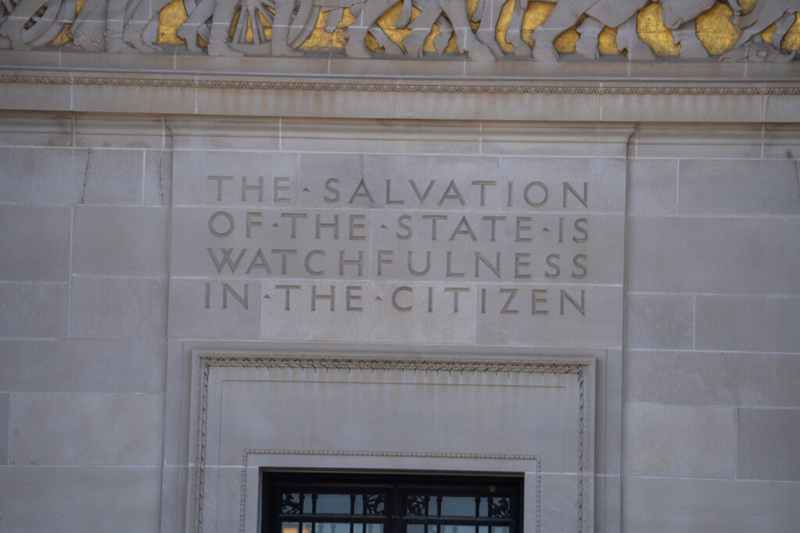
The saying on the north side of the Nebraska State Capitol reads, "The Salvation of the State is Watchfulness in the Citizen." Feb. 28, 2026 (Zach Wendling/Nebraska Examiner)
We are writing in response to former state Sen. John Stinner’s commentary of Sept. 19.
When we were sworn into the Legislature in January of 2017, the state was facing a budget crisis. The 17 new senators in our class were told repeatedly, “We are $1 billion short.” In reaction to the forecasted shortfall, we reduced the minimum reserve from 3% to 2.5% and we reduced the school funding formula by increasing the local effort rate from $1 per $100 valuation to $1.03. The local effort rate change meant we were reducing state funding for public schools. In too many cases, that change resulted in local school boards having to raise property taxes to make up the difference. We supported the changes as we were told “we’re broke.” Turns out we were not broke; the forecasts were far gloomier than the reality. This was the opposite of what had occurred two years earlier, when the forecasts were too rosy.
Understanding how the budget process works in Nebraska is a laborious and time-consuming task. The crisis that many are pointing to today might happen. But one can make the case it is more likely it will not. As the Flatwater Free Press reported last week, Nebraska’s Forecasting Board “has on average, underestimated state revenues by 3% annually over the past 30 years. … But the forecast’s accuracy varies widely year to year. In 2020, the forecast came within .22% of actual revenues. A year later, the board undershot revenues by more than 19%, according to data from the Legislature’s Fiscal Office. The board has overestimated state revenues 17 times since 1984, including in each of the last two fiscal years, missing by an average of 4.6%.”
Three or 4 percent does not sound like much of an error, but 4% of $6 billion is $240 million. Over two years, it can suggest a shortfall of $480 million. If one understands the inherent difficulty in accurately projecting revenue, facing a supposed $208 million shortfall by the end of 2027 fiscal year is hardly a crisis. Wringing one’s hands over a supposed shortfall at the end of 2029 would seem a significant waste of energy.
So then why are so many politicians screaming “budgetary disaster”? Answer: They do not support the income tax cuts from a high of 7.8% of adjusted income to 3.99% implemented over the last few years. Every year there is an effort in the Legislature to roll those income tax cuts back. Stinner appears to agree with the naysayers that the income tax cuts were a mistake. He says as much in his commentary, “The effect of the income tax initiative has been a swift dismantling of the budget’s structural integrity.” We disagree. The effect of the tax cuts is leaving more money in the pockets of those that earned it. Due to the diligent work of Gov. Jim Pillen and the current Legislature, especially of the Appropriations Chair Rob Clements and Revenue Chair Brad von Gillern, the structural integrity of Nebraska’s budget remains intact.
Further, some politicians do not support the significant property tax relief implemented over the last few years starting with LB 1107’s passage in 2020. Again, as Stinner states, “Property tax relief, the costliest initiative … totaled $518 million, which included $310 million of property tax credits (in 2022-23). Fast forward to FY 2026-27, and transfers out now account for $1.76 billion, an increase of 239%. Less than $1 million of that money will go to something other than property taxes.”
Stinner supported LB 1107, as did we. Property taxes were the No. 1 concern of Nebraskans when we were elected to the Legislature. Therefore in 2020, along with passage of LB 1107, we increased the property tax credit fund and continued to increase both it and the 1107 credit over the next four years. As Stinner writes, the state of Nebraska is now reducing property taxes statewide by $1.75 billion. But he seems to suggest that relief should be rolled back onto the backs of Nebraskans whose property tax bills were among the highest in the nation when we were elected. We disagree. We know there is still more work to do on property taxes, but we certainly do not agree that current property tax relief should be dismantled, therefore increasing property taxes by $1.75 billion.
Stinner also suggests we are not focused on needs. As we said previously, the Legislature reduced school funding in the 2017 biennium budget. That was the last time the Legislature reduced school funding. The reality is Pillen and the Legislature increased public school funding by 34% in 2023, the largest increase since the state passed significant school funding in 1989. We increased special education funding from 40% of the schools’ costs to 80%, ensuring that all children are receiving the services they deserve. We removed community colleges’ general funding from the property tax rolls to state funding. We managed hundreds of millions of COVID cash according to rules laid out by the Biden administration. And today, the state has over $840 million in cash reserves, a significant cushion for possible shortfalls.
Anyone is free to disagree with the Nebraska Legislature’s efforts over the last decade to reduce Nebraskan’s tax burden and improve funding for our public schools. But understand that all the hyperbole around the supposed “budget crisis” appears to be created in an effort to gain support to roll back your tax relief. We support Pillen’s and the Legislature’s — especially Chairs Clement’s and von Gillern’s — efforts to ensure that the tax relief implemented over the last decade remains in place.
Lincoln, NE