Report predicts substantial hit to Maine’s economy if Trump’s immigration enforcement continues
Sep 25, 2026 | 11:27 am ET
Description
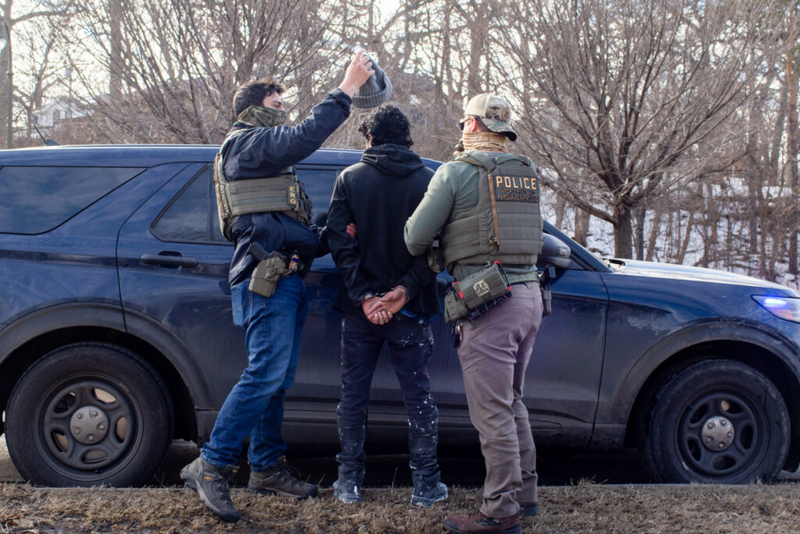
Immigration and Customs Enforcement agents search the passenger of a truck as they arrest both him and the driver during a February traffic stop in Robbinsdale, Minnesota. Minnesota faced a high rate of street arrests after Trump administration officials criticized the state’s sanctuary policies, but even states without such policies have seen street raids to round up immigrants. (Photo by Nicole Neri/Minnesota Reformer)
President Donald Trump’s immigration enforcement could result in the state losing anywhere from $395 million to $3.3 billion in annual economic output.
That’s according to a report commissioned by the Maine Office of New Americans, which assessed the contributions of more than 33,000 foreign-born workers in Maine and modeled how federal enforcement could leave employers across various sectors critically short of workers.
“This report is the first of its kind to examine what Maine’s economy could look like if immigrants continue to disappear from our workforce,” Gov. Janet Mills said in a statement. “President Trump’s cruel and dangerous immigration agenda is forcing us to contemplate this reality.”
Maine’s immigrant workforce is relatively small but an increasingly important component of the state’s economy, concluded the report, which was prepared by Maine-based Wallace Economic Advisers using U.S. Census data.
An estimated 33,079 foreign-born workers directly generated about $177 million in state income tax revenue and $2.25 billion in personal income between 2020 and 2024, the report found. Factoring in broader economic activity that employment supports, the report estimates that immigrant employment helps sustain nearly 74,000 jobs and nearly $15 billion in total economic output.
When estimating the potential economic consequences of heightened enforcement in the state, the report looked beyond the number of arrests or removals, given that enforcement has ripple effects with not only immigrants but people of color generally fearful of going about their daily lives, causing disruptions to employers, reduced business-to-business purchases, and lower household spending.
The analysis considered three scenarios: a low scenario assuming a relatively limited direct employment effect and modest withdrawal from activities, a middle scenario of more substantial and persistent enforcement, and a high scenario where direct enforcement is accompanied by a significant change in behavior among the noncitizen workforce.
Applying these assumptions produced estimated labor force reductions of approximately 840 workers in the low scenario, 5,037 workers in the middle scenario, and 7,050 workers in the high scenario.
This modeling has its limits, as the report caveats. The assumptions about how much enforcement would deter participation in daily life beyond immigrants directly detained involve a large amount of uncertainty, for example, so the analysis captures a range of potential labor market responses.
The report does not estimate outcomes of actual enforcement that has occurred so far, so it is not meant to predict the future.
Disruptions to Maine’s workforce have already been seen.
After U.S. Customs and Immigration Enforcement’s large-scale operation in the state in January, the Maine State Chamber of Commerce, Portland Regional Chamber of Commerce and Lewiston Auburn Metropolitan Chamber of Commerce sent a letter to Maine’s congressional delegation detailing ways ICE’s presence was harming the state’s economy and calling for changes to enforcement.
And after ICE fatally shot Johan Sebastián Durán Guerrero in July, Biddeford Mayor Liam LaFountain told members of Congress that many of the immigrants in the community “retreated from public life,” skipping school and work.
Several employers and workers provided testimony in the report, including Wyman’s of Maine, one of the world’s leading growers and marketers of frozen wild blueberries. About 38% of Wyman’s year-round, full-time employees are immigrants and the company has experienced considerable disruption in this talent pool in recent years.
“The bottom line is that this is not a partisan issue,” the statement from Wyman’s read. “Sustaining agriculture in Maine truly does hinge on having enough employees who want to farm and process our wild blueberries. This is reality.”
Augusta, ME