Lawmakers call on Michigan House to move on offshoring protections for call center workers
Sep 24, 2026 | 3:12 pm ET

Description
Communications Workers of America Union Senior Campaign Lead Charles Daniels, State Reps. James DeSana (R-Carleton) and Amos O'Neal (D-Saginaw), former state Rep. Jon Hoadley and members of the Communications Workers of America Union District 4 gather on the west Capitol steps on Sept. 24, 2026. (Photo by Kyle Davidson/Michigan Advance)
On Thursday, communications workers gathered with lawmakers from separate sides of the aisle as they continued an almost 10-year push to keep call center jobs in Michigan.
In June, state Reps. James DeSana (R-Carleton) and Amos O’Neal (D-Saginaw) introduced a pair of bills to require companies with a large call center workforce to notify the Department of Labor and Economic Opportunity of their plans to move jobs out of the country while giving the state an opportunity to recoup any funding the company is receiving through a loan, grant or tax incentive.
Now the pair of lawmakers, alongside members of the Communications Workers of America union, are calling on House leadership to put the bills to a vote.
“I cannot think of anything more offensive than taking my taxes and those of my fellow Michiganders and giving them to corporations that offshore jobs and hire foreign workers when these jobs had Americans ready and willing to fill them,” said DeSana, who was one of the two Republicans who voted in favor of previous versions of the bill which were vetoed by Gov. Gretchen Whitmer.
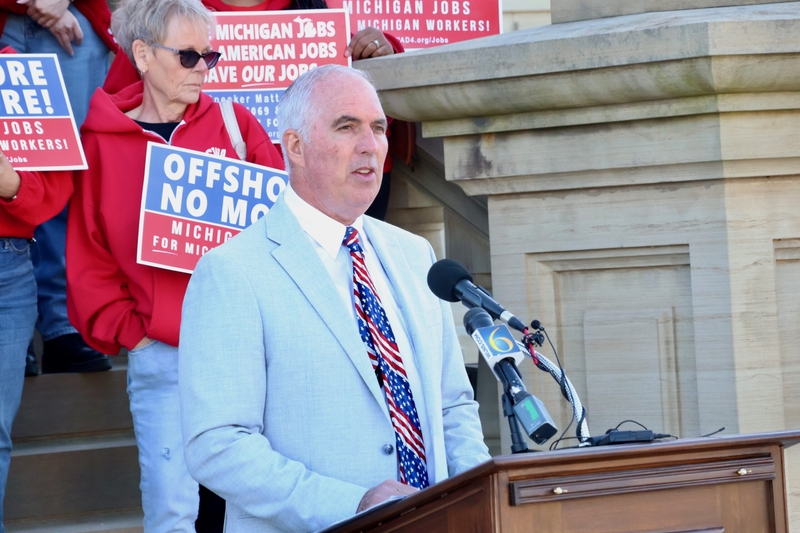
In a divided political climate, O’Neal argued that protecting Michigan workers should not be a partisan issue.
“We all know what happens when good jobs leave our state,” O’Neal said. “People feel this at the kitchen table, an uncertainty of how to make ends meet without a steady income, the anxiety of competing for a new job against dozens of former coworkers, and the wounded pride of having to explain to your neighbors, your friends and your families of why you lost a job.”
If Michigan provides a company with a loan, grant or tax break, that is an investment of taxpayer money, O’Neal said, introducing a simple question: What are Michigan workers gaining in return?
“If a company asks Michigan taxpayers to help them grow, we should expect them to have the commitment to Michigan workers,” O’Neal said. “We should not be helping that company today only to watch those jobs move overseas tomorrow.”
Charles Daniels, a senior campaign lead with the Communications Workers of America, noted that when Whitmer vetoed the bills, she called them duplicative.
“The Worker Adjustment and Retraining Notification (WARN) Act already requires certain employers to provide written notice at least 60 days in advance of a facility closure or mass layoff,” Whitmer wrote in her veto message. “Accordingly, these bills would likely result in the unnecessary use of the department’s time and resources.”

However, the WARN Act was passed in 1988, nearly 40 years ago, Daniels said.
“We’ve had a dozen CWA call centers close during that time,” Daniels said. “And that’s thousands of workers, and that’s just CWA. Think about everything else. If the WARN Act actually saved jobs, it would have saved jobs. This will save jobs, and these are the people that are going to make it happen”
DeSana and O’Neal’s House Bills 6069 and 6070 were referred to the House Economic Competitiveness Committee, where they await a hearing.
Lansing, MI