Inside Indiana’s new downtown archives, where state history gets a new home
Sep 24, 2026 | 3:40 pm ET
Description
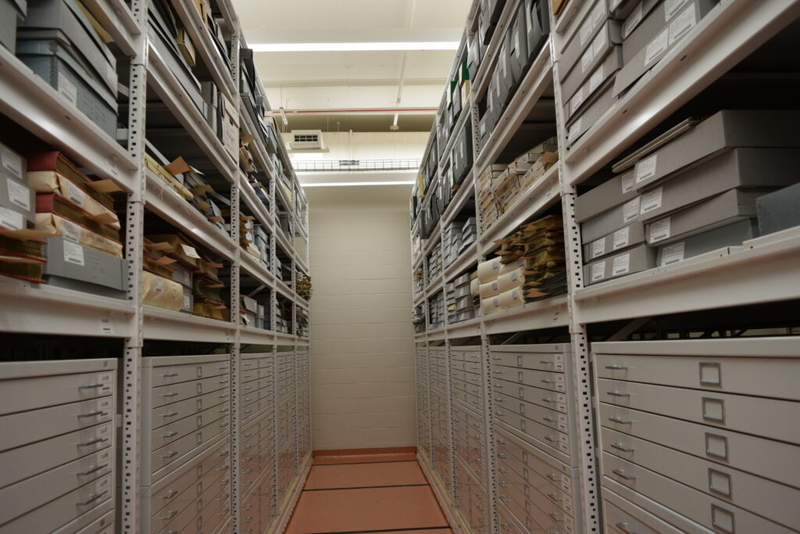
Shelves of records fill one of four storage floors at the new Indiana State Archives in downtown Indianapolis. Staff moved about 90,000 cubic feet of boxes into the building. (Photo by Casey Smith/Indiana Capital Chronicle)
Indiana’s centuries-old paper trail — from the state’s original constitutions to governors’ correspondence and millions of agency records — is back downtown after a quarter-century in a temporary warehouse.
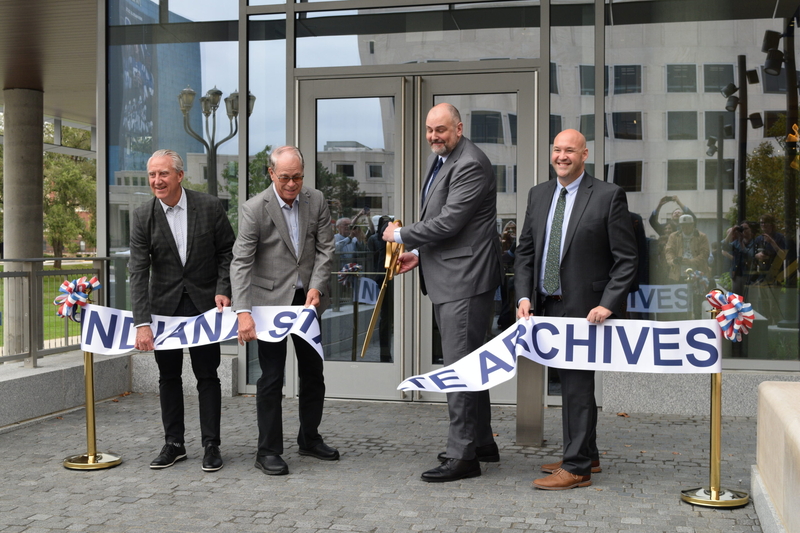
State officials marked the opening of the new Indiana State Archives with a ribbon-cutting Thursday, celebrating a long-awaited home designed to better protect the records and make them easier for Hoosiers to explore.
The building at 350 W. Ohio St., alongside Indianapolis’ Central Canal, brings together archival storage, conservation and imaging workspaces, exhibits and a public reading room near the Statehouse. With the Indiana Historical Society and Indiana State Museum across the canal and the Indiana State Library nearby, the archives adds to a cluster of institutions where visitors can explore the state’s history within a few downtown blocks.
Behind the new public spaces are four floors of records storage. Staff moved in about 90,000 cubic feet of boxes, said Chandler Lighty, executive director of the Indiana Archives and Records Administration.
Some contain the paperwork of state government. Others hold evidence of family members’ military service, ancestors’ naturalization or court fights that helped define Hoosiers’ rights.
Gov. Mike Braun pointed to his own experience with historical records, recalling a map that helped him trace property he owns in Dubois County to an original land transaction.
“I look up on that map and see 320 acres, half of which I now own, was part of that original land transaction,” Braun said at Thursday’s ribbon-cutting ceremony. “It gave me the chills. And that’s what you’re going to find here.”
During a behind-the-scenes tour earlier this week, Lighty described three priorities for the building: proper climate controls, bringing staff together and improving public access.
“We’re one of the smaller agencies, but up until this point, we were in four different locations,” he said. “Having everybody in one location allows us to work more cross departmentally.”
Preservation advocates had raised concerns about the former facility at 6440 E. 30th St., a former RCA record-stamping warehouse. Along with extreme climate fluctuations, they cited vulnerability to tornadoes and roof leaks caused in part by gunfire.
Elizabeth Hague, who works in the archives’ conservation lab, recalled watching an old book’s cover warp as conditions changed at the previous building. Climate fluctuations caused materials to expand and contract — and dry conditions damaged leather bindings.
“In the winter, the humidity would go down to like 12% in the lab, or up to 73% in the summer,” she said, noting that the humidity should stay between 35% and 50%, with temperatures around 68 degrees. “The leather dries out, and then you get red rot, and spines fall off.”
The new building’s storage areas, however, are designed to maintain the temperature and humidity needed for long-term preservation.
A ‘temporary move’ — 25 years later
The archives moved out of the Indiana State Library’s basement during a 2001 renovation and into a warehouse on East 30th Street. The arrangement was supposed to be temporary. But finding and financing a replacement took years.
An earlier proposal under then-Gov. Mike Pence was tied to Indiana’s bicentennial celebration. His plan to help pay for construction through a public-private partnership involving state-owned cellphone towers was scrapped by his successor, Eric Holcomb, in 2017.
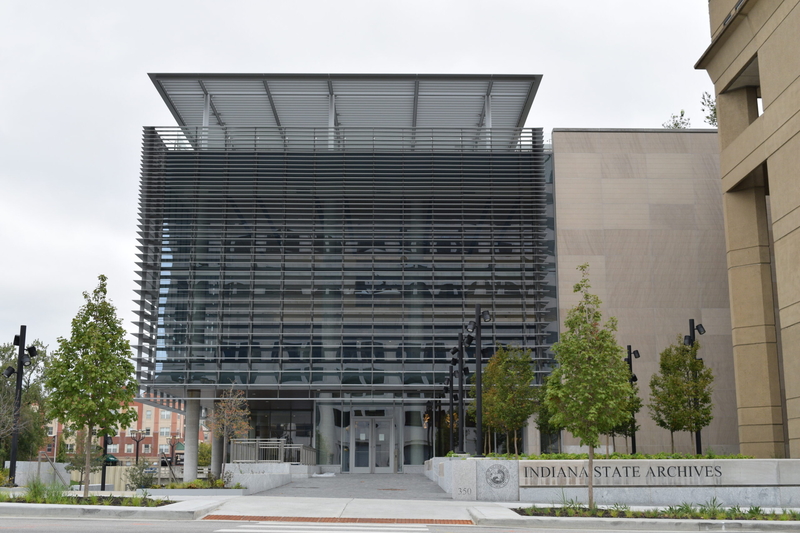
Lawmakers authorized a new building in the 2021 budget and provided funding in 2023. The State Budget Committee approved work on the project that June, with a $102 million budget, despite criticism from lawmakers over both the price and the state’s delay in moving forward.
Holcomb joined officials for the groundbreaking in August 2023. Plans called for a five-story, 133,000-square-foot building on the narrow site between the canal and the Senate Avenue Parking Garage.
“We take a while maybe to get from here to there,” Braun said Thursday. “We’re understated on the way, but we always overperform.”
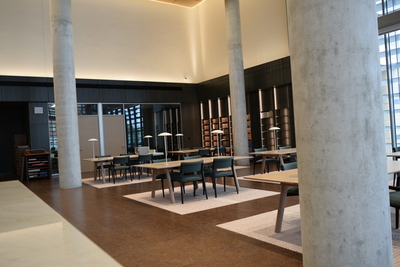
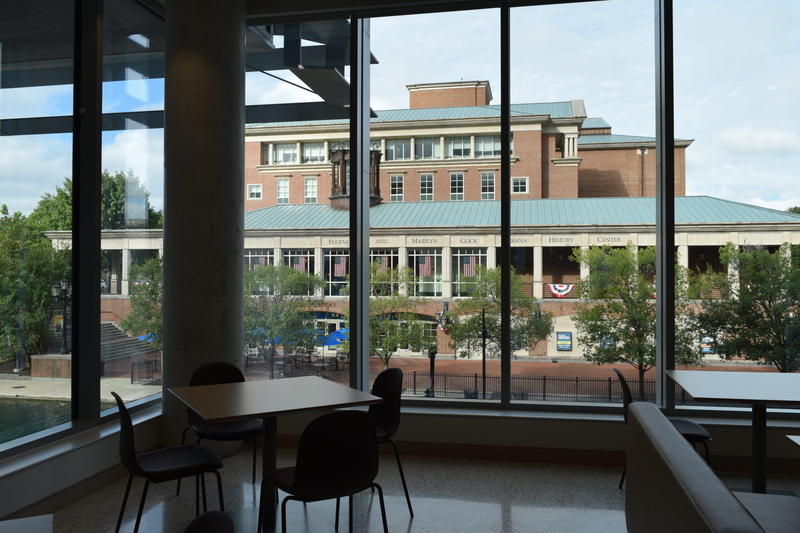
Completed offices now look out toward the canal and the Indiana History Center across the water. The public reading room has long tables, individual lamps and tall windows shaded by an architectural design Lighty said draws on a paper motif. Visitors also can use computers to access digital collections and equipment to read records preserved on microfilm.
A rooftop terrace provides space for gatherings, with views across downtown.
Architect Bill Browne of RATIO Design said the narrow site offered an advantage for storing fragile records: the space against the parking garage could accommodate storage areas that needed no daylight, leaving the canal frontage for offices and public rooms.
Connecting the building to an existing tunnel also allowed the archives to use the state office building’s loading dock rather than construct its own.
Putting pieces back together
In the conservation lab, the work can come down to a few fragile scraps of paper.
Among Hague’s current projects is a survey map of Porter County that had broken into pieces. She uses tinted mending tissue to reassemble the fragile document without making the repairs more conspicuous than necessary.
“It is so, so brittle that it just shattered,” she said of the deterioration.
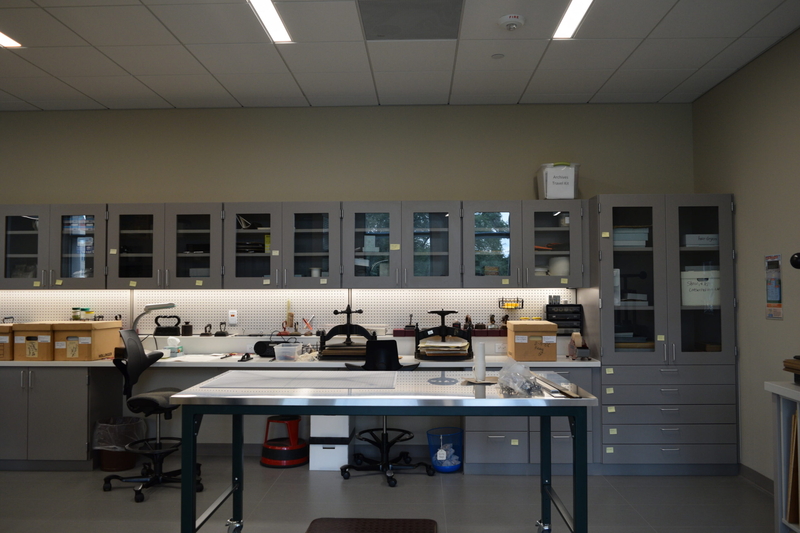
She estimated the restoration would take four to six weeks.
The repairs require drying time, so Hague works on several projects at once, switching tasks while a mend dries before returning to the map.
Other records require cleaning, humidifying and flattening before researchers can safely use them.
Some old court papers arrived folded and covered in soot after being stored near a coal furnace, said Jill Weiss Simins, the agency’s historian and director of special projects.
The results can be difficult to distinguish from a document that never needed repair.
“Some of the people that visited the other day thought they were replicas,” Hague said of materials prepared for display. “The idea is to make it very subtle and not noticeable.”
Conservation also improves the images staff can make when documents are digitized, Lighty said.
“Obviously, we do that to make them available for patrons to use,” he continued. “But also, anytime we digitize something, the better conserved it is, the better the scan we’re going to get of it.”
Four floors of Indiana history
Upstairs, rows of boxes and bound volumes show the scale of the collection.
On the shelves holding governors’ papers, the amount of correspondence grows from one era to the next. Materials from Indiana’s early decades occupy relatively little shelving, Lighty said, while later administrations generated far more correspondence.
More recently, that work has shifted to electronic records. Lighty said the gubernatorial records received from the Pence and Holcomb administrations were electronic.
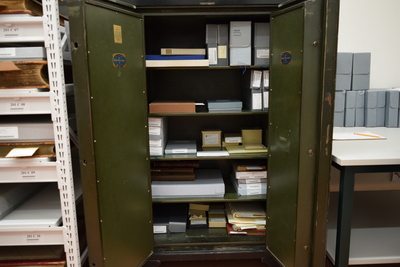
Elsewhere, an old combination-lock safe holds some of the collection’s more unusual and recognizable materials: Jim Jones’ church incorporation papers, Donald Trump’s casino application for Gary and photographic negatives from the Beatles’ Indiana State Fair appearance.
Indiana’s original constitutions are kept in the safe when they are not on exhibit, Lighty said.
Even staff who work with the records regularly find surprises.
“As we were getting ready to move and we had our hands on everything, I found a book with little wheels on the bottom so it would roll on and off the shelf,” Hague said. “That was awesome.”
The new storage areas also include room for the collection to grow. Lighty estimated the move left capacity for another 30,000 to 40,000 cubic feet, although some existing materials will take up more space as archivists unfold and process them.
Movable shelving uses hand cranks, a choice Lighty said should require less maintenance than the aging electronic system at the previous building.
State history on display
The opening additionally introduces a small ground-floor exhibit, “Indiana’s Foundations of Independence, 1776–1851,” connecting the nation’s founding ideas with the records of Indiana’s government.
The display on Thursday included the state’s 1816 and 1851 constitutions, legislative acts and Indiana Supreme Court decisions. Lighty told attendees that both original constitutions were on display together for the opening day only. The exhibit coincides with the nation’s 250th anniversary and the 175th anniversary of the 1851 Constitution.
That second constitution remains Indiana’s governing charter. The exhibit pairs it with the state’s most recent constitutional amendment, approved in 2024, Weiss Simins said.
Other documents show how individual Hoosiers made their cases to government.
An 1803 petition tells the story of Sarah Lusk, a widow who sought permission to operate an Ohio River ferry after a man seized it following her husband’s death.
Lusk argued that the ferry was her means of supporting herself and her children. Fourteen men signed in support of her account, and the court agreed to let her run it.
Nearby materials from the Vincennes Library Company, established in 1806, document what early Hoosiers read. A lending record tracks books donated and borrowed, while a selection of volumes includes works by classical and Enlightenment thinkers.
The records help show the ideas available to people building the state’s institutions, Weiss Simins said.
The archives will continue that focus with a public symposium on the Indiana Constitution on Nov. 5. The program includes a keynote address by Indiana Chief Justice Loretta Rush.
Beyond online searches
On site, visitors can research family histories and other subjects in records that aren’t necessarily available online.
The sheer volume makes it impossible to describe every document individually, Lighty said. An archivist can help identify a promising set of records, but a researcher may still need to work through boxes to find a particular person, letter or event.
“Sometimes, you have to dig and find the history that’s related to your ancestor — your ancestry,” Light said. “It takes a little work to find the bit of history you’re looking for.”
The agency is expanding digital access, too.
Partnerships with FamilySearch have helped make records with genealogical value available online, Lighty said. Staff also are working with new digital collections software to make frequently used materials easier to access.
An online index can help a researcher determine whether the archives has a relevant record even when an image of that document is not available.
“We do work hard to index some of those records so people can do a quick search for their family member and see, ‘Oh, they do have something,'” Weiss Simins said. “It might not be digitized. They can’t click and see it. They might have to order a scan or make an appointment. But they can see that we do have the records up there.”
That work has uses beyond historical research, too. Archives staff are indexing military discharge records, for example, to help veterans locate documents they may need for benefits. The archives provides those records to veterans free of charge.
The agency also has two electronic records archivists working on the growing challenge of preserving records created digitally.
Lighty described the archives as a forum rather than a temple — a place for people to use historical records, not simply admire them from a distance.
“Ultimately, this building belongs to you because the records preserved inside are for you,” he said. “Any Hoosier can come here and look at the exact documents that they live under.”

Indianapolis, IN