Autism Speaks chair, managed care plans up on next ABA task force agenda
Sep 24, 2026 | 11:16 am ET
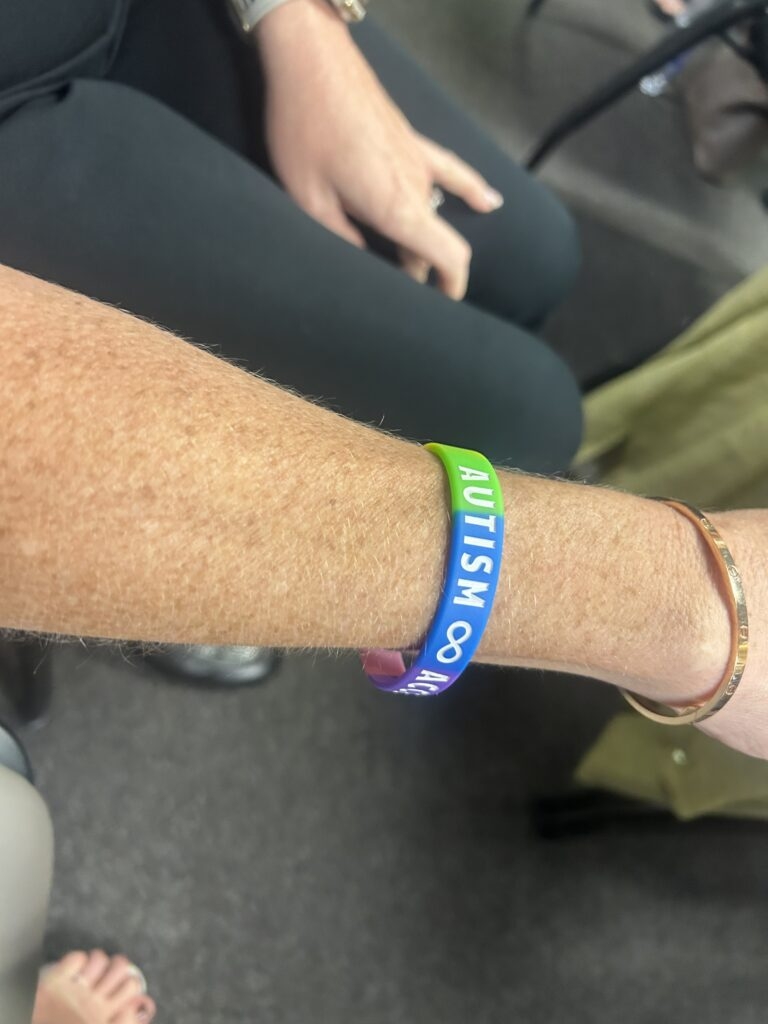
Description
Autism awareness bracelet worn by an audience member at the Aug. 31, 2026, ABA task force meeting in Tallahassee. (Photo by Christine Sexton/Florida Phoenix)
A Florida task force that could reshape how the state provides therapy to children with special needs and autism is getting together again.
The state’s applied behavior analysis (ABA) task force meets Monday and will consider testimony from a managed care panel that includes representatives from Simply Healthcare, Sunshine Health, and Humana Healthy Horizons.
It also will hear from Dr. Thomas Frazier, national board chair at Autism Speaks and a research professor at SUNY-Upstate.
The 10-member task force was created to make recommendations to the next Legislature and governor on ways to improve the “care and experience and service continuity for enrollees and families receiving ABA services, while safeguarding long term program sustainability.”
In legislative parlance, that’s code for trimming costs.
But just how big of a budget worry is the delivery of ABA services in Florida?
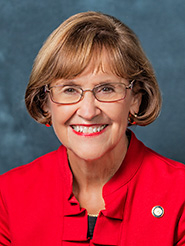
State Sen. Gayle Harrell, a Republican from Stuart, pressed Florida’s top economist during a recent Legislative Budget Commission meeting about ABA services and how the costs of providing the care are affecting the state budget. That’s a panel empowered to spend money outside of legislative sessions.
Amy Baker, director of the Office of Economic and Demographic Research, said the news is encouraging, at least for now.
“What we’re starting to hear this summer … is that the escalation and costs associated with kids with autism or other related issues is starting to slow down some and soften a little bit,” Baker told Harrell. “And so, we’ll have to see if that continues, but that was pretty encouraging. I think in part that had to do with some changes that had been made to how we service those children.”
One such change was requiring Medicaid-covered ABA services to be provided by managed care plans under contract with the state. Before 2025, these services were provided on a fee-for-service basis by providers outside the managed care plans’ networks.
Harrell pressed Baker about fraud and abuse.
“I know we’ve had a major problem with ABA services and a lot of fraud that has gone into that. Are we making adjustments for that?” Harrell asked, referencing the announcement by the DeSantis administration that it was cracking down on Medicaid fraud, waste, and abuse.
The governor announced the state’s efforts after Centers for Medicare and Medicaid Services Director Mehmet Oz said on social media that “Florida has been a hotspot for health care fraud for years.”
Oz sent a letter to Florida (as well as California, Maine, and New York) seeking information about the state’s Medicaid integrity and oversight efforts.
But Baker said, “To my knowledge, we’re not. I don’t remember any discussion of that or any issues that came up in the summer conferences related to that. So, I think the best I could say, at this point, is we’re silent on that.”
Big part of state budget
Baker told the panel members that Medicaid is always one of the critical-need drivers in the state budget. Health and human services spending in Florida, mostly provided by Medicaid, ranked as the No. 6 critical need in the Long Range Financial Outlook that Baker’s office released Sept. 11
This year’s report projects that spending on health and social programs will continue to eat a large part of the state’s general revenue commitment over the next three years, both in terms of overall dollars spent and the overall percentage of state general revenue dollars being directed to those programs.
While health and human services accounts for $1.96 billion, or 37.5%, of general revenues in state fiscal year 2027-2028, the spending requirement drops the following year to $1.53 billion (25.5%) and $1.19 billion (21.6%) in state fiscal year 2029-2030.
Those Medicaid spending estimates are based on enrollment, service utilization, the federal government matching rate (officially called the Federal Medical Assistance Percentage), medical inflation, and managed care rate changes.
Applied behavior analysis uses structured interventions to decrease maladaptive behaviors and reinforce appropriate ones. ABA is common in the treatment of children diagnosed with autism spectrum disorder and for people with attention deficit hyperactivity disorder (ADHD), traumatic brain injuries, and intellectual and developmental disabilities.
Why does Florida spend so much money on treatment for children with autism and special needs?
While Baker didn’t single out ABA as a worry, Shena Grantham, Florida’s deputy secretary for Medicaid policy and quality, told the task force last month that in the past two years Florida has spent more money than any other state in the nation providing ABA services to children.
About 60,000 poor and low-income children in Florida receive applied behavioral analysis at a cost of about $2.3 billion, Grantham said, although she didn’t cite the year.
She said the state spent more on ABA services for those children than it did providing pediatric hospital care for 966,900 children, doctor visits for 1.75 million children, and prescription drugs for about 1.4 million children.
Before a child can receive ABA services through Florida Medicaid, he or she must be referred by a doctor or child psychologist. The child must undergo a comprehensive evaluation to formally diagnose or rule out autism and determine medically necessary therapies.
The task force must submit its recommendations — along with the pros and cons of each proposal — to the governor and Legislature by Dec. 31.
Tallahassee, FL