Ohio is the nation’s No. 1 for business. Our challenge is to become No. 1 for students.
Description
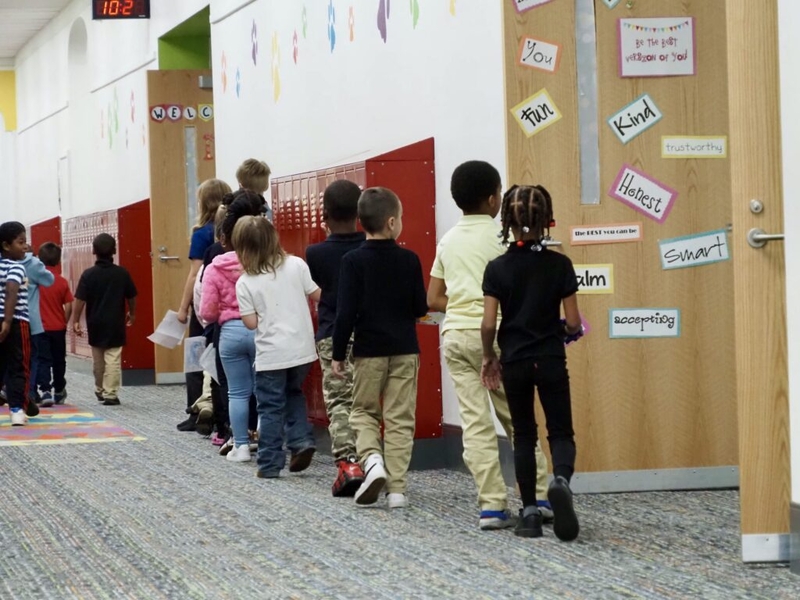
Students walk down the hall at a public elementary school. (Photo by Nuria Martinez-Keel, States Newsroom.)
With the new school year underway, Ohio students have returned to their classrooms, settled into new routines, and started thinking about what they hope to accomplish during the school year ahead. Teachers and families are helping them set goals, measure progress, and understand that academic improvement rarely happens by accident.
Ohio should approach its future with the same sense of purpose.
CNBC recently named Ohio the nation’s top state for business in its annual and widely followed assessment. That’s an achievement worth celebrating but one that also creates responsibility.
If Ohio wants to remain the best place for starting and growing a business, it also needs to become the best place for every student to learn, prepare for a career, and build a successful life.
Accomplishing this must be the education goal placed before Ohio’s next governor, regardless of which party wins the November election. By 2035, Ohio should strive to be the nation’s top-performing state in K-12 academic performance and postsecondary outcomes.
Business organizations that advocate for stronger education and workforce-development success in Ohio — including the non-partisan groups we represent — have long been committed to supporting this goal.
The need for that commitment is clear. Respected studies tell us that while Ohio ranks between 7th and 14th on national outcome measures, even that leaves many students woefully unprepared for the world ahead.
Consider these statistics: only 36% of Ohio children enter kindergarten ready to learn, while only 32% of fourth graders are proficient in reading and 43% are proficient in math on the National Assessment of Educational Progress (NAEP). By eighth grade, on this same national measure, proficiency stands at 32% in both readingand math.
Ohio’s latest school report cards show encouraging gains in reading and math, and educators deserve credit for that progress. But nearly 4 in 10 students remain below proficiency in reading and more than 4 in 10 in math on state tests.
Our next governor must build on these gains, close persistent achievement gaps, and hold the state accountable for better results.
The next governor’s administration should commit to the goal and to the strategies that have propelled students in states across the country toward higher achievement. Ohio Excels has studied the best practices across the country and identified models in each area for emulation.
A student’s readiness to succeed begins by making high-quality early education more accessible and affordable, particularly for low-income families, while fully funding all-day kindergarten so that more students are prepared to succeed in the following years. Colorado provides an excellent example of achieving this.
As students enter elementary school, Ohio must lead the nation in reading and math by maintaining high expectations, using evidence-based strategies such as the Science of Reading, supporting educators, and insisting that major reforms are implemented in good faith rather than replaced before they have a chance to work. The “Southern surge” (Mississippi miracle) demonstrates significant performance gains. Ohio has begun the work, but success requires sustained commitment.
Every family should have transparent and understandable information about school performance, along with access to a high-quality district, charter, or private school. When schools consistently fail to improve, the state must provide stronger leadership, targeted support, appropriate incentives, and real accountability. Texas’s reporting and accountability system is a strong example.
Ohio must also expose every student to career paths by expanding awareness, advising and real-world learning. Higher education, technical training, and apprenticeships should all be more affordable, more accessible, and more clearly connected to careers that offer economic mobility and a return on a student’s investment. Mississippi and Indiana offer models to emulate in career coaching and alignment.
Finally, business groups cannot simply ask schools to do it alone. Companies should open their doors through internships, co-ops, job shadowing, apprenticeships, and other work-based experiences that help inform and inspire students and educators and then provide them with an understanding of the preparation needed to pursue them.
Accomplishing all this by 2035 is ambitious but intentional, spanning two terms and providing enough time to achieve meaningful change without becoming an excuse for delay. Ohio should establish annual benchmarks, report progress publicly, and tie funding to outcomes.
Our students are already setting goals for the year ahead. Ohio’s next governor should be prepared to set one for the state that is every bit as ambitious. Ohio Excels, and our business groups, are ready to partner in this effort.
Being No. 1 for business is an extraordinary achievement, and now Ohio must become No. 1 for students.
Columbus, OH