Member of Congress Denied Access to Secretive New Immigration Courtroom in Manhattan
Sep 23, 2026 | 8:14 pm ET

Description
Photo courtesy of New York Focus
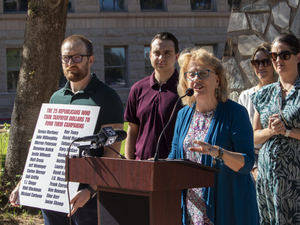
United States Representative Dan Goldman was denied access to a secretive new immigration courtroom in Manhattan on Wednesday, though immigration court hearings are generally open to the public under the law.
The confrontation took place in the late morning in a quiet hallway on the third floor of 26 Federal Plaza, nine floors below the long-standing courtrooms that bustle with immigrant families, attorneys, and court observers. Security guards stopped Goldman and several staffers as they tried to enter a room where about 20 people, almost all without lawyers, were supposed to report for their hearings on Wednesday.
New York Focus was also barred from entry, though observers could still view the proceedings online or inside a courtroom upstairs. Several Department of Homeland Security police officers joined Goldman in the hallway.
“That’s ICE’s space,” one of them said, referring to the private courtroom. “So we have to talk to someone at ICE if they want to allow you into this space.”
Other makeshift courtrooms have recently popped up nationwide, NPR has reported, including one in a building occupied by the Federal Emergency Management Agency in Washington, D.C. Some immigration judges have started calling them “basement court,” one told New York Focus. But this appears to be the first such courtroom in New York. The move is one of many initiated by the federal government to dramatically ramp up deportation orders.
Goldman has previously joined other members of Congress in suing ICE to gain access to its detention facilities.
Betsy Schmid, Goldman’s deputy district director, told New York Focus that the office had been trying to get answers about the third floor courtroom for weeks. She said the Department of Homeland Security said the courtroom was overseen by the Executive Office of Immigration Review, under the Department of Justice, which runs the country’s immigration courts. But the Justice Department, she said, had insisted the courtroom was Homeland Security’s space.
“The runaround,” Goldman said, “is clearly intended to prevent me from exercising my statutory right to conduct oversight over the Department of Homeland Security.”
“What are they hiding?” he added.
Documented and The City Reporter previously reported that in recent days, some immigrants had been directed to hearings on the third floor, limiting public access and causing widespread confusion.
The rationale for the new courtroom is unclear, but immigrant rights advocates say the change of venue to a poorly marked, low-traffic area of the building could prevent people from attending their hearings, which generally results in the judge issuing deportation orders. They also fear it could be a way to enable ICE to detain people more easily, since a judge ordered a temporary halt to immigration arrests at courthouses in New York earlier this year. There are no reports of ICE arrests at the courtroom since it opened.
Court observers, attorneys and advocates have started calling it “black site court.”
Goldman’s staff waited to speak with the ICE chief of staff in the building. They tried to call EOIR, to no avail. Eventually, a commander with the Federal Protective Service told them they had to speak with Acting Assistant Chief Immigration Judge John Burns. At that point, nearly an hour after Goldman and his staff arrived on the third floor, the congressmember decided to leave.
Goldman said it was the first time he had been denied access to an immigration court hearing.
Neither DHS nor EOIR responded to requests for comment by New York Focus.
“As it continues to add new immigration judges, EOIR will continue to make scheduling adjustments, to include opening new hearing locations as needed, to ensure all cases are handled in a timely and lawful manner,” the office said in a statement to Documented.
The third floor hearings were overseen remotely by Immigration Judge Brett Geiger, who took the bench last month. He addressed the immigrants in the room from a computer screen, while the attorney representing the Department of Homeland Security sat in the 12th floor courtroom where observers could watch the proceedings. One person with an attorney, a 16-year-old from Guatemala, was also directed to that upstairs courtroom for his hearing, limiting those in the third-floor room to immigrants representing themselves.
Of the 22 immigrants with hearings scheduled in the room, at least nine did not show up and Geiger ordered them deported in absentia.
Most of the people whose hearings New York Focus observed were in their teens. Geiger gave each of them a new hearing and told them they would likely be assigned to see a different judge in the future.
Some said they had received little notice for the day’s hearing.
“We are in the process of getting some help, but then suddenly I got hit with this court appearance, because my understanding was that it was scheduled for December 1,” the mother of a teenage girl told the judge.
“I see in the record that the hearing was moved up to an earlier day,” Geiger told her.
The DHS attorney told Geiger that the agency would request a deportation order at the next hearing, scheduled for October 28, if the girl didn’t submit an asylum application or other petition for status.

Albany