State leaders vow new multiyear approach to mounting budget gaps
Nov 14, 2026 | 5:59 am ET
Description
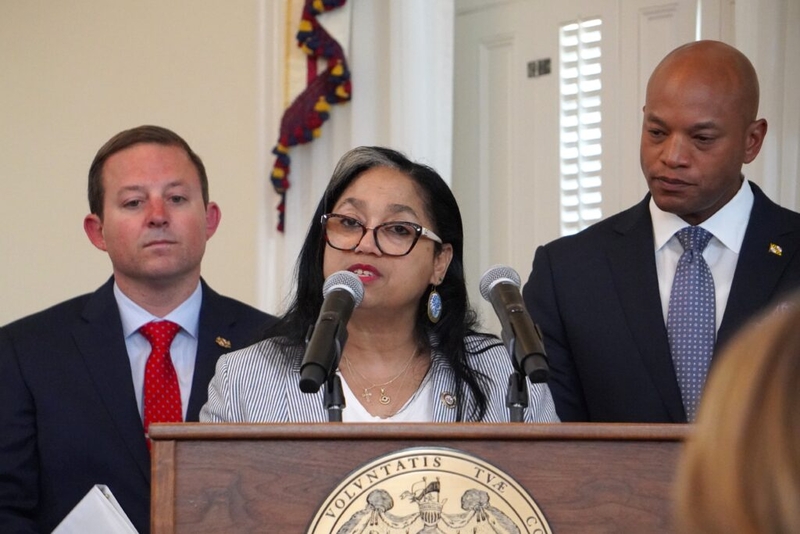
Senate President Bill Ferguson (D-Baltimore City), House Speaker Joseline Peña-Melnyk (D-Prince George’s and Anne Arundel) and Gov. Wes Moore (D) during a bill signing in April. (File photo by Danielle J. Brown/Maryland Matters)
Maryland’s governor and legislative leaders said Friday they have agreed on a new multiyear approach on the state budget as they look to resolve a series of looming budget gaps.
Gov. Wes Moore (D) and lawmakers will return in January facing a nearly $3 billion projected structural budget gap for fiscal 2028. Larger gaps are projected for the following three years.
Moore, Senate President Bill Ferguson (D-Baltimore City) and House Speaker Joseline Peña-Melnyk (D-Prince George’s and Anne Arundel) said in a joint statement that addressing the deficits one year at a time “cannot continue.”
“Today, we agreed to work together to develop a four-year plan that addresses the state’s ongoing budget shortfalls and puts our finances on a more sustainable path,” the trio of Democrats said in their statement. “A more predictable state budget will be a stronger foundation for diversifying our economy and supporting the most vulnerable in our communities.”
Much of Maryland’s fiscal problem is self inflicted, as lawmakers approve aspirational but expensive programs not moored to adequate sustainable funding. Lawmakers have long been told that mandated spending grows by nearly 5% while projected revenues increase by 3.5%.
Traditionally, the gaps were addressed in one-year fixes. More recently, state fiscal leaders have had to address structural gaps to varying degrees — some small enough to be considered rounding errors. Others, like those projected in each of the next four years, are big enough to become cause for concern.
Budget officials ask agencies to tighten belts, including a 10% cut scenario
A pandemic, a business climate seen by many as unfavorable and national pressures exacerbated the problem.
“Trump administration cuts and economic uncertainty have added to the financial pressures facing Maryland,” the trio said in their statement. “But we cannot wait for Washington to change course. We have a responsibility to address the challenges within our control.”
There is also pressure on the state to get its fiscal house in better order. The state’s “sizable and growing out-year budget gaps” were cited by bond rating agency Standard & Poor’s in May when it downgraded the outlook on the state’s debt.
“It is our understanding that, ahead of the January 2027 fiscal 2028 budget introduction, the state intends to establish a consensus budget framework that will meaningfully address these gaps through structural adjustments that better align revenues with spending, which will be critical, in our view, to maintain the state rating,” S&P wrote.
Maryland’s current $71 billion total budget includes just under $30 billion in general funds — money collected directly by the state through sources including personal and corporate income taxes and sales taxes.
The Department of Legislative Services in June projected a nearly $2.6 billion structural gap in the fiscal 2028 budget — about $150 million lower than a December estimate. The Department of Budget and Management in an email to agencies earlier this year pegged that gap at closer to $3 billion.”
Fiscal 2028 is also the first year in which costs of the Blueprint for Maryland’s Future, the decade-long education reform plan, will exceed dedicated revenues. To cover the balance, the state will have to dip into the general fund, as a first-in-the-nation digital ad tax meant to help pay for the Blueprint remains in legal limbo.
The Blueprint is seen as a driver of the structural budget gap projections for the coming four years. Lawmakers may be asked to trim back the program or extend implementation over a longer period of time to better absorb costs.
In a September interview, Budget Secretary Yaakov “Jake” Weissmann acknowledged the urgency of the budget problem. He said “tough decisions” would need to be made.
“There will be difficult decisions ahead,” Moore, Ferguson and Peña-Melnyk said in their statement. “We know those decisions affect people’s lives, and we are committed to making them together, being straightforward with Marylanders about the choices we face, and protecting the services and investments that matter most to our state’s future.”
Over the last four years, Moore and his team have addressed budget gaps with the shifting of one-time funds, taxes and some cuts.
“Developing this joint four-year plan will require a careful review of state spending, a commitment to making government more efficient, and an honest assessment of which investments are delivering results and where changes are needed.”
Over the summer, state agencies were asked to submit budget requests for the coming year that included roughly 3% reductions. Two dozen Cabinet-level agencies were asked to also prepare budgets with 10% in cuts — an amount roughly equal to the structural gap projected for fiscal 2028.
Weissmann said in September that the goal would be to put the state budget on better footing for the next two decades rather than battling annual budget gaps.
Weissman said “all options are on the table.”
One of those options is likely to be cuts coupled with a tax increase. The easiest of those to implement — though not a popular option — would be an increased sales tax.
Maryland has not raised its sales tax since 2008, when it went from 5% to 6%. Going from 6% to 7% — a penny on the dollar — could generate an additional $1.2 billion a year.
Another option could include expanding the sales tax to services — an option considered in 2020 and 2024.
But sales taxes are seen as regressive, as they hit lower-income families harder, proportionally, than higher-income taxpayers.
Annapolis, MD