SC service members need more affordable housing, military leaders say
Sep 23, 2026 | 5:35 pm ET
Description
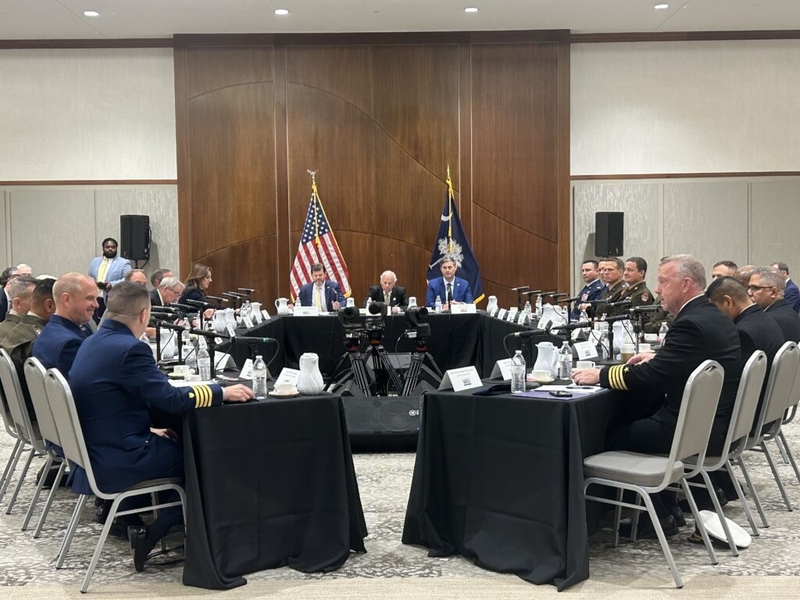
Veterans' Affairs Secretary Todd McCaffrey, Gov. Henry McMaster and House Speaker Murrell Smith, R-Sumter, oversee a conference of South Carolina military leaders at the University of South Carolina alumni center in Columbia, S.C., on Wednesday, Sept. 23, 2026. (Photo by Skylar Laird/SC Daily Gazette)
COLUMBIA — South Carolina’s military forces are growing, but they need more places to live, military leaders told top lawmakers Wednesday.
Affordable housing, education and support for military spouses are among the biggest concerns service members face when relocating, leaders of South Carolina’s military installations said during a round-table meeting with the governor and legislators as part of an annual conference.
The conference is meant to identify military bases’ biggest successes and challenges in South Carolina, with the goal of giving lawmakers ideas on how they can help out.
Participants come from military installations across South Carolina, as well as Fort Gordon located just across the border in Augusta, Georgia. A law passed in 2024 officially added it to South Carolina’s list of installations qualifying for state grants.
This year, most of their needs centered not around service members themselves but around their families. Making sure communities have resources for families is key for encouraging people to enlist and to work at South Carolina’s bases, leaders said.
“You recruit a service member, but you retain a family,” said retired Army Maj. Gen. Todd McCaffrey, who leads the state Department of Veterans’ Affairs.
That’s especially true as South Carolina’s population continues to boom, McCaffrey said.
The Palmetto State has seen a surge in population in recent years, with one of the highest growth rates in the country. That squeezes an already tight market, making buying a home even harder in already pricey parts of the state.
Those areas include Beaufort County, which has Marine Corps Recruit Depot Parris Island and the state’s Marine Corps Air Station, and Charleston, with Joint Base Lindsey Graham, which was renamed last month to honor South Carolina’s late senator.
Along with the strains of a growing population, more service members are being assigned to South Carolina, installation leaders said.
Beaufort, especially, has seen a surge in Marines assigned to the air station there. It’s expected to grow from about 4,700 Marines to as many as 6,000 in the next four years, said Col. Trevor Feltor, the station’s commander.
Even more service members might come to South Carolina as the war in Iran continues, military leaders said.
“That causes compression, and compression could be a challenge if you don’t have the infrastructure, you don’t have the housing, the schools,” McCaffrey said. “You hear that from these military members.”
When the number of service members grows quickly, bases run out of space to house them all.
That often leaves people scrambling to find leases or mortgages they can afford nearby for themselves and their families, said House Speaker Murrell Smith, whose district includes Shaw Air Force Base.
“We’re going to have to take on the issue of how we’re going to house people in military communities, especially when we’re in a time of war and we have been transitioning on and off the bases,” the Sumter Republican said.
He floated the idea of expanding the state’s Palmetto Heroes homebuyers’ program, which helps active-duty military, teachers, nurses, law enforcement and other public sector employees buy homes.
SC approves $72M in low-interest loans to help its ‘heroes’ buy homes in the state
The program offers $10,000 in forgivable down payment loans and low, fixed-rate mortgages until funding is depleted. This year, the $74 million SC Housing had to spend ran out after less than a month, the quickest in the program’s history, according to the agency.
Smith didn’t give details on how legislators might look to expand the program to further help service members, and McCaffrey didn’t offer specific ideas. But both agreed affordable housing was a major challenge for military members.
“You’ve got to be able to take care of families, you’ve got to be able to take care of service programmers, and you’ve got to be able to generate readiness,” McCaffrey said.
Concerns about housing for service members often center around those with families, but fresh recruits often need somewhere to live, too, several base leaders said.
Many service members don’t have driver’s licenses or cars, having gone straight from high school to basic training, said Capt. Jason Anderson, deputy commander of Joint Base Lindsey Graham. If they can’t stay on the base, which sometimes happens when they run out of space, that makes it even more essential to have housing nearby, he said.
Beaufort Naval Hospital is dealing with that pressure during renovations of its onsite barracks, said Capt. Juan Rosario, the military hospital’s commander. Around 20 sailors had to move off base during the improvements, and the hospital struggled to help them find places to live that they could afford, he said.
“Parents expect me as a leader to help their children, to keep them safe, so that they can do what they were called to do, and that is to serve our nation,” Rosario said. “In order to do that, I need to find an affordable, safe house where I can put them.”
For service members with families, making sure their spouses have job opportunities and their children have access to high-quality education is essential to keeping South Carolina a military-friendly state, leaders said.
“The reality is, when these young people decide to join the military and have families, they have an expectation — and, frankly, they’re right, I think — to have the kind of housing, the schools and the job opportunities that all Americans want to have,” McCaffrey said. “South Carolina’s working really hard to provide that.”
In July, the federal government relaunched the SpouseWorks program to help spouses of active-duty military members get jobs when they relocate. The program offers career coaches, job boards and scholarships for career-advancing degrees.
Statewide, K-12 public schools that go above and beyond to help military families can receive a Purple Star designation. Criteria for becoming a Purple Star school include designating a liaison to help with military-specific challenges, providing extra training for school staff and making sure policies are in place that allow transfer students to join sports and clubs throughout the year.
A state law passed last year also gives children from military families enrollment preference in charter schools that use a lottery system.
Programs like those “give Marines a valuable peace of mind,” said Col. Clark Mitchell, of Parris Island. “It allows them to focus on the mission, knowing their family is supported by a grateful community.”
Columbia