Appeals court hears arguments over Arkansas’ Ten Commandments in classrooms mandate
Sep 22, 2026 | 2:15 pm ET
Description
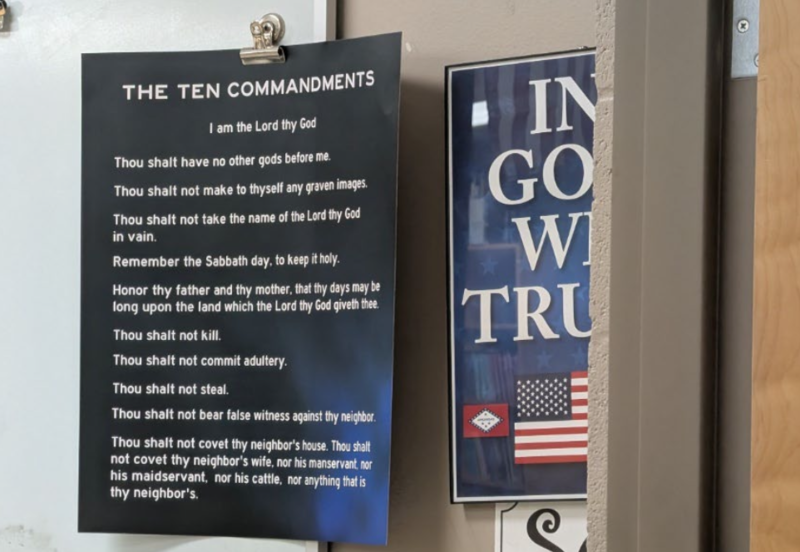
The Ten Commandments were on display in a classroom in the Conway School District in August 2025 in adherence to a state law requiring the religious display in taxpayer-funded public buildings, including school classrooms. A federal judge ordered them to be removed. (Screenshot from court documents)
A federal appeals panel is considering whether to allow six Arkansas school districts to enforce a 2025 state law requiring Ten Commandments displays in all public school classrooms.
A three-judge 8th U.S. Circuit Court of Appeals panel heard arguments Tuesday in St. Louis in a federal lawsuit challenging Act 573 of 2025, which requires public schools and public institutions of higher education to “prominently” display a “historical representation” of the Ten Commandments in classrooms and libraries.
The statute also applies to public buildings or facilities maintained or operated by taxpayer funds.
The lawsuit involves ten Arkansas families of varying religious and nonreligious backgrounds who are suing the state and the districts their children attend — Bentonville, Conway, Fayetteville, Lakeside (Garland County), Siloam Springs and Springdale.
U.S. District Judge Timothy Brooks in March said the law violated the families’ First Amendment rights, declared the statute unconstitutional and blocked it from being enforced in the six challenged districts. The state appealed the ruling.
During Tuesday’s oral arguments, Autumn Hamit Patterson, solicitor general for the Arkansas attorney general’s office, said Brooks’ decision was flawed and should be reversed.
Patterson said the seven families who filed the original lawsuit lacked standing because their challenge was based on speculation that Ten Commandments posters would be donated and hung at their children’s schools, and “offend or coerce” them in some way.
Three families that were added to the lawsuit later joined after displays were hung in their kids’ classrooms.
Patterson also said the displays have historical significance and are not coercive because the law doesn’t require them to be incorporated into the public school curriculum. Therefore, the statute doesn’t burden plaintiffs’ free exercise rights, Patterson said.
“There’s no requirement for teachers, school officials or students to interact with, bring attention to or even acknowledge the posters in any way,” she said.
Patterson made her arguments to Judges Bobby E. Shepherd, L. Steven Grasz and David R. Stras. Shepherd, who is from El Dorado, was appointed to the bench by George W. Bush. President Donald Trump nominated Grasz and Stras.
Brooks, who issued the ruling against the displays, was nominated to the bench by Barack Obama.
The panel said challenges to the Free Exercise Clause often focus on limiting religious activity, but this case is about religious activity coming into the classroom, and questioned how neutrality works in this case.
“There’s nothing neutral about it,” said Jonathan Youngwood, an attorney for the plaintiffs, who noted the law mandates a Judeo-Christian version of the Ten Commandments that’s inconsistent with the beliefs of an atheist family or any faith tradition with multiple gods.
The panel questioned if plaintiffs objected to the displays’ directives to not steal or kill or simply to the commandments as a whole. Youngwood said the displays also command belief in one God.
“Schools use their limited classroom walls to teach,” he said. “This is instruction. These are, after all, commandments, and they are directly religious.”
Following the conclusion of arguments, the judges said the case had been submitted and they would render a decision “as soon as possible.”
Similar Ten Commandments laws have been challenged in Louisiana and Texas. Following rulings from the U.S. 5th Circuit Court of Appeals earlier this year that both laws could go into effect, a Louisiana teacher and Texas families asked the U.S. Supreme Court to hear challenges to their state’s laws.
The Alabama Legislature this year approved a law requiring Ten Commandments displays in schools that goes into effect Oct. 1.

Little Rock