Nearly half of Center for Intellectual Freedom advisory council members resign
Sep 22, 2026 | 3:08 pm ET
Description
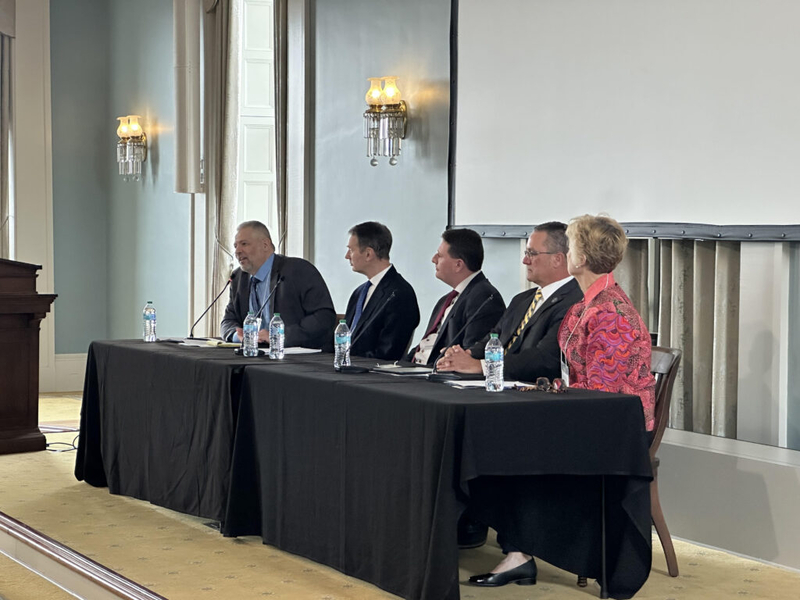
Eleven of the 26 advisory council members for the Center for Intellectual Freedom at the University of Iowa have resigned this week. Panelists speaking Dec. 6, 2025, at the Center for Intellectual Freedom at the University of Iowa, from left, are center Interim Director Luciano de Castro, U.S. Assistant Secretary for Postsecondary Education David Barker, state Rep. Taylor Collins, state Sen. Kerry Gruenhagen and Regent Christine Hensley. (Photo by Brooklyn Draisey/Iowa Capital Dispatch)
Nearly half of the Center for Intellectual Freedom at the University of Iowa’s advisory council membership have resigned from their roles after issues were voiced about the Iowa Board of Regents’ dismissal of their concerns relating to control of the center and finding its permanent leader.
The Iowa Board of Regents Tuesday stated in a news release that it accepted the resignation of 11 members of the advisory council, including executive committee chair Richard Lowery and other professors and academics from universities across the U.S.
According to a letter sent to Board President Robert Cramer, the resignation was the group’s expression of its “vote of no confidence in the Board of Regents and in the Board’s Center for Intellectual Freedom (CIF) Supervisory Committee.”
Regent Christine Hensley, who chairs the advisory council and leads the board committee overseeing the center, said in the release that the board appreciates “the work these individuals have put into the Center for Intellectual Freedom.”
“The Board of Regents looks forward to working with the remaining 15 members of the CIF Advisory Council to keep the Center moving forward in a positive direction,” Hensley said in the release. “The Board and the Advisory Council fully support helping CIF achieve its stated goals of providing scholarship on the intellectual foundation of free societies, the principles, ideals and institutions of the American constitutional order, and the foundations of responsible leadership and informed citizenship.”
Other resigning members include Thomas Gallanis, Dorian Abbot, Daniel Bonevac, Carlos Carvalho, Joshua Katz, Sergiu Klainerman, Ivan Marinovic, Nicola Persico, Joshua Rauh and Herald Uhlig.
The advisory council is now down to 15 members, having started with 26. The center advisory council moving forward includes Hensley, Cramer, Regent Steve Lacy, former Regents Jim Lindenmayer and Mike Richards, Fareway CEO Reynolds Cramer, Iowans for Tax Relief Foundation Policy Director John Hendrickson, former lawmakers Greg Ganske and Liz Mathis, former Iowa Gov. Terry Branstad, philanthropist Norman Johnson, Heart of America Group CEO Mike Whalen, UI Senior Advisor to the President Peter Matthes and professors Wilfred McClay and Mark Bauerlein.
Emails show friction on how to move forward
Advisory council members have bristled at the amount of control the board of regents has exercised over the center’s staff and planning. They expressed concerns in a September meeting about restrictions on director travel and the UI’s involvement with figuring out required curriculum for civics education.
The main focus of the advisory council currently is to select a permanent director, and the board of regents last week approved a timeline for candidate interviews and finalist visits to campus. At the board meeting, Hensley said she would set up a council meeting this week to discuss candidates and tackle interviews and other steps throughout the month of October, but “some members of the executive committee” won’t be “pleased with us moving forward.”
Hensley shared the timeline with advisory council executive committee members in a Sept. 16 email, according to records provided by the board of regents, but Lowery responded saying “that is not the timeline we will follow.”
Cramer emailed Lowery Sept. 17 asking him to “get on board” with Hensley and work with her or step down to let someone else lead the search process, saying he appreciates Lowery’s work but “it appears we are going down different paths.” Gov. Kim Reynolds and Rep. Taylor Collins, chair of the Iowa House Higher Education Committee, were copied in the email.
Lowery seems to “want to run the center” his way and isn’t respecting board of regent decisions, Cramer said in his email, and while the board “covets and appreciates” the council’s thoughts, the board of regents is the body responsible for the center and any final decisions relating to it.
Rather than an “island of disgruntled nonconformists,” Cramer said he and other board members want the center to stretch its engagement across the UI campus and change university culture through their shared goal of teaching civics, debate and American history.
“Instead of fighting each step of the way, we want the permanent executive director and the Advisory Council to set a new course by working in partnership with the Board and the University,” Cramer said in his email. “CIF will maintain its independence and ensure its courses are taught in a fair and balanced way that matches the legislative intent. But we don’t have to do everything in isolation.”
Lowery responded Sept. 19, saying in an email it’s been made clear to him that the UI and board of regents “will never allow the Center for Intellectual Freedom to be a success and will never allow the Center to operate in accordance with the law,” and the center won’t receive the external support it needs to succeed. He said under Cramer’s leadership, “no serious academics with an interest in higher education reform” would want to stay with the center.
“Your message demonstrates clearly that you have complete contempt for those academics who do not adhere to the dominant, leftist ideology on university campus, describing us contemptuously as ‘disgruntled nonconformists,’” Lowery said in his email. “That is not an environment that can possibly lead to a vibrant Center for Intellectual Freedom.”
The pair exchanged one more email each Sept. 19, with Cramer saying he’s not interested in in-fighting but wants to “change hearts and minds.” Lowery said the board gave an ultimatum rather than accept the advice of the council and hasn’t answered questions of “hiring authority, independence, and tenure protections we raised months ago.”
“My colleagues and I gave our time to this in good faith, and the Board gave us no reason to keep giving it,” Lowery said in his email.
Des Moines, IA