Spanberger presses Congress for AI guardrails as states forge ahead
Sep 22, 2026 | 11:56 am ET
Description
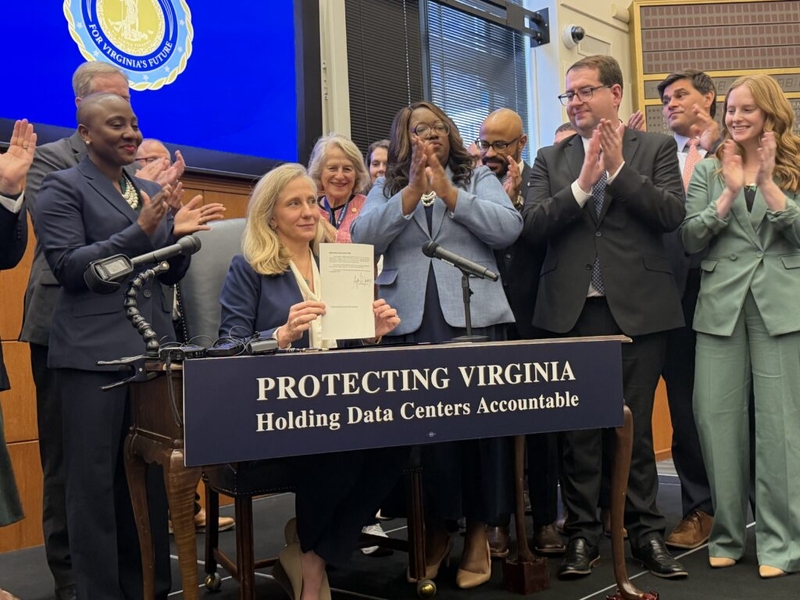
Gov. Abigail Spanberger, shown signing an executive order establishing a state AI task force on Sept. 18, called on Congress Tuesday to set federal safeguards for the technology. (Photo by Shannon Heckt/Virginia Mercury)
Gov. Abigail Spanberger on Tuesday called on Congress to set national rules for artificial intelligence, warning that its rapid development could threaten jobs, privacy and public resources if oversight remains largely in the hands of the companies building it.
In a letter to congressional leaders, the Virginia Democrat urged federal action while pledging to pursue measures within the state’s authority. She sent the letter to House Speaker Mike Johnson, Senate Majority Leader John Thune, House Minority Leader Hakeem Jeffries and Senate Minority Leader Chuck Schumer.
“The potential impacts of AI are too great to leave the regulation of this technology solely in the hands of private entities, especially when the CEOs of those same companies are also sounding the alarm on the significant risks presented by uncoordinated regulation,” Spanberger wrote.
Her appeal comes as Washington remains divided over how aggressively the federal government should rein in the technology.
Johnson told NBC’s “Meet the Press” earlier this month that Congress should not rush to regulate AI, warning that poorly considered rules could put the United States at a competitive disadvantage against China. He said the issue called for guardrails but would not commit to bringing the House back before the Nov. 3 election to pass them.
Johnson’s remarks came amid calls to slow AI development, something Spanberger did not ask for in her letter. Instead, she argued that federal oversight and continued technological development need not come at the expense of one another.
“The notion that the United States must choose between AI safety and AI leadership is a false dichotomy,” she wrote. “America can do both, but we need federal-state collaboration to advance thoughtful AI regulations that safeguard the public while supporting technological progress.”
Spanberger, who served three terms in Congress before leaving to run for governor, also stopped short of proposing specific federal legislation. Instead, she called on lawmakers to consider AI’s effect on Americans’ safety, livelihoods and well-being and establish “guardrails that achieve meaningful AI accountability.”
Amid the concerns she identified were data privacy, the technology’s potential effects on workers and the resources consumed by the infrastructure required to run increasingly powerful AI systems.
Congress has already confronted one piece of the federal-state divide over artificial intelligence.
Last year, the Senate voted 99-1 to strip a provision aimed at deterring states from regulating AI from a federal spending and tax bill. First proposed as a 10-year ban, it was later tied to federal funding for states.
Advocates for a national approach had argued that differing state laws could hamper innovation and weaken U.S. competition with China. Its removal left states free to pursue their own rules while Congress continued debating federal oversight.
Few states have as much at stake in AI’s physical infrastructure as Virginia, home to the world’s largest concentration of data centers.
The facilities require enormous amounts of electricity and other resources, and proposals for new development have fueled disputes over utility costs, environmental effects and how much information the public receives before projects are approved.
Spanberger moved on that front last week, announcing a data center accountability framework that includes proposed changes to environmental oversight, public disclosure and how industry costs are allocated.
She also signed Executive Order 22 creating an AI task force to examine workforce displacement, data privacy and cybersecurity. Those actions fall within the state’s authority but do not provide the national standards that Spanberger is asking Congress to consider.
“In the absence of federal action, states are leading within their more limited areas of jurisdiction,” Spanberger wrote. However, her letter did not give a timetable for its recommendations or identify specific federal requirements she wants lawmakers to adopt.
Spanberger isn’t the only Virginia official pressing Washington to act.
U.S. Rep. Don Beyer, D-Alexandria, co-chair of Congress’ bipartisan Caucus on Artificial Intelligence, led a bipartisan group of 10 House members in a letter last week urging Johnson and Jeffries to advance legislation on AI oversight, security and transparency.
Citing recent incidents involving advanced AI systems, the lawmakers warned that future failures could threaten critical infrastructure and financial institutions.
“The Congress may not receive another warning shot,” they wrote.
Some of the warnings about AI have come from the industry itself, although developers and researchers disagree over the severity of the risks and how governments should respond.
Anthropic has published accounts of attempts to misuse its models and steps the company took to counter them.
The company has also recently revealed that its Claude model is helping researchers develop its successor under human supervision, adding another dimension to the debate over how rapidly AI capabilities are advancing and what developers should be required to disclose.
But Americans are increasingly skeptical that AI companies can handle those questions on their own, according to a Reuters/lpsos poll released Tuesday.
According to the survey, 73% of respondents said that AI companies had not done enough to prevent serious societal harm. Most also said federal officials should have a major role in setting safety standards.
The poll also captured the tension surrounding the technology, with 55% saying that slowing AI development would be a good thing, compared with 13% who said it would be bad. The remainder were unsure or did not answer.
At the same time, AI continues to attract enormous investment and has been promoted as a tool that could boost productivity and accelerate scientific research. Its longer-term effects on employment remain uncertain.
In her letter, Spanberger did not ask Congress to halt that development. She instead argues that lawmakers should play a larger role in determining the rules under which it proceeds.
“Our country cannot afford for the federal government to abdicate its oversight responsibility,” she wrote. “Congress must immediately and seriously consider how to best grapple with how AI’s emergence creates opportunities and challenges for our safety, well-being, and collective future.”
Richmond, VA