5th District candidates disagree on Iran war, public food assistance
Sep 21, 2026 | 7:39 pm ET
Description
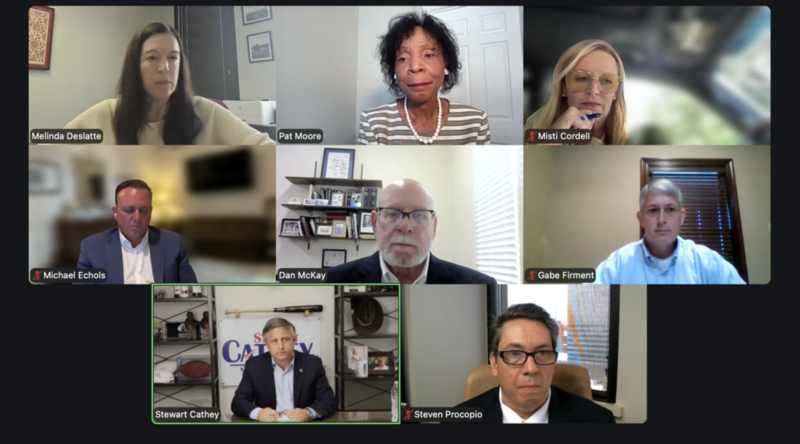
The Public Affairs Research Council of Louisiana hosted an online forum for selected 5th Congressional District candidates Monday, Sept. 21, 2026. Pictured are, top row from left: PAR Research Director Melinda Deslatte, state Rep. Pat Moore and Board of Regents Chair Misti Cordell. Middle row: State Rep. Mike Echols, attorney Dan McKay and state Rep Gabe Firment. Bottom row: State Sen. Stewart Cathey and PAR President Steven Procopio. (Photo by Julie O'Donoghue/Louisiana Illuminator)
Democrats and Republicans running for Congress in Louisiana’s 5th District have sharp differences over how to handle the Iran war as well as whether restoring food assistance benefits should be a priority for lawmakers.
Six candidates took part in an online forum Monday hosted by the Public Affairs Research Council of Louisiana, a nonpartisan group that promotes civic engagement and government transparency. The group limited its event to candidates who are elected officials or had raised $100,000 for the race.
The two Democrats in the race, attorney Dan McKay of Bunkie and state Rep. Pat Moore of Monroe, said they would work to end the war with Iran if elected.
“The first and most obvious thing to do about inflation and affordability is to end the war in Iran that Donald Trump started,” McKay said. “That was totally ill-advised. There’s no basis for it.”
All four Republicans — state Sen. Stewart Cathey of Monroe, Board of Regents chair Misti Cordell of Monroe, state Rep. Michael Echols of Monroe and state Rep. Gabe Firment of Pollock — said they supported Trump’s decision to go to war with Iran.
“Have there been some short-term pain points? Absolutely. And should we end this as soon as possible? Absolutely,” Echols said when asked if he backs the war. “But I do appreciate the president holding the bully accountable.”
The forum participants are among the nine candidates seeking to replace U.S. Rep. Julia Letlow, R-Baton Rouge, in the 5th District. The congresswoman is the GOP’s nominee for Louisiana’s open U.S. Senate seat in the Nov. 3 election.
The mostly rural 5th district covers all or parts of two dozen parishes, extending from Northeast Louisiana to the outskirts of Baton Rouge and the Florida Parishes.
Democratic and Republican candidates also differed during the forum on what to prioritize in the federal farm bill, a massive multiyear package that drives public assistance to farmers, oversees agriculture policy and funds the Supplemental Nutrition Assistance Program, also known as food stamps.
Congress is currently struggling to pass the farm bill, in part, because Senate Democrats won’t vote for one that keeps SNAP cuts enacted in 2025 in place.
Over the past year, 166,000 Louisiana residents have lost SNAP benefits, which help low-income households purchase food each month. Others stayed in the program but saw them drastically reduced, in some cases from $300 to just $24 per month, after Congress approved Trump’s One Big Beautiful Bill Act.
McKay and Moore, as Democrats, said restoring SNAP funding would be a priority if elected. Many Democrat-leaning policy organizations have argued that a more robust SNAP program would provide a boost to farmers because it increases demand for American agricultural products.
“People that have been removed from the SNAP benefit, that of course impacts the farmers,” Moore said.
Republicans Cordell and Echols implied SNAP should not be such a point of focus in the farm bill.
“SNAP is a very large part of the farm bill, and of course, no one, Republican or Democrat, wants anyone in America to go hungry. But there’s a lot of that farm bill that SNAP eats up,” Cordell said.
Echols said he believed SNAP should be removed from the farm bill altogether because the fight over funding food aid holds up other crucial farming assistance.
On the controversial topic of data centers and artificial intelligence regulation, McKay was the only candidate to call for a moratorium on the facilities.
Cathey and Cordell said it is in Americans’ best interest to be friendly toward data center and AI development in order to protect national security interests. Cathey said he favors minimal federal regulation of the industry for that reason.
“They’re going to construct these somewhere. I’d much rather us have an inviting environment here in America rather than them go to China, where there will be absolutely no regulation, no oversight and no controls to protect your date,” he said.
Firment and Echols said the AI and data center boom could provide opportunities for the state’s timber industry. Woody biomass, which can be produced easily by Louisiana companies, could be used to help power the new data centers, they said.
Firment said it’s also crucial that Louisiana residents don’t end up paying for the energy and water resources needed to power data centers.
“It’s absolutely critical that the cost of energy infrastructure and transmission is not passed along to the ratepayer,” Firment said.
“Energy really is the biggest issue when we’re talking about data centers,” he said.
Baton Rouge, LA