Appeals court backs Missouri’s gerrymandered map, but decision is put on hold
Sep 21, 2026 | 7:31 pm ET
Description
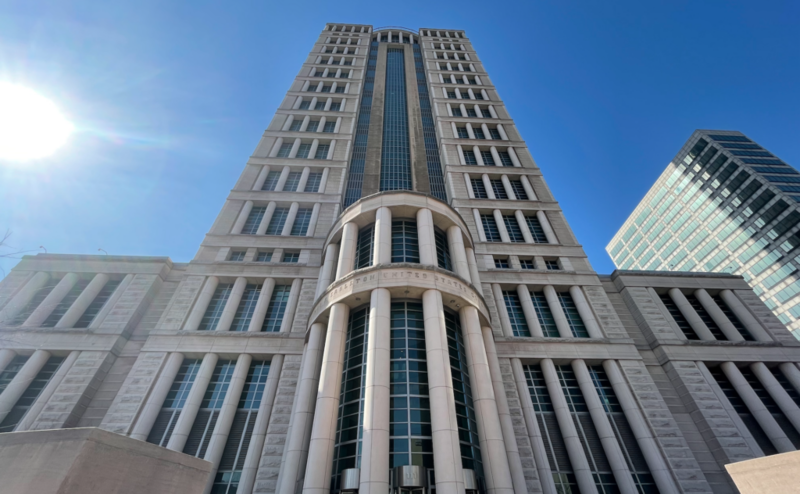
The 8th Circuit Court of Appeals in St. Louis ruled Monday that Missouri should use the 2025 congressional map drawn to favor Republicans in the 2026 election. the court is housed at the Thomas F. Eagleton U.S. Courthouse (Rebecca Rivas/Missouri Independent).
A federal appeals court ruled Monday that Missouri must use the congressional map passed by Republicans in 2025 for the Nov. 3 election, but the decision was put on hold for a week — leaving election officials to proceed for now under the map they were already using.
The 8th U.S. Circuit Court of Appeals issued its order just before 5 p.m. Monday, ruling the election in November must use the same district lines that were used in the Aug. 4 primary election. But the judges stayed the order until Sept. 28 to give opponents time to seek relief from the U.S. Supreme Court.
That means Monday’s ruling does not immediately change how the election will proceed. The first ballots went out Friday for overseas voters, and absentee voting begins Tuesday for people who are unable to make it to the polls on Election Day because of travel or mobility issues.
The ruling is contrary to a decision of the Missouri Supreme Court that a referendum petition to force a vote on the 2025 map also negated the legal effect of the legislation enacting the plan. The U.S. Supreme Court has intervened twice already in the dispute, most recently on Sept. 10, when it blocked a federal judge’s order requiring use of the 2025 map while the case moved through the 8th Circuit.
The court’s order changes nothing in how the election will proceed, said Boone County Clerk Brianna Lennon. She tested voting tabulators Monday using the 2022 map and will mail 1,000 ballots on Tuesday to people who requested them.
People who have not voted could be given a new ballot if the district lines do change, Lennon said. She’s not certain what message, if any, she will send to those voters.
“That is what I am going to spend tonight trying to figure out,” Lennon said.
Missouri election officials begin mailing ballots as they await ruling on congressional map
People Not Politicians, the political action committee that circulated the referendum petition, plans to appeal, attorney Chuck Hatfield said in a text to The Independent.
The judges “make it clear that we have until the 28th to get a stay and that there is no requirement to switch back to (the 2025 map) until then,” Hatfield wrote. “So we have a couple of days.”
In a statement, Richard von Glahn, director of People Not Politicians, said he is confident the U.S. Supreme Court will again find that the map used in the 2022 and 2024 elections will be used in November.
“Ballots have been printed, and Missourians have already voted,” von Glahn said. “Thousands more will vote before this order seeks to take effect. Officials should stop wasting taxpayers’ money on pointless legal action and instead focus on administering our elections.
The appeals court concluded that equal protection rights would be violated if the map lines change between the primary to the general election. That, the court ruled, means “some Missouri voters will have more say than others on who represents them in Congress.”
The order directed U.S. Chief District Judge Stephen Clark of the Eastern District of Missouri to issue a permanent injunction barring Missouri from using any map except the one passed by lawmakers in 2025.
He issued the order shortly after the 8th Circuit decision, including the one-week stay to allow for an appeal.
The 8th Circuit ruled in the appeal of a temporary restraining order, issued by Clark on Sept. 8, barring Secretary of State Denny Hoskins from using any map except the 2025 map for this year’s election. Clark ruled in a lawsuit brought by U.S. Rep. Bob Onder, an incumbent Republican running for re-election in the 3rd District; state Sen. Rick Brattin, the Republican nominee in the 5th District, and two voters who will change districts from the primary.
Onder and Brattin sued Hoskins after the state Supreme Court decision, arguing that the change in maps violated their rights and federal election law as interpreted by the courts. People Not Politicians intervened when Hoskins agreed with Onder and Brattin as they sought an order to restore the 2025 map.
The 2025 map puts Onder’s entire home county in the 3rd District and redraws the 5th District to shift its partisan composition toward Republicans. The 5th District is currently represented by Democratic U.S. Rep. Emanuel Cleaver.
If it takes effect next week, the 8th Circuit order would mark the fourth shift since Sept. 3 in which congressional map election officials have been directed to use. The appeals court blamed the confusion on the Missouri Supreme Court.
The 2025 map was in place for candidate filing and the primary, the opinion noted.
“During that time, Missourians filed to run for Congress, met candidates, watched campaign advertisements, received campaign mail, and voted under the 2025 map,” the court wrote. “Any confusion stems from the last-minute decision by a state court to switch the congressional map.”
The 8th Circuit also rejected arguments that it was improperly interfering with a state-law question or improperly taking over a role that belongs to state courts.
“Allowing state courts to issue, without any federal-court review, lastminute decisions affecting the conduct of federal elections would increase the volume of last-minute requests to state courts, decrease the public’s confidence in the election results, and potentially allow a handful of state judges to render decisions that decide the outcome of a presidential election or party control of Congress,” the opinion stated.
Brattin issued a statement praising the ruling.
“I am hopeful the U.S. Supreme Court will agree,” Brattin said. “Voters cast their primary ballots under this map, and they should be able to vote in the same districts for the general election.”
If the district lines must change next week, Lennon said, it will not be a simple process.
“There is a fundamental difference between just removing and adding a candidate and creating entirely new ballot styles,” Lennon said.
Boone County has five Missouri House districts and the congressional lines do not conform to the legislative district lines. Local ballot questions mean that voters in some polling locations will get a ballot with questions that others do not. Each distinct ballot is what election officials call a ballot style.
And she would have to start over, Lennon said.
“We have to regenerate the entire election because the districts are completely different, so the make-up of the voters is different for each of those ballot styles,” she said. “I have to reprogram, reproof and create a new order for our vendor for printing, retest the absentee voting machines and get all of that done while absentee voting is happening.”
- 7:51 pmThis article was updated to clarify that the 8th Circuit decision is in conflict with but does not directly reverse the Missouri Supreme Court.
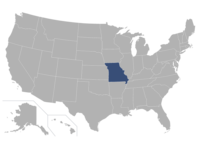
Jefferson City, MO