Governor, EPA administrator tout cleanup, development actions at Columbia Falls Superfund site
Sep 19, 2026 | 7:55 am ET
Description
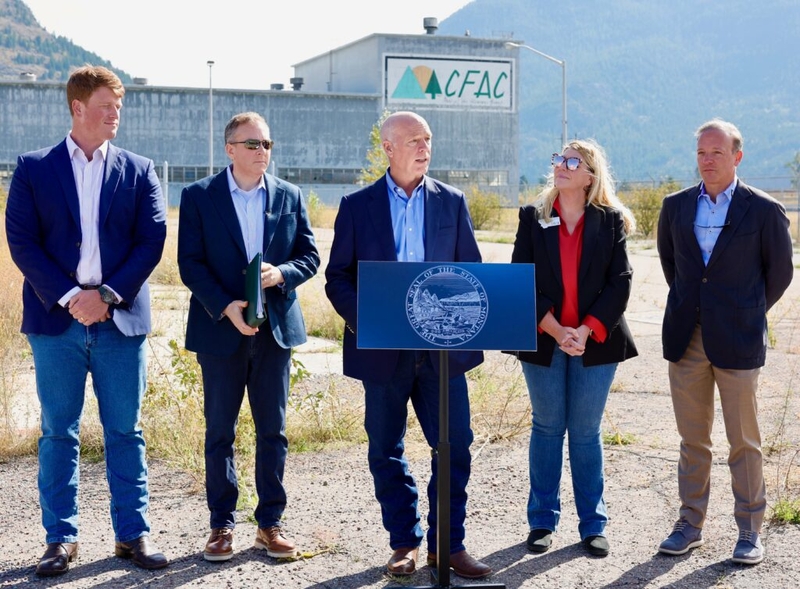
Gov. Gianforte (center) and Administrator Zeldin (center left) hosting a press conference at an EPA Superfund site in Columbia Falls. (Courtesy photo)
COLUMBIA FALLS — A new subdivision is under development within the boundaries of a federal Superfund site, the first use of the Columbia Falls Aluminium Company plant property since the plant closed in 2009.
The 78-acre development by Mick Ruis will bring more than 400 housing units, and eventually commercial development, to the site, and on Thursday, Gov. Greg Gianforte and Environmental Protection Agency Administrator Lee Zeldin praised it as part of a successful future for the blighted area.
“One of the most exciting steps of the Superfund process is being able to delist a project at the end of it, to be able to get an important vision not just started, but completed,” Zeldin said during a press conference. “Fortunately, we are at a very important milestone moment here in Columbia Falls, where there is just so much incredible progress imminently ahead on this project.”
The Columbia Falls Aluminum Company, known as CFAC, began operation in the 1950s, importing alumina and converting it into aluminum, supporting thousands of jobs in the Flathead Valley, but creating hazardous waste byproducts from the smelting process.
In 2016, the site received official Superfund designation from the federal Environmental Protection Agency, and this year a $57 million cleanup agreement was reached between CFAC, owned by the Swiss commodities firm Glencore, Ltd., and the federal government.
Touring the property on Thursday, Zeldin and Gianforte both complimented the work by Ruis, a major developer in the Valley, who purchased a huge swath of the property that has been controversial among local residents.
Residents and city officials have raised issues of having a major development in a wildlife corridor, straining city services, and whether there are additional health and safety concerns due to the proximity to a federal Superfund site.
But the development has been approved by the city and both the EPA and Montana Department of Environmental Quality have said the site does not require cleanup and is cleared for development, according to local reporting.
During the plant’s productive years, hazardous waste materials like cyanide, fluoride and arsenic were deposited in repositories around the CFAC site, which can be picked up by groundwater as it moves towards the Flathead River.
A major part of the cleanup process includes constructing a slurry wall that will be injected below the repository site to prevent further groundwater contamination.
Constructing the slurry wall is expected to be completed in 2029.
The cleanup will also include lining a nearby overflow ditch, adding a landfill to contain contaminants without having to transport them off site, and long-term monitoring of the remedy’s effectiveness.
“Our main goal with cleanup is to protect the Flathead River and cut off that clean groundwater from encountering the waste source,” said plant Superfund Project Manager Allie Archer.
In his comments to the press, Gianforte echoed Archer’s sentiment and highlighted the agreement signed between the EPA and Montana Department of Environmental Quality detailing what the cleanup plan would be, an agreement that followed years of scrutiny by watchdog groups.
“This is going to address the contamination, hazardous materials, and eliminate exposure to prevent contamination of groundwater and the Flathead River, which is right over here, near and dear to my heart,” Gianforte said, adding that he and First Lady Susan Gianforte recently camped on the banks of the Flathead River. “It’s great to see the cleanup efforts underway today to address the hazardous contaminants and return the site to productive use.”
Montana has nearly 20 federal Superfund sites, and DEQ administrator Sonja Nowakowski said the state is seeing progress at “nearly all of them right now.”
Helena, MT