Utah Fits All school voucher program’s review is up: Here’s how $94.7 million were spent
Sep 18, 2026 | 3:31 pm ET
Description
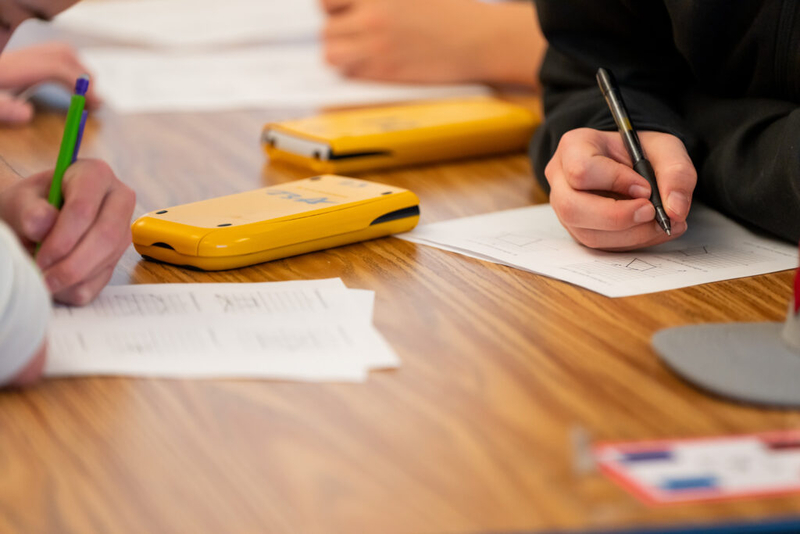
Students work in a math class at Wasatch Junior High School in Salt Lake City on Tuesday, March 12, 2024. (Photo by Spenser Heaps for Utah News Dispatch)
When John Arthur, a Democratic representative from Holladay, read a recent report on how the Utah Fits All funds were spent last school year, he let out a big sigh. Utah’s school choice program is one of the issues that has deeply split the state Legislature. And for him, it’s an issue that’s very close to home.
A report that Odyssey, the program manager for Utah Fits All, filed to the Legislature this month discloses how $94.7 million the state allocated for the program was spent during the 2025-2026 school year. After lawmakers approved tweaks to further limit the expenses families could cover with the scholarship dollars, the report looks different than last year, when items like ski passes and chaperone expenses for field trips were allowed.
Arthur, also an elementary school teacher, acknowledged the program has become more restricted. Still, he says the purchases are extravagant, especially when he pays for some supplies for his classroom out of his paycheck.
“On a personal note, it kills me as I go through this report and I look at the things that the money was spent on and and then I look at my own personal budget and look at the money that I spend on Kleenex boxes and food and other supplies that I bring into my classroom for my students,” Arthur said, “while this money is just going straight from the legislature either into private schools and religious schools or into the homes of the people who are receiving it.”
According to the report, 14,522 students used the program. About $57 million was spent on tuition and fees in private schools and about $27 million on educational goods, like software and applications, supplies, electronics and textbooks, among others.
Utah Fits All voucher program will continue until Utah Supreme Court rules on its constitutionality
Some of the largest specific expenses for goods were for art supplies (about $1.9 million), learning manipulatives ($2.5 million), STEM kits ($2.3 million), curriculum textbooks ($2.2 million), laptops ($2.3 million), tablets ($1.3 million) and 3D printers ($1.1 million).
For Arthur, the electronics purchases are one of the things that make him most concerned about the program, especially since the Legislature has started efforts to keep children off screens, including a default ban on cellphones during the school day. Also, he said, because other students in the state don’t have the same opportunities.
“There’s $468,000 listed here for headphones. I had to do a donation drive to get headphones that had microphones into my classroom, so that my multilingual learners who have to take the WIDA test (an English language proficiency assessment program) every February can practice with headphones that have microphones. I had to ask for charity. I had to ask friends to donate to that fund,” he said. “Meanwhile, you’ve got the Utah Fits All voucher program using tax dollars to buy people headphones that they just get to keep.”
However, program proponents like Utah House Majority Whip Candice Pierucci, a Republican from Herriman, see the report under a much more positive light, especially since the Legislature made substantial changes to ensure expenses “have a clear nexus and tie to education.”
With reduced scholarship for homeschool students, Utah Fits All update poised to become law
“There is no other education program in our state that we audit annually and have it meet such rigid financial requirements. So, in this program we are certainly being mindful of taxpayer dollars, and we also recognize that not every child is going to fit into one system,” Pierucci said. “We do not believe in a one-size-fits-all approach. We believe in empowering parents to make decisions that are best for their kids.”
Last year, lawmakers reduced the annual scholarship amount for homeschool learners, from $8,000 to $4,000 for students 5 to 11 years old. Students 12 to 18 years old could get $6,000, while private school students are still eligible for $8,000 a year to help cover their tuition or other expenses.
That led to a change in the proportion of students who use the vouchers for homeschool education. About 80% of recipients last year were homeschooled. This year, that number went down to almost 48%, while the remaining 52% of students went to private schools.
There was also a 20% cap for extracurriculars and physical education, and the clear exclusion of ski passes, furniture, musical instruments, apparel and other items from the allowable expenses.
Amid the fracturing debate in the Legislature, Pierucci finds the notion of the Utah Fits All program taking away from public schools disingenuous, she said.
“Over the past five years, the state legislature, we in the majority caucus, have increased state funding for public education by 1.8 billion, which is a 44.2% increase. So we have increased education funding, despite the fact that enrollment is declining as fertility rates start falling,” she said.
She also contested a major argument program detractors make: that not all Utah children have access to it. She said that any family in the state can apply for the scholarship, and that regular school districts offer similar programs, like speech therapy, art or gym classes.
“I’m not seeing the disconnect here on kids in this program getting something different than kids whose families are choosing to go to a district or charter school,” she said.
That question is expected to be answered in court, when the Utah Supreme Court makes a decision on the program’s constitutionality.
A 3rd District judge declared last spring Utah Fits All was unconstitutional, saying it was a “program within the public education system that is not free and is not ‘open to all the children of Utah,’” and diverts constitutionally appropriated funds from already underfunded public schools.
The program was allowed to continue as Republican state leaders appeal that decision and wait for a final say from Utah’s highest court.
Utah’s largest teacher union, which filed the lawsuit against the program, didn’t comment on the report’s content. But, leaders said they hope to prevail in court.
“Public money belongs in public schools. Last year, Utah’s Third District Court ruled the state’s voucher program unconstitutional and we will continue defending that ruling,” UEA President Renée Pinkney said in a statement. “Our tax dollars should support public schools, where more than 90% of Utah students attend.”
Apart from tuition and goods, over $10.6 million of the scholarships were used for services, including after-school or summer programs, educational therapies and tutoring services.
Under Odyssey, the cost of administering the program for the 2025-2026 year was $4.8 million, about half of the $9 million the Utah State Board of Education awarded last year to ACE Scholarships, the past Utah Fits All program manager, before terminating the company’s contract “for convenience” after just one year.
Salt Lake City, UT