Arkansas reports fewer failing schools and school districts in 2025-2026
Sep 17, 2026 | 6:25 pm ET
Description
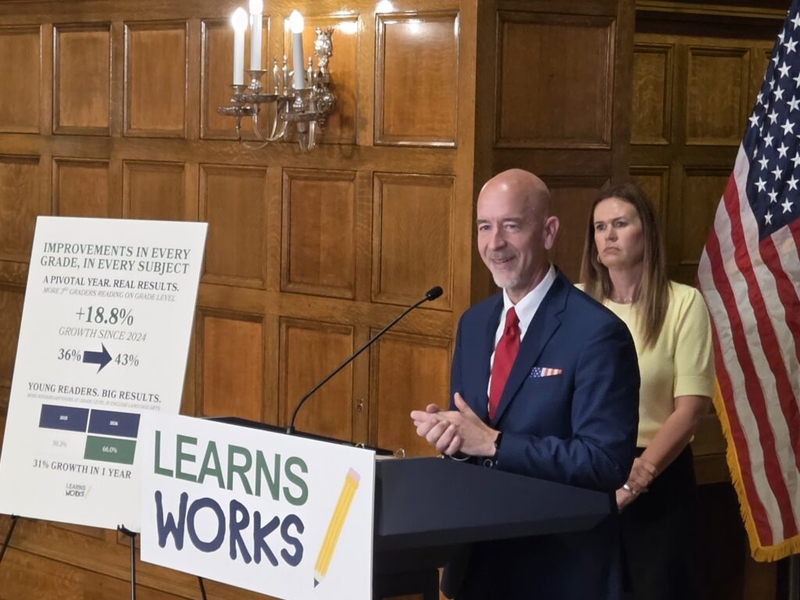
From left: Arkansas Education Secretary Jacob Oliva and Gov. Sarah Huckabee Sanders tout the improvements in public school students' test scores at a press conference at the Arkansas Capitol on June 18, 2026. (Photo by Tess Vrbin/Arkansas Advocate)
The percentage of Arkansas schools and districts receiving failing or low grades from the state for their performance has decreased, according to data released by the state Department of Education Thursday.
Arkansas Gov. Sarah Huckabee Sanders and education officials touted the numbers as validation for her signature 2023 education law, the LEARNS Act. Education Secretary Jacob Oliva told reporters Thursday that “the improvements that we’ve made by building out this blueprint and this system are showing more students are performing at or above grade-level.”
Arkansas public and charter schools are assigned an A-F ranking by the education department, based on Arkansas Teaching, Learning & Assessment System standardized testing scores, individualized growth targets for students and, for high schools, post-graduation readiness.
The percentage of schools receiving a D or F during the 2025-2026 academic year decreased, according to data released Thursday. One hundred and nine schools that previously received a D or F improved to at least a C in 2025-2026.
Schools receiving a B saw the largest increase, with 350 receiving the ranking, 58 more than the previous year.
However, 80 schools lost ground. Of the 613 schools that scored a B or C last year, 68 scored a D or an F this year, and 12 of last year’s D schools received an F this year. The majority of those 80 schools were given C grades last year.
Schools that received an A grade last year mostly maintained high grades this year, though nearly a third of them fell from an A to a B. Schools that received a B saw similar patterns. While 39 schools improved from a B to an A, 79 fell to a C grade.
School district grades showed similar results. Seven of the 11 districts that scored an F last year were given at least a C this year — though the remaining districts did not improve. However, 11 districts that receivved a B or C saw their grades fall to a D or an F.
In all, nearly 45% of Arkansas’ 1,047 schools neither improved or worsened. At the district level, 58.5% of the state’s 258 districts neither improved or worsened.
Oliva said struggling districts that took advantage of the support offered to them for improvement saw the biggest gains.
“Every D and F school got assigned a literacy coach. Every D and F school had access to high-impact tutoring,” Oliva said. “Whenever we focus on students’ needs, those schools saw outstanding increases in achievement and learning gains.”
Oliva pointed to the North Little Rock, Crossett, and Fordyce school districts as examples. All three increased their grades from an F to a C this year.
“Those districts acted with intentionality and saw significant gains in overall student performance,” Oliva said.
This year is the second year the education department has graded school districts, Oliva said. Arkansas has provided letter grades for schools for several years, but revised the formula for how those grades were assigned after the LEARNS Act.
Arkansas has made several educational changes as a result of the LEARNS Act, which Sanders, a Republican, signed in 2023. The overhaul of the state’s K-12 education system included an increase in the state’s minimum teacher salary to $50,000 and the creation of a school voucher program.
“Three years later, the results continue to speak for themselves: test scores are up, and more school districts are improving than falling behind, building on the historic gains we saw in this year’s ATLAS scores,” Sanders said in a press release. “Arkansas teachers and schools are helping students achieve more, our schools are getting better and LEARNS is working.”
The law has faced criticism from Democrats and some Republicans who have raised concerns about the impact of the voucher program on public schools and its cost to the state. Democratic Sen. Fred Love, who is challenging Sanders in the governor’s race, has promised to sign an executive order ending the voucher program if he’s elected.
Arkansas school rating system should consider additional factors, superintendents say
April Reisma, the president of the Arkansas Education Association, criticized the letter grades, saying it was “questionable to measure schools using the current method.”
She said judging public schools by a “rigid test-based A-F system” undermines claims of transparency when private schools receiving taxpayer dollars through the school voucher program do not have to be graded, release standardized test results or meet comparable accountability rules.
Education officials created the new formula to go along with the new state test, the Arkansas Teaching, Learning & Assessment System, also known as ATLAS, which replaced the discontinued ACT Aspire and was first administered to students in spring 2024.
“Our schools deserve to be measured on everything they provide for children, with the weight of what they face with limited resources counted in that mix, not just results from end of year tests that do not fully measure the growth of a child or the ability of an educator,” Reisma said in a statement.
Oliva said during the press call that differences in standardized test scores in schools with higher poverty rates or with more students with disabilities was accounted for during the letter grade redesign, which was why some schools or districts with more of those students may still be given an A.
“So all those mitigating factors, regardless of programs that you’re in, demographics, regions of the state, are calculated for in building out a very statistically significant growth model,” Oliva said. “If kids are learning, you’re going to get a good grade.”
Last year was the first year schools were fully assessed under the new grade system, with grades in the 2023-2024 academic year being simulated based on the first administration of the ATLAS test.
Little Rock