Auditor: Employee salaries rose for governor’s and secretary of state’s offices
Sep 17, 2026 | 6:07 pm ET

Description
The Iowa Capitol on Feb. 25, 2025. (Photo by Kathie Obradovich/Iowa Capital Dispatch)
Employee salaries in the Iowa governor’s and secretary of state’s offices increased by double-digit percentages over the past decade, a report released Thursday by Iowa Auditor Rob Sand shows.
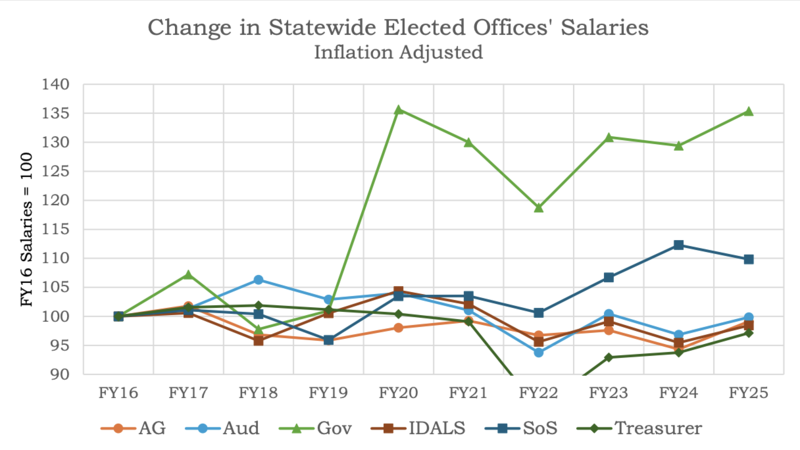
The report shows that in inflation-adjusted figures, executive branch salaries declined over the past 10 years by 7.6%, but when looking at individual offices within the branch, the governor’s and secretary of state’s offices increased employee salaries over the period.
“With deficits of more than a billion dollars every year over the state, and inflation adjustment cuts to education and Medicaid, as well as incoming cuts from the Big Beautiful Bill, we think it’s important to take a fact-driven look at aspects of state spending, including employment in the executive branch,” Sand, who is running for governor in the 2026 election, said at a news conference Thursday.
According to the report, inflation-adjusted salaries in the governor’s office increased 35% during the time period and salaries in the secretary of state’s office increased 10% over the same time.
The report analyzes executive branch compensation, employment trends and travel reimbursements for the fiscal years between 2016 and 2025. While this time frame coincides with Gov. Kim Reynolds’ time in office, Sand said that was not intentional. The time frame, he said, was chosen to show a 10-year trend and to include “a good amount” of time before and after the COVID-19 pandemic.
The report compares pre-pandemic averages, encompassing fiscal years 2017 through 2020 and post-pandemic averages, fiscal years 2022 through 2025. When comparing average salaries, in inflation-adjusted figures before and after the pandemic, the salaries at the governor’s office increased 16%, and 7% at the secretary of state’s office. Salaries at the other analyzed branches decreased between 1% and 9%.
In 2024, Reynolds’ office received a higher standing appropriation from the Legislature. Public records requests analyzed by Bleeding Heartland found Reynolds subsequently raised the salaries of top officials in the office.
Reynolds’ office, in a statement about Sand’s report, said “the most important investment any organization makes is in its people.”
“Government should be no different,” the statement said. “Governor Reynolds has built a strong team of experienced professionals, recruiting executive branch leaders from other states and members of her own staff from the private sector. She’s prioritized hiring senior level staff members with expertise in relevant areas.”
Sand said Reynolds’ 2023 plan to reorganize and consolidate state agencies made it “really difficult” to track numbers at individual departments, as some employees moved departments under the reorganization plan.
The report notes that it “attempted” to adjust for changes in department names by recoding the salary book data set. With these figures, the auditor report found that the Department of Health and Human Services, the Department of Corrections, and the Department of Transportation have accounted for 54% to 57% of all full-time executive branch employees since fiscal year 2021.
While these departments account for more than half of executive branch employees, the report said the reorganization changes made it “infeasible” to make “department-specific comparisons from one period to another.”
Instead, the report compares employee salaries at offices with statewide elected officials, as it said these offices — attorney general, auditor, governor, secretary of agriculture, secretary of state and treasurer, were “widely unaffected by the state government reorganization.”
Based on this comparison, the report concludes that all offices aside from the governor’s office and secretary of state’s office paid inflation-adjusted salaries to employees that were “roughly equal to or slightly lower than the salaries paid a decade earlier.”
A statement from the secretary of state’s office said that while the office had not been given a copy of the report to review, it “navigated significant crises” like the pandemic and “rising cyber threats” during the examined period.
“While we don’t have all of the facts in front of us as to how the report was generated, we are confident that our staff is paid fairly and competitively,” the statement said.
The spokesperson for the office also noted that Secretary of State Paul Pate has not had a raise over the period and that the office has “invested significantly” in full-time, specialized IT and cybersecurity roles that “many similar agencies have contracted” to other agencies or vendors.
The spokesperson said the office has also invested in training and development divisions to account for an increased turnover in election workers and county auditors.
More temporary workers and more turnover
The report detailed an increase in the number of seasonal, temporary, or intern positions, which also caused an increase in the overall number of salaried staff in executive branch offices. According to the report, in 2016 employees with these titles accounted for 1% of total staff numbers and about 9% of total staff numbers in 2025.
The Iowa Department of Agriculture and Land Stewardship and the auditor’s office had the highest increase in part-time or seasonal employee figures of the analyzed offices. IDALS increased staffing in the category by about 43 when comparing pre-pandemic and post-pandemic averages. Sand’s office increased by about 6. The secretary of state’s office decreased its use of interns, part-time or seasonal employees by 2 and the governor’s office remained at an average of 0 temporary employees before and after the pandemic.
Sand said the increase in temporary employees likely contributed to the increased turnover rates seen across the executive branch. He also said it “definitely impacted the salary increases” since temporary employees would not be eligible for the same salary increases or benefits as full time employees.
“At the end of the day, if you see an increase in turnover, you have to ask yourselves whether or not the increase in turnover is costing you what you might have saved by not hiring full-time employees,” Sand said.
Executive branch spending on travel and subsistence has also declined during the period, which Sand said “isn’t surprising” since the pandemic opened up more opportunities for remote work and meetings. Comparing pre-pandemic spending to post-pandemic spending in the category, the report notes a more than 21% decline in inflation adjusted dollars.
Sand said Thursday he had not consulted other offices in the executive branch about the increases shown in the publicly available data.
“When we saw the numbers, we just thought that this is an important conversation to be having,” Sand said.
He said while an overall reduction in salaries “can be a good thing” the “taxpayer’s watchdog” needs to look at how dollars are being spent in state government.
“We really need to think about balancing, making sure we’re balancing the prudent use of taxpayer resources, while also actually delivering to Iowans what they need from their own government in a timely manner too,” Sand said.
Des Moines, IA