There’s a name for working families who are surviving but not thriving in Rhode Island: ALICE
Sep 17, 2026 | 5:35 pm ET
Description
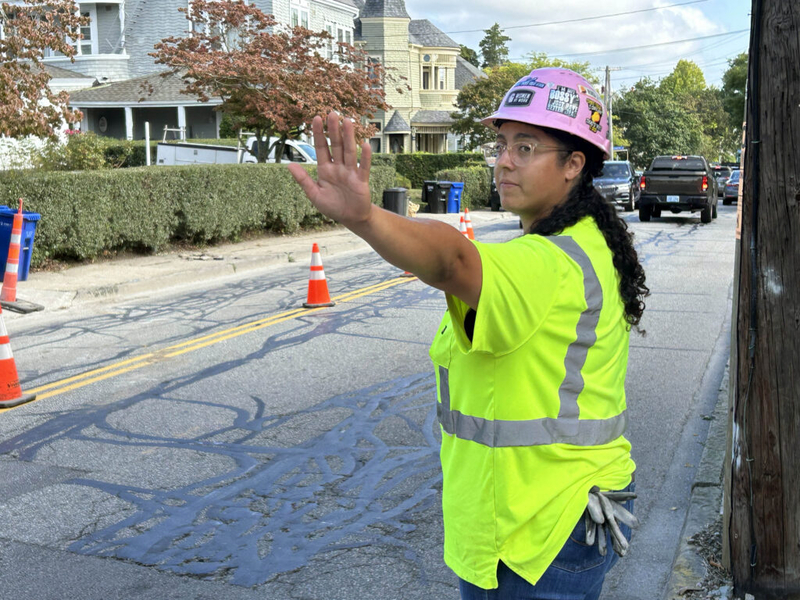
Ashlynn Jorge, 26, a laborer with CCS of Johnston and mother of two, handles traffic control while her coworkers rebuild a sidewalk on Kay Street in Newport on Thursday, Sept. 17, 2026. (Photo by Janine L. Weisman/Rhode Island Current)
In her neon yellow shirt and pink hard hat, Ashlynn Jorge extended her arm and held her palm out to halt traffic approaching a sidewalk construction site on Kay Street in Newport shortly before 10 o’clock Thursday morning.
But the 26-year-old union laborer can’t stop the bills.
Jorge earns about $4,800 a month. But rent for the three-bedroom house in East Providence where she lives with her boyfriend and their two children, ages 6, and 3, is $2,500 a month. The lease on her Hyundai Palisade is $767 a month. Food, utilities and other expenses eat up the rest of her income.
It costs less for her boyfriend, also 26, to stay home and take care of their son and daughter than for him to work and pay for childcare, she said.
“Live paycheck to paycheck,” said Jorge, who gets up each workday at 4:30 a.m. “I try to give my kids what they deserve, so I try my best to work overtime sometimes.”
The gap between earnings and the cost of basic living is the focus of a new report from the United Way of Rhode Island released Thursday morning at the same time Jorge and her coworkers were rebuilding a section of sidewalk.
Jorge’s income is well over the $33,000 federal poverty threshold for a household of four. But that still means her family is among the nearly one in three Rhode Island households working and struggling to afford adequate food, housing and health care, unable to save money for the future.
There’s a name for these households: ALICE.
‘Survival budget’
The acronym stands for Asset Limited, Income Constrained, Employed, an economic space occupied by those who work but don’t earn enough to afford the essentials where they live. The United Way’s report, “ALICE in Rhode Island: A Study of Financial Hardship,” concluded that a Rhode Island family with two working adults and two young children would need to earn $111,000 annually to afford their basic needs. And this so-called “survival budget” still does not account for unexpected expenses like home or auto repairs, extras like vacation and dining out, and saving.
Rhode Island had 446,751 households in 2024. Of this number, 131,627, or 29.46%, were ALICE. When combined with the 58,903 households in poverty, that adds up to 190,530 below the ALICE threshold, or about 43% of all households in the state.
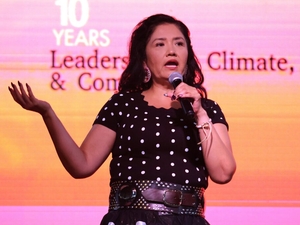
“We really wanted to put into place, like what it actually looked like to survive,” Cortney Nicolato, president and CEO of United Way of Rhode Island said during an event at the Community College of Rhode Island’s Warwick campus. “Our survival budget includes things like technology and food and childcare, and elder care if it’s not childcare. Really, what we wanted to illustrate is what families were dealing with and how that affects them.”
Nicolato said the report should prompt new conversations about just who we think of when we picture someone who is struggling to make ends meet. Members of the ALICE club include recent college graduates unable to move out of their parents’ house, young families strapped by childcare costs, underemployed mid-career professionals and the blue-collar workers essential to a functioning economy.
We really wanted to put into place, like what it actually looked like to survive.
Occupations with the largest share of ALICE workers included construction laborers, food servers, landscaping and groundskeeping workers, and cashiers, according to the report.
The United Way is looking to develop personalized analysis for employers to inform initiatives for transportation and childcare options to benefit employees, Nicolato said. Additionally, there will be conversations with lawmakers about increasing programs to support families in their communities, especially in Providence County where the highest share of ALICE households are.
“ALICE is an opportunity to really understand our constituents here in Rhode Island and what they’re facing,” Nicolato said. “We’ve been sharing this with all leaders.”
Among the report’s other findings:
- 63% of Hispanic households and 56% of Black households fall below the ALICE threshold.
- In the workforce, ALICE can claim 76% of childcare workers, 64% of construction laborers, and 50% of cashiers, waitstaff, and landscapers; all are among the state’s 10 largest industry sectors.
- 64% of households headed by people age 65 and over are ALICE, the fastest-growing age demographic in the state.
- Only 38% of ALICE households in the Northeast reported in 2024 having emergency savings or rainy day funds, compared to 77% of those over the ALICE threshold.
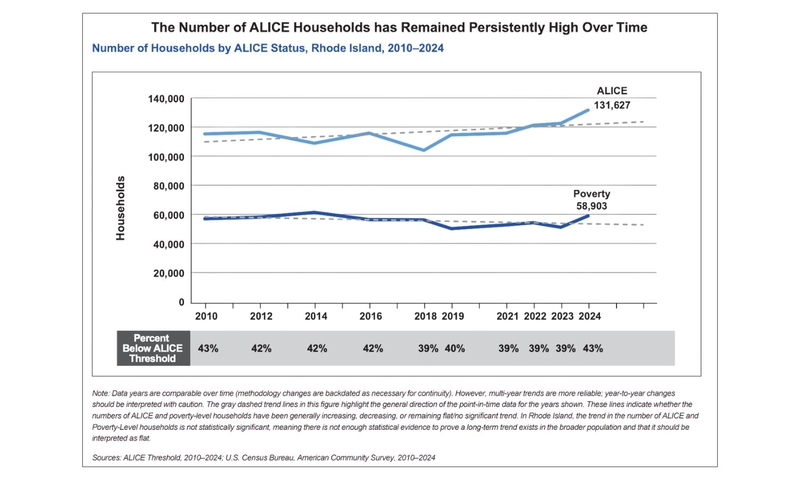
The report relied on the U.S. Census Bureau’s American Community Survey for data on the income of households below the ALICE threshold. It shows the number of ALICE households remained high from 172,201 in 2010 to 190,530 in 2024, wavering between 39% and 43% of all households in the state, through years of economic shifts, changing political administrations and a pandemic.
Erin Spaulding, executive director of Connecting for Children & Families, a social service agency in Woonsocket, said the report offers a new way to think about who is struggling.
“This is not people asking for freebies,” Spaulding said. “These are working people that are not trying to live on the system or have somebody else take care of them.”
Jorge has worked in the trades since she graduated from high school. She usually works until 3 p.m. When she gets home, it’s the first time her kids have seen her all day.
“The kids miss me all day, so they’re all over me,” she said. “I play with them, cook dinner together, bedtime stuff.”
On rainy days when she gets out of work early, she can pick up her son after school and chat with other parents. And what topic comes up the most?
“The struggle of like paying bills and being overwhelmed with activities from school that cost money and like we can’t afford it,” she said. “It’s a lot.”
Reporter Christopher Shea contributed to this story.
Providence, RI