Tennessee Democrat to propose bill to ban corporations from political spending
Sep 17, 2026 | 6:02 am ET
Description
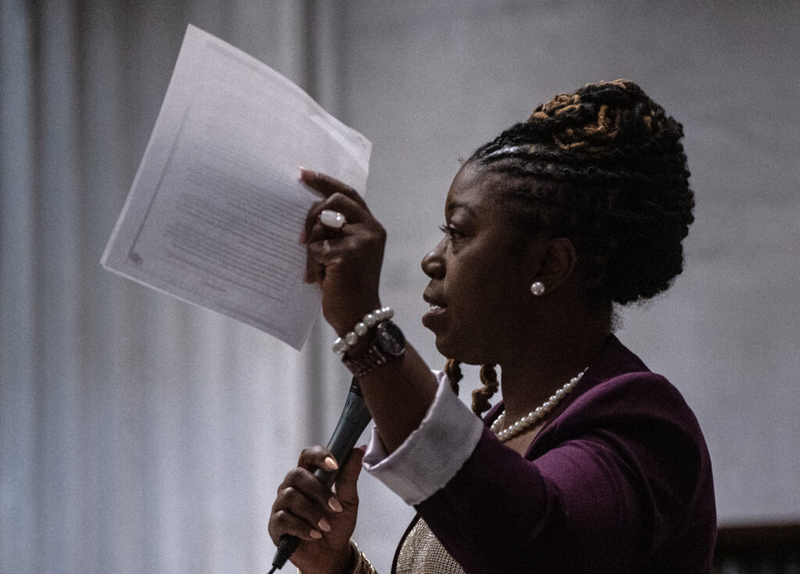
State Sen. Charlane Oliver, a Nashville Democrat, plans to propose a bill to ban corporate money in politics. (Photo: John Partipilo/Tennessee Lookout)
A Tennessee Democrat is set to push for new restrictions on corporate campaign spending, following the seminal steps of a movement to limit dark money in politics.
State Sen. Charlane Oliver, a Nashville Democrat, said she plans to introduce a bill in January mirroring a move by Hawaii to ban corporations, unions and dark money organizations from spending money in state politics as a condition of receiving a state business license.
Montana voters will have the chance to adopt a similar bill as part of a November ballot measure.
“Right now, we have money being tossed around, and the corporate interests get everything they want and the Tennessee taxpayers get stuck with the bill,” Oliver said.
The legislation, called the Corporate Power Reset Act in other states, would ban any group that must form as a business in Tennessee from donating money to political campaigns as a condition of receiving its operating license.
The legislation comes from the Center for American Progress, a progressive think tank that, among other issues, has been urging lawmakers across the country to address the influx of corporate money into politics.
The U.S. Supreme Court ruled in the Citizens United case in 2010 that a ban or limits on independent spending was unconstitutional. This effect was corporations, unions or other organizations like dark money groups sometimes called 501(c)4s, could spend unlimited amounts in elections as long as it was spent independently.
Michael Beckel, the Money in Politics Reform Director at One Issue, said the proposed law is about rethinking corporate power.
“The way that we now think about artificial persons, i.e., corporations having all of the same powers and privileges as natural persons, doesn’t need to be that way,” said Beckel. “The foundation of this legal theory is that artificial persons should be treated differently than natural persons.”
One Issue is a nonprofit founded to reduce the influence of money in politics through bipartisan reform and supports states passing the Corporate Reset Act.
Tennessee and the federal government limit how much candidates can raise from corporations and dark money groups. But because of Citizens United, these dark money groups can raise unlimited sums of money, never disclose their donors and spend the money in elections without limits.
Oliver said one of the most prominent examples of money’s “corroding influence” in Tennessee politics was the passage of a universal private-school voucher program.
Pro-school voucher groups spending tops $4.5 million in Tennessee Republican primaries
In 2024, Tennessee lawmakers failed to pass the universal statewide voucher plan. But that election year, the School Freedom Fund spent more than $3 million to ensure pro-private-school voucher candidates were elected to the Tennessee General Assembly.
The School Freedom Fund is affiliated with Club For Growth, which has raised millions of dollars from New York finance billionaire Jeff Yass.
The School Freedom Fund flooded specific state House and Senate districts during the Republican primary with advertisements supporting pro-voucher candidates and tearing down voucher opponents with a smear campaign.
Lawmakers revisited a statewide private-school voucher plan in January 2025 and narrowly passed it.
“It’s a shame billionaires can wield millions of dollars and get vouchers passed,” Oliver said.
Nashville, TN