Senate confirms 2 more Utah Supreme Court justices, capping off era of change for the court
Sep 16, 2026 | 8:51 pm ET
Description
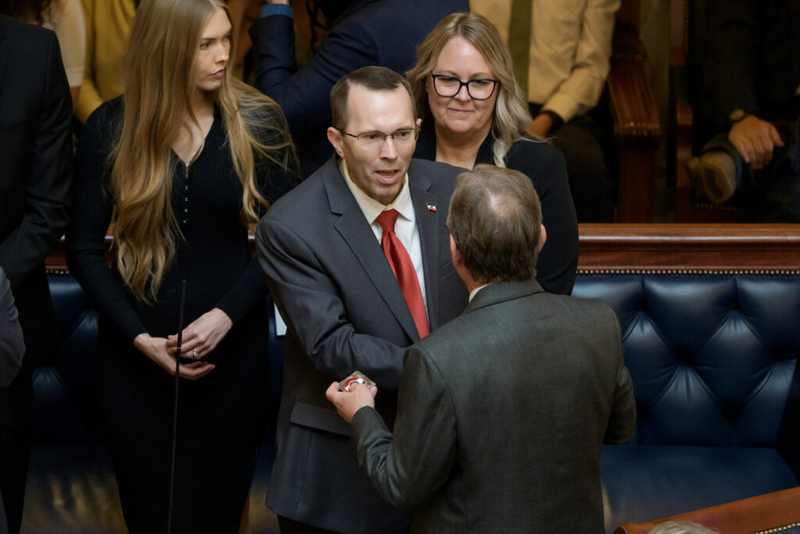
Matthew Bell talks with Senate President Stuart Adams, R-Layton, before being confirmed by the Senate as a Utah Supreme Court Justice at the Capitol in Salt Lake City on Wednesday, Sept. 16, 2026. (Photo by Spenser Heaps for Utah News Dispatch)
The Utah Senate has confirmed two more new justices to the Utah Supreme Court, capping off an era of major changes to the state’s highest court.
The Senate on Wednesday voted 26-2 to consent to the appointments of 5th District Judge Matthew Bell and civil litigator Michael Menssen. The two men will fill vacancies created by longtime Chief Justice Matthew Durrant’s retirement and the resignation of former Justice Diana Hagen amid controversy.
Bell and Menssen’s confirmations came after no floor debate and with relatively little controversy in the Senate chamber. Unlike the last pair of Utah Supreme Court nominees (when they questioned Jay Jorgensen’s residency qualifications), Utah Democrats didn’t put up a fight against Bell or Menssen’s appointments — though two, Sens. Nate Blouin and Kathleen Riebe, voted against both of them.
Cox appoints 2 more justices in year of major changes to Utah’s Supreme Court
Riebe said her no vote was because of the “lack of diversity” and “lack of women” in the Legislature and the state’s highest court, which up until recently was made up of a majority of women. With Hagen’s resignation and the two-seat expansion, now Associate Chief Justice Jill Pohlman and Justice Paige Petersen are outnumbered by five men.
Riebe said only a handful of women applied, and she questioned if that’s because they don’t feel comfortable.
“I rise in support of women who don’t feel comfortable applying for these jobs, and I rise in support of women that don’t see themselves in our government,” Riebe said.
Wednesday’s Senate floor vote came after the Senate Judicial Confirmation Committee, including its two democrats, voted unanimously on Monday to recommend both Bell and Menssen’s appointments to the full Senate.
The two confirmations complete what has been a near-total overhaul of the Utah Supreme Court, in part because of the Republican-controlled Utah Legislature moving earlier this year to expand the court from five to seven seats, as well as high turnover due to Durrant’s retirement in August, former Justice John Pearce’s retirement last year, and Hagen’s resignation in May.
Cox makes 2 picks to fill expanded Utah Supreme Court: A church attorney and a prosecutor
Last fall, Cox appointed John Nielsen to take Pearce’s place on the court. And earlier this summer, Cox picked Jorgensen and Stephen Dent, both attorneys, to fill the two-seat expansion of the Supreme Court.
Now that all five open seats have been filled, Cox has appointed six out of seven justices sitting on the state’s highest court all within the last year. Petersen was appointed by former Gov. Gary Herbert in 2017.
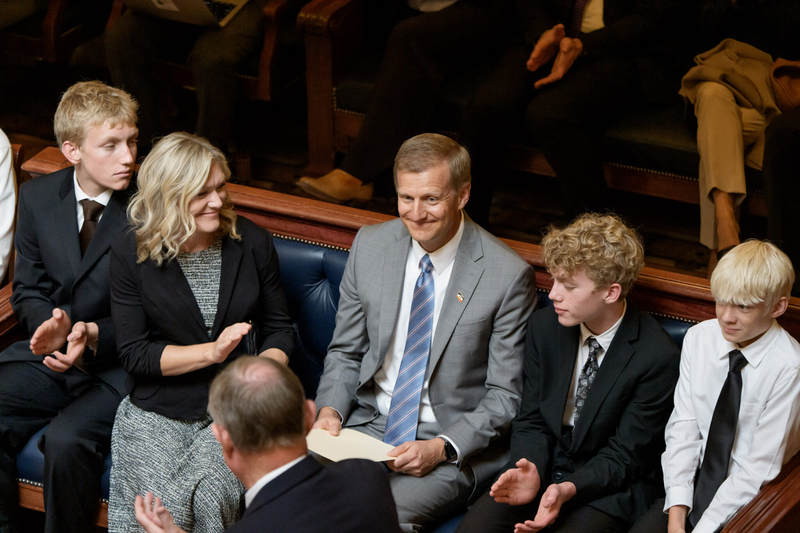
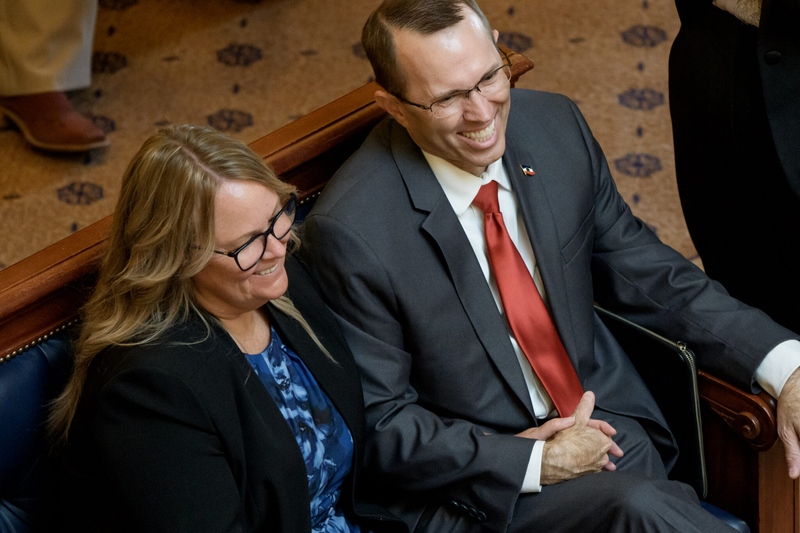
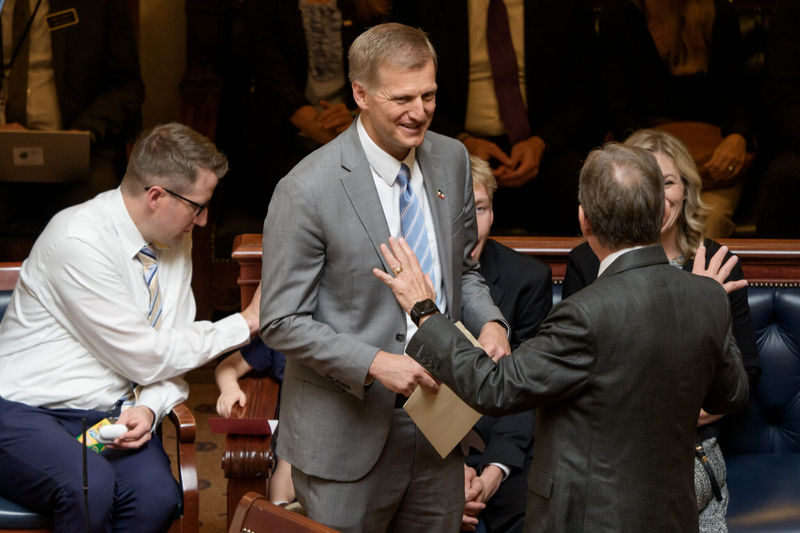
Bell and Menssen sat with their families on the sidelines of the Senate floor while senators cast their votes. Bell held his wife’s hand, and Menssen nodded and smiled as senators applauded him after the vote.
In a speech after his confirmation, Bell pledged to uphold the Utah and U.S. constitutions “without regard to political pressure, public opinion or personal preference.”
Menssen said that being “entrusted to interpret the Constitution and the laws of the state of Utah is a sacred responsibility.”
“I pledge that I will always give the position the work and the respect that it requires,” Menssen said.
Who are the court’s newest justices and what are their philosophies?
Bell has spent nine years as a 5th District Court judge in southern Utah, in a district that includes Washington, Iron and Beaver counties. He was previously an assistant U.S. attorney and a trial attorney in the U.S. Department of Justice’s antitrust division. He began his career as a corrections officer and police officer.
Menssen is an attorney who specializes in complex commercial and labor law. While announcing his appointment of Menssen, Cox described him as “one of the finest civil litigators in our state” and praised his work with groups helping to expand legal aid for low-income Utahns.
Menssen received his law degree from the University of Virginia, while Bell graduated from Brigham Young University.
During their two-day hearings in front of the Senate Judicial Confirmation Committee on Monday and Friday, both Bell and Menssen emphasized their focus on “originalism” and “textualism,” judicial philosophies that focus on the original meaning of the Constitution, as intended when it was written.
Cox and Republican legislators have emphasized originalism and textualism as important philosophies for future Utah Supreme Court justices to foster.
Court overhaul comes amid tension between Legislature, the courts
During the confirmation hearings for Bell and Menssen, Utah lawmakers didn’t ask the nominees to share their opinions about any specific case.
However, Republican lawmakers in recent years have loudly decried rulings from both the district court and the Utah Supreme Court, especially in an anti-gerrymandering lawsuit brought by the League of Women Voters of Utah and Mormon Women for Ethical Government that thus far has struck down the Legislature’s 2022 congressional boundaries as unlawful.
The courts replaced those boundaries with a court-ordered map that’s being used in this year’s elections after 3rd District Judge Dianna Gibson ruled the 2022 boundaries were the result of an unconstitutional process after lawmakers repealed and replaced a voter-approved 2018 law known as Better Boundaries’ Proposition 4, which created an independent redistricting commission that lawmakers couldn’t ignore and neutral map-drawing standards meant to guard against gerrymandering.
Utah Supreme Court rejects Legislature’s redistricting appeal; court-ordered map still stands
In 2022, after replacing Proposition 4 with their own law, the Legislature adopted new political boundaries that lawmakers drew themselves while ignoring the independent redistricting commission’s recommendations.
After deeming that 2022 map unlawful — and ruling the Legislature failed to adopt a lawful remedial map that abided by Proposition 4’s neutral standards — Gibson instead picked a map drawn by the plaintiffs in the case to be used for the 2026 elections.
That ruling infuriated Republican lawmakers, who argued Gibson stepped beyond her constitutional authority by ordering a map to be adopted rather than asking lawmakers to go back to the drawing board and try again to put a lawful map in place.
In the wake of those rulings and amid continued outcry over the anti-gerrymandering case, the Utah Legislature expanded the Utah Supreme Court — and passed a law giving the governor and the Senate say over who the high court’s next chief justice will be.
Questioning during confirmation hearings
While grilling Bell and Menssen during their confirmation hearings, lawmakers asked them varying questions that related to the Utah Supreme Court’s role when it came to “checking” the other branches of government, as well as how they would treat preceding rulings that they disagree with.
Bell and Menssen said their decision-making would always hinge on the constitution.
Sen. Todd Weiler, R-Woods Cross, asked: “What authority does a Utah judge have to tell the elected branches that they have violated the Utah Constitution, and what limits does the Constitution place on the judge’s own authority?”
Bell said the Utah Constitution “forbids judges from … the exercise of executive or legislative power.”
“Let me put it this way: Maybe it’s a mindset, but it’s important to me as a judge,” Bell said. “I don’t view myself as a check on the Legislature or the executive branch. I view myself as an independent branch of government, and the constitution itself is the check on all three of us.”
Bell said that while he has a “duty under the constitution to strike down government action on the legislative or executive side that exceeds those boundaries, first and foremost I’ve got to vigorously police the boundaries of my own authority.”
“Failure to do so is hypocritical, and I think that it undermines the public confidence,” he said. “If we call out someone for exercising … extra-constitutional powers, but in the same breath we’re stepping outside of our lane and violating Article V.” That article of the constitution establishes separation of powers between the three branches of government.
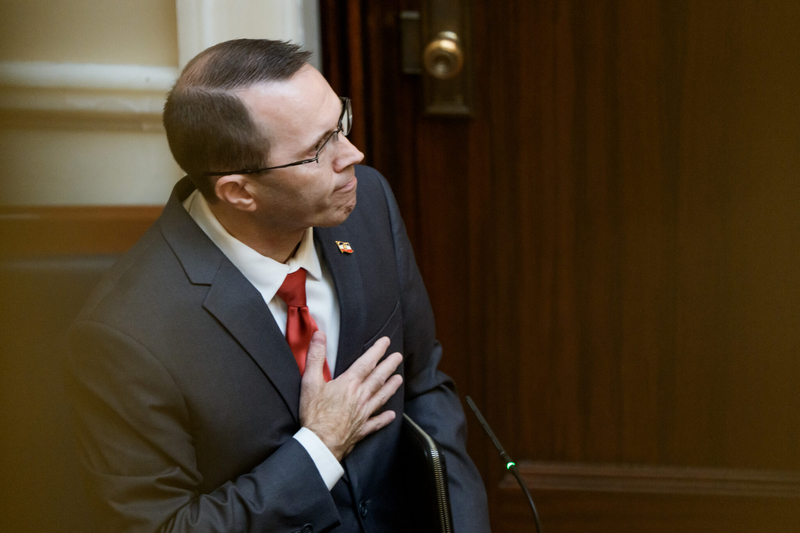
Weiler asked another question: “Imagine that the Utah Legislature passed a law that you strongly disagreed with, but the governor signed it and the public overwhelmingly supported it. But you conclude that it violates the Utah Constitution. What is your obligation as a judge in that case?”
“My oath is the constitution,” Bell said, “and ignore political pressure, public outcry, whatever. If I am convinced that it is in fact unconstitutional, then I have a duty to rule accordingly.”
Weiler also asked whether anyone associated with the executive or legislative branches had asked Bell within the last two years how he would vote on any case currently pending before the courts.
“No sir,” Bell said.
Weiler also asked if anyone has “indicated to you that your confirmation, to be successful, will be contingent on an understanding that you would rule a certain way.”
“Never,” Bell said.
Weiler also asked if there has ever been any “quid pro quo” offers to him.
“None,” Bell said, while adding that he told the governor during one of his interviews that “if he were to appoint me, I would not do his bidding, not do the bidding of the Senate or the House or anyone. My allegiance would be the constitution. (I) take that oath seriously, and I will support, obey and defend it.”
While questioning Menssen during Friday’s confirmation hearing, Sen. Brady Brammer, R-Highland, asked him to differentiate between “conservatism and originalism and textualism.”
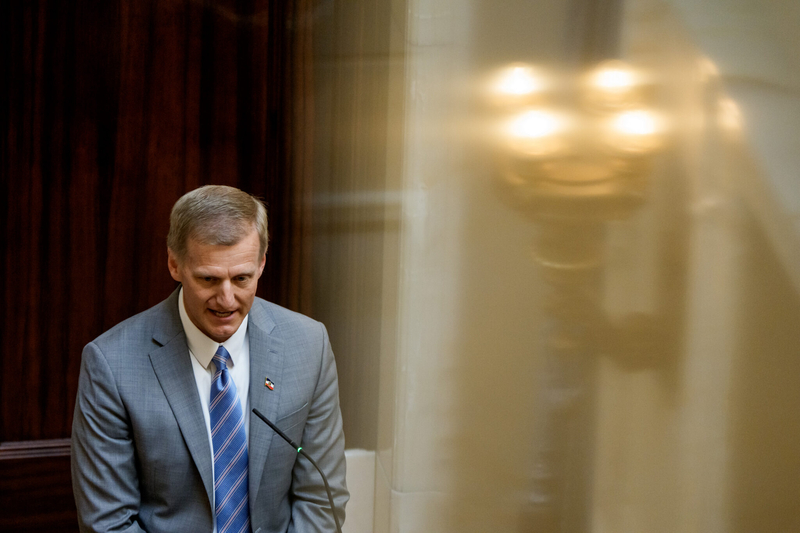
Menssen said there’s no “overlap between how those terms are used in the political sense and how they are sometimes used in the judicial sense.”
“Originalism and textualism are very process driven,” he said. “I believe they reflect basic facts about how the constitution creates law (and) sets forth a process for changing the law. At times, it seems like the media uses the term conservative as a coverall and applies it the same to the political world as the judicial world, and I think that is more confusing than helpful.”
Brammer noted that there are times when there are “conservative legislatures that take actions that originalist judges still strike down as unconstitutional.”
“Where Utah is a conservative state, that doesn’t mean that, you know, an originalist judge would refrain from being aggressive at protecting the constitutional rights of its citizens through the proper means of originalism and textualism,” Menssen said.
When asked by Sen. Stephanie Pitcher, D-Salt Lake City, during his confirmation hearing about “when it would be appropriate to overturn precedent,” Menssen said that when a case is “clearly wrong … it’s important to follow the law.”
“Precedent is not what we swear an oath to follow. That would be the constitution and the rule of law,” Menssen said. “And so, when a precedent is wrong, I would overturn it. However, I think it is an important check to make sure that my reasoning is sound.”
Salt Lake City, UT