Alabama Public Television board to survey residents on APT, PBS programming
Sep 16, 2026 | 6:01 pm ET
Description
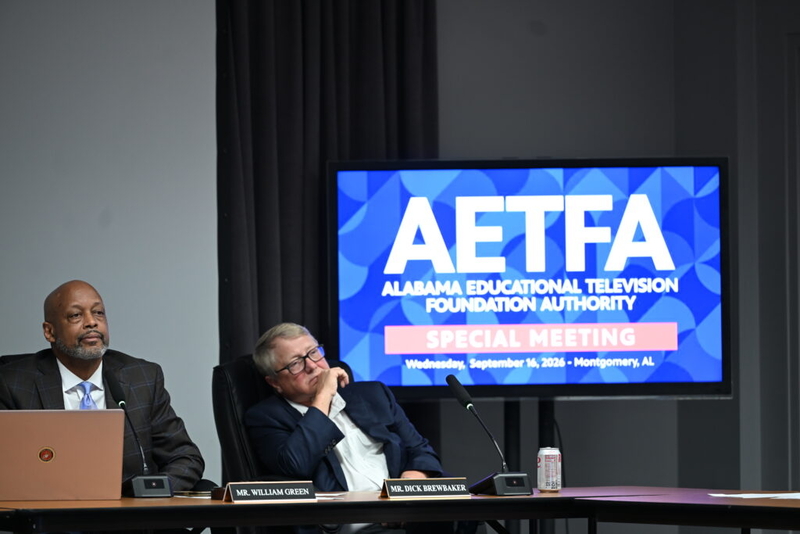
Alabama Educational Television Foundation Authority Chairman William Green (left) and authority member Dick Brewbaker, a former Republican state senator, listen during an AETFA meeting on September 16, 2026. (Andrea Tinker/Alabama Reflector)
Members of the Alabama Educational Television Foundation Authority Wednesday voted to fund a survey conducted by a Republican-leaning polling group amid disputes over its purpose and funding.
The survey, coming after an attempt by some authority members to disaffiliate Alabama Public Television from the Public Broadcasting Service, will be conducted by Cygnal, a polling firm that mainly works with Republican candidates, including U.S. Sen. Tommy Tuberville’s gubernatorial campaign.
After the meeting, Ferris Stephens, a member of the AETFA, said Cygnal was chosen because it’s a “very reputable company” and the questions provided by the company “speak for themselves.”
Alabama Daily News reported Tuesday that a draft script of the survey included questions about APT’s political ideology and the potential for APT to end its relationship with PBS.
According to a resolution Stephens read aloud at the beginning of the meeting, the survey will poll 600 people across the state and cost $39,500. Funds for the poll will come from APT’s rainy day fund.
The members passed the resolution on a 5-2 vote. Commissioners Pete Conroy and Tijuanna Adetunj voted against the survey.
Messages seeking comment were left with Cygnal Wednesday afternoon.
Two APT commissioners in October suggested dropping PBS after the Trump administration cut funding to the Center for Public Broadcasting. But the following month, members of the Alabama Educational Television Commission voted to maintain PBS programming amid a public backlash and after Gov. Kay Ivey recommended a survey before proceeding.
In April, the AETC voted to survey Alabamians on how they feel about the station’s programming. The survey was to be conducted by McLaughlin & Associates, a national survey company that has worked with several Republican candidates, including former Attorney General Jeff Sessions and U.S. Rep. Robert Aderholt, R-Haleyville.
The contract with McLaughlin fell through in late August. Conroy said during the meeting the cancellation was because “negative public opinion and news coverage concerning APT have reached an unprecedented level in Alabama.”
Prior to the vote, Conroy said he sent an email to all of the board members urging them to reconsider doing the poll. Conroy said he was met with negativity from some board members.
“I will share the one thing you (AETFA Chairman William Green) said in that email, and that was you asked me what was I afraid of, insinuating that somehow or another I was afraid of the answers to the questions that were being posed by this survey,” Conroy said. “I’m afraid that we’re losing public trust. I’m afraid that this whole process, Tijuanna, has been rushed. I don’t understand that. That’s never been explained.”
Members of the public also shared their concerns with the survey.
“Why endanger one of Alabama’s most cost-effective agencies with a no-bid political survey some of us fear the objectivity of?” said Jim Vickery, a former president of the University of Montevallo. “That’s why this process matters. It plays right into the perceptions that we already have that you’re doing this for political reasons, and that’s another reason why it’s outrageous.”
Elaine Witt, a retired APT donor from Birmingham, raised concerns about using the rainy day fund for the survey.
“The money in the rainy day fund is that money that we donated. That’s where they came from. It’s not budgeted. It’s not from the governor. It’s not from the legislature,” Whitt said.
Whitt also criticized the board for voting to spend nearly $40,000 on the survey, saying the foundation has done surveys in the past for less.
“You have the chairman of the commission picking out the survey company instead of your professional staff, which has been surveying Alabama’s for $6,000 instead of $40,000 a year— and he’s sitting over there shaking his head,” she said.
Alabama Public Television last conducted a survey in 2023 through Troy University, Samford University and the University of Alabama which cost less than $10,000.
Conroy said after the meeting he thinks doing the survey is “headed in a direction of polarizing public media.”
“I don’t think we need to politicize our public media,” Conroy said. “We need to stay in the middle as best we can and just report the facts as they are. Allow PBS to do what PBS does best, and that’s educate kids.”
- September 17, 20269:00 amUpdated on September 17 at 9 a.m. to correct the spelling of Witt's last name and occupation.
Montgomery