During Banned Books Week, librarians weigh threat of ‘soft censorship’
Oct 09, 2026 | 12:00 pm ET
Description
Photo courtesy of CT Mirror
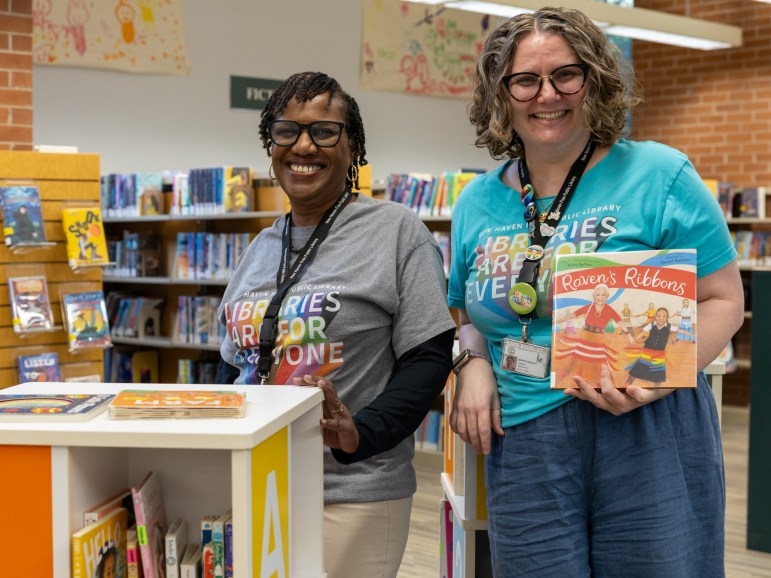
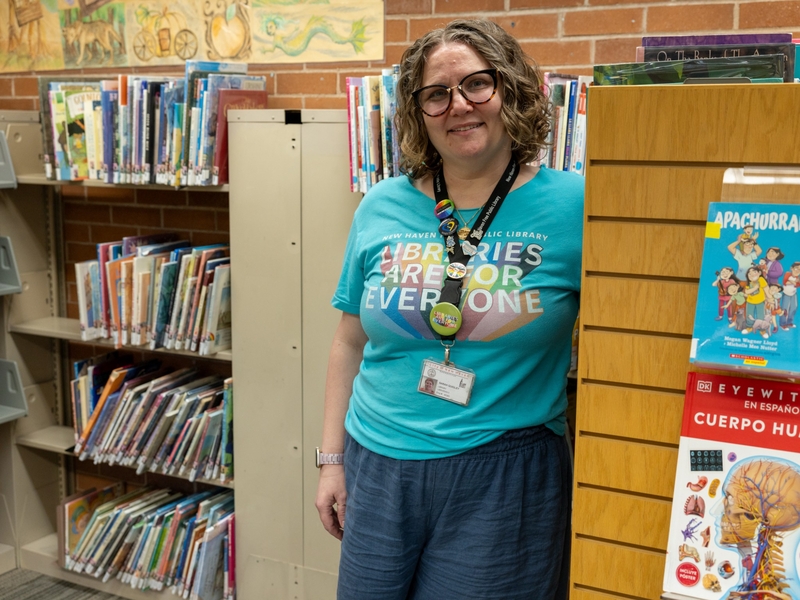
Children’s librarian Sarah Quigley still remembers when the call came in earlier this year, midway through a mid-morning storytime packed with young children. She had just finished Tasha Spillett’s “Raven’s Ribbons,” a book about a young Indigenous boy who wants to wear a ribbon skirt, and turns to his grandmother for guidance. At the end of the book, Spillett writes about two-spirit people, who have an expansive gender identity that exists outside of a binary.
Then a person from the neighborhood, who had heard about it via text from someone attending the story time, called the library. They were angry, and said the book pushed harmful gender ideology. On a round rug patterned with the ABCs in the library’s brightly lit children’s section, Quigley had moved from the book to a sing-along, unaware of the controversy.
Quigley, who is a children’s librarian at the Mitchell Branch of the New Haven Free Public Library, is one of an increasing number of people who work at Connecticut libraries who report noticing examples of “soft censorship,” a term that refers to books that are not formally banned or challenged, but have received complaints or informal challenges from patrons, parents, and “pressure” from special interest groups.
As the American Library Association (ALA) observes its 44th annual Banned Books Week, many library staffers are thinking through how to respond to this new chapter of censorship, from open discussions with concerned parents to small, meaningful interventions like bookmarks that let a patron know that if they remove a book with the intention of restricting access to fellow readers, librarians will replace it.
Launched by the ALA in 1982, Banned Books Week is a celebration of banned and challenged literature that also seeks to bring attention to censorship in libraries and school districts across the country. A formal book challenge means that an individual or group of people have filled out paperwork asking that a book be relocated or removed.
Last year, the ALA’s Office for Intellectual Freedom recorded challenges to a total of 4,235 unique titles, from Patricia McCormick’s “Sold,” which addresses child sex trafficking, to Malinda Lo’s “Last Night At The Telegraph Club,” which takes place in a lesbian bar in California’s Bay Area during 1950s era McCarthyism. According to the ALA, over 90 percent of those challenges came from “pressure groups” like Moms for Liberty, and elected officials on the municipal, state and federal level.
Of those, Connecticut saw challenges to seven unique titles, including Maia Kobabe’s “Gender Queer,” Peter Brown’s “Fred Gets Dressed,” Edwidge Danticat’s “Mama’s Nightingale: A Story of Immigration and Separation,” Loren Grush’s “The Six: The Untold Story of America’s First Women Astronauts,” Yaakov Katz’s “While Israel Slept: How Hamas Surprised the Most Powerful Military in the Middle East,” Lucy Knisley’s “Apple Crush,” and Syed Masood’s “More Than Just a Pretty Face.”
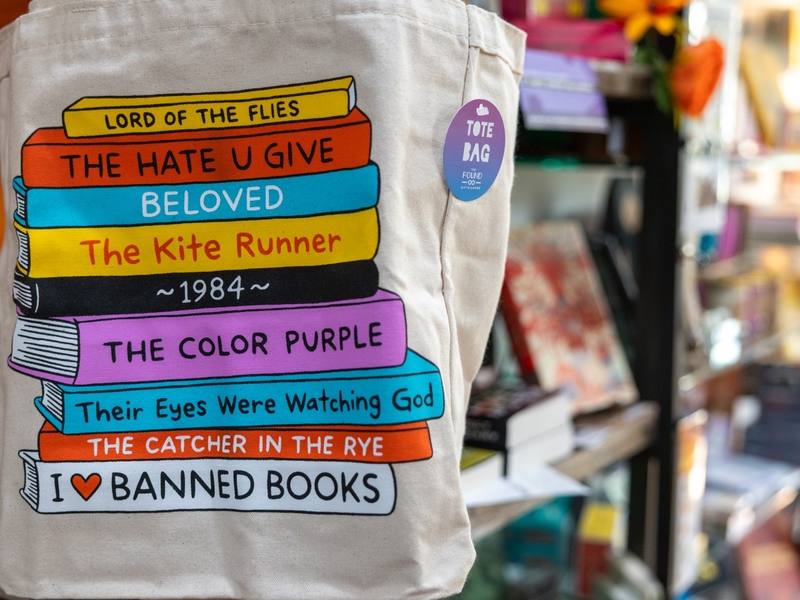
“These book challenges are happening in every corner of Connecticut, and what I’m most concerned about is the quiet censorship that doesn’t make it into the news,” said Sam Lee, co-chair of the Intellectual Freedom Committee at the Connecticut Library Association (CLA), stressing how hard it is to track challenges in public schools that do not have a designated library and media specialist on staff.
“This is especially nefarious in school libraries,” but also includes public libraries across the state where librarians may feel actively discouraged from collecting titles by LGBTQ+ authors and authors of color, Lee added.
Because the CLA, which sends data to the ALA’s Office of Intellectual Freedom, protects the confidentiality of those reporting book challenges, Lee said that she could not disclose where in Connecticut those challenges are taking place, or from whom they originated. Including branch locations, Connecticut is home to 235 libraries, according to the CT State Library.
She also noted that those numbers may be artificially low: librarians sometimes do not report book challenges because they fear retaliation from patrons, parents, and elected officials. It can also be harder to track challenges in schools where paraprofessionals or volunteers are running an understaffed or informal school library. Fifty-one percent of book challenges curently take place in public libraries, according to the ALA; 37 percent take place in school libraries, eight percent in curricula, and three percent in higher education.
Across the state, “a lot of media specialists are being laid off on a town-wide level,” said Kym Powe, children and young adult consultant at the CT State Library. While CASL tries to track challenges across the state, “it’s like a game of whack a mole.” In 2025, for instance, Bridgeport Public Schools cut all district librarians, citing a tight budget year. Powe sees that pattern happening over and over again across Connecticut, meaning that formal challenges within schools become that much harder to track.
What is ‘soft censorship’?
In part, understanding what constitutes “soft censorship” also means understanding the policies and protections that already exist in Connecticut’s libraries. Last year, the state passed S.B. 1271, “An Act Concerning School and Public Libraries,” championed widely as an act that protected the freedom to read and based on eponymous legislation that passed in New Jersey in 2024.
The legislation, which is now state law, requires both school and public libraries in Connecticut to create organization-wide policies around collection practices, programming and library displays, and material review and reconsideration.
In practice, having those standardized policies in place strengthens protections for both public and school librarians at a time when many are seeing their peers and colleagues lose or risk their jobs in other states without the same laws on the books. In March, for instance, Rutherford County Library Director Luanne James was fired for refusing to move 132 children’s books to the Tennessee library’s adult section (she has since filed a federal lawsuit).
“I can’t be fired because of these things anymore,” said Jenny Lussier, a digital and media specialist in Connecticut’s District 13 (Durham and Middlefield) who works with students from Pre-K through first grade, and is the former president of the Connecticut Association of School Librarians (CASL).
During her time as a school librarian, Lussier has only had one direct request for reconsideration, around a book in Rachel Russell’s popular “Dork Diaries” series. But during her time as the president of CASL, she observed “this onslaught,” which began before the Covid-19 pandemic and then escalated as schools returned to in-person learning after going remote.
Now, she said, the most significant challenge to the legislation is school districts that have not created any sort of plan for implementation, either because they do not want that degree of oversight, or because they do not have enough, or any, library and media specialists working for the district.
The legislation, meanwhile, does appear to be working. In the year that the law has been in place, the number of recorded challenges in Connecticut has decreased, from 17 unique book titles in 2024 (that took place over just seven attempted challenges, in what the ALA calls multi-title challenges) to seven challenges in 2025. Raymond Garcia, a communications specialist with the ALA, said that the organization does not yet have the state-by-state data for 2026.
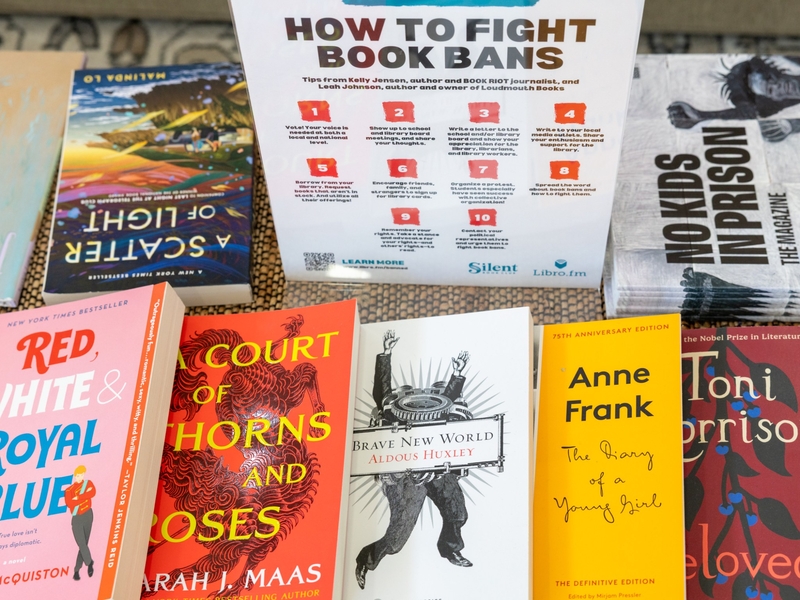
Lee said this year, she personally has tracked three formal book challenges, as well as two library program challenges and one “Hide the Pride” maneuver, in which a person entered the library, emptied a Pride Month display, and hid the books around the library, including under pieces of furniture. She said she cannot comment on where those took place.
“I didn’t come up with this phrasing, but when people are vocalizing their concerns [around books and literary content], it’s confusing public accountability with public control,” she said.
What she and colleagues are now increasingly concerned about, she continued, are “soft” or “quiet” challenges that don’t ever make it formally into the CLA’s records, but sometimes spook librarians into changing what books they request or recommend for a library’s collection. When a book gets taken off the shelf, or never makes it onto it in the first place, there’s suddenly one less story in which a reader of any age might be able to see their own lived experience, they said.
Both Lee and Powe said that the majority of these challenges, in keeping with the national trend, target children’s books, especially those that feature LGBTQ+ characters, characters of color, and other “folks with minoritized identities.”
In recent years, that’s looked like everything from Mike Curato’s “Flamer,” which the Newtown Board of Education narrowly avoided banning in 2023, to Justin Richardson’s and Peter Parnell’s “And Tango Makes Three,” a picture book about two male penguins who adopt a motherless egg and raise the nestling after it hatches.
“When I’m having these conversations from a public perspective, sometimes people don’t understand what challenging might look like,” Powe said in a phone call Monday. For instance, “moving a book from the teen section of the library to the adult section of the library” can constitute a challenge, but some of these acts never get reported.
“It’s okay if a parent or a household or a person does not want to expose their child to a book or a topic,” Powe continued. “That is ok. That is your right. The issue is, as it has always been, making that decision for other people. That’s just not ok.”
Lee pointed to “the four R’s of censorship,” a concept that comes from Dr. Emily Knox, interim dean and professor at the School of Information Sciences at the University of Illinois Urbana-Champaign.. Those include redaction (“when you remove a page or you draw pants on a naked baby,” Lee said), restriction, relocation and removal.
In the past several years, she and colleagues have also seen pressure that comes directly from patrons, whether in the form of a parental concern or a group that asks the library to pull a program, such as a drag queen story hour, or a patron who takes it upon themselves to quietly hide or remove a book from the collection.
“We are getting reports of this from library workers in the field and parents’ groups that we work with,” said Amelia Aldred, deputy director for state and local advocacy at ALA. “The issue and the problem, which is clear, is that it is silent. It’s not as transparent as a reconsideration process for a book. We see library professionals who are preemptively removing books, before they have been challenged. We also see librarians telling us that they’ve been told not to purchase books that have been banned or challenged, or are even similar [to those titles].”
Hamden resident and parent Nijija-Ife Waters, who runs the educational advocacy, training and consulting firm Un1que2L3arn, pointed to the importance of parents remaining vigilant about what their children read. As an advocate for all students, she doesn’t support book bans, she said. In fact, she’s currently working with a few clients in Florida who are fighting for the right to keep books that address Black history in their schools.
At the same time, and as a mother to a now-teenager, she believes libraries could do a better job categorizing sensitive and controversial books, in the same way that video stores used to add a parental advisory label or that movie theaters restrict entry to R-rated movies.
She added that parents need to remain active participants in their children’s lives. For her, this includes going with a child to the library and looking at the books they want to check out.
“It’s about having a conversation,” she said. In her own home, that often looks like picking up an extra copy of what her son is reading, reading the material herself, and talking about the book together. It both gives her a better sense of how her son is processing the material — she referenced Shakespeare’s “Macbeth,” for instance, which has several violent scenes — and lets her know he’s keeping up with it.
“Books are meant to give knowledge and not cause confusion,” she said in a phone call Friday morning. “I think if a parent feels that they’re not ready for their child to be exposed to a particular topic or global challenge, it shouldn’t be pushed onto them. There still should be some form of conversation around this. Certain topics should not be accessible to a certain age without adults’ supervision.”
‘I feel furious & I feel heartbroken’
In New Haven earlier this year, Quigley experienced that firsthand.
In late April, she selected “Raven’s Ribbons” for a program celebrating America’s semiquincentennial, because it centers the role of Indigenous people in the story of this country. The book, which came out in 2025, tells the story of Raven, a young boy who loves round dances for the sense of community they weave through communal movement and the syncopated beat of hand drums.
In the book, Raven is especially drawn to the bright, traditional ribbon skirts that dancers wear, and which his grandmother is particularly gifted at sewing. But when he asks his grandmother if he can have one, “she hesitates,” Quigley remembered, because she’s never seen one on a boy or a man before. After thinking about the tradition, and her love for her grandson, she stays up all night sewing a rainbow-colored ribbon skirt for him. The book ends with Raven dancing joyfully in a rainbow-patterned ribbon skirt, hand in hand with his grandmother.
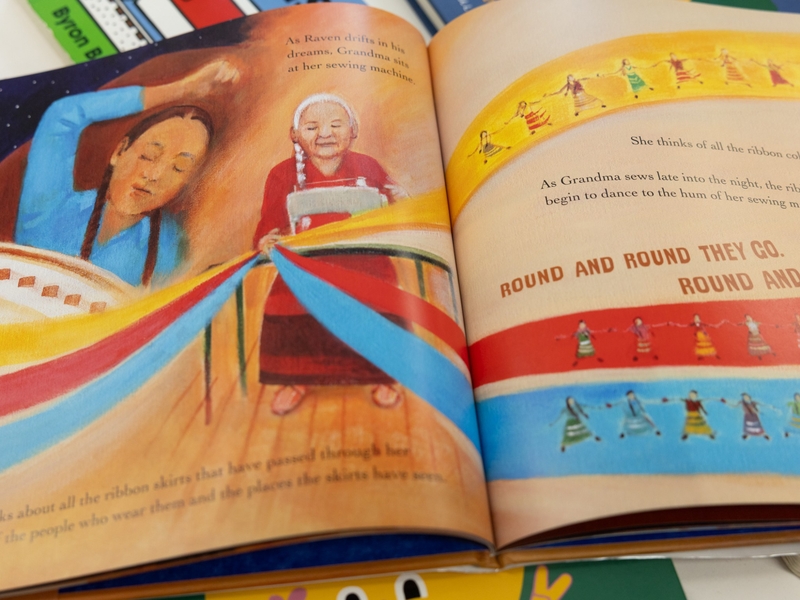
“It’s a beautiful nod to Indigenous tradition and the value and the beauty of those traditions, and the value and the beauty of saying when it’s okay to change a thing,” Quigley said. At the end of the book, Spillett includes a note about two-spirit people. When Quigley was talking through the note at storytime, “I said, and two-spirit is kind of like trans people,” she said. Quigley acknowledged that the phrasing may have been an oversimplification, but that she was trying to find a way for kids to understand the concept.
As a children’s librarian and an educator, Quigley said, it’s important to her to share a diverse range of lived experiences. Spillett, as well as illustrator Daniel Ramirez, are both Indigenous: Spillett is Cree and Trinidadian, and Ramirez has roots in the Saginaw Chippewa Tribe in Michigan.
But after Quigley read the book aloud, a patron called the library, having heard about the story time from a parent who was there. Speaking to Quigley’s supervisor, Branch Manager Marian Huggins, the patron pushed back against the book, suggesting that it was indoctrinating children. The person also threatened “to go to the press,” both Quigley and Huggins remembered, leaving both librarians shaken.
“This is unacceptable indoctrination and is completely inappropriate,” the person later wrote anonymously on SeeClickFix, a website on which people normally report problems with municipal infrastructure, like downed power lines, broken stoplights and potholes. Sarah from the library needs to be held accountable for pushing an agenda on children who have yet to start kindergarten!!”
It was ultimately the first of three complaints that was made. Quigley, who has helped the library organize wide-ranging children’s programming on themes that range from LGBTQ+ Pride to the hip-hop nutcracker to nail art, said that she absolutely considers the exchange an example of soft censorship. Since April, she hasn’t changed anything about her storytime choices, or the books she requests for the library’s collection. And yet, it’s given her pause every time she puts together a program or reaches for a title.
Before Quigley was in New Haven, she was a school librarian in Austin, Tex., where she heard the same kind of challenges and concerns from parents much more frequently. In 2022, the same year she and her partner moved to Connecticut, Texas saw formal challenges to 2,397 unique book titles across 94 challenges, according to the ALA.
Any time that a patron suggests she is somehow harming children, she takes it personally. She thinks a lot about the students she served in Texas, and the fact that they’re still there, as their libraries become increasingly restricted.
“This is my community!” Quigley said. “I feel furious and I feel heartbroken. It feels like people are digging their hands into places where they’re not invited just because they can.”
Quigley added that she feels empowered largely because she knows that as her supervisor, Huggins, has her back. As both Powe and Lee noted over separate interviews, that’s not always the case.
“She’s the children’s librarian,” Huggins said in a phone call Wednesday morning. “She has an MLS, she has years of experience, she has enthusiasm for the kids. She loves the kids, and the kids know it and they appreciate it. I think a lot of librarians are librarians because they love books. Sarah is a librarian because she loves people.”
“You can only make decisions for your own kid,” she added, noting that she speaks from experience as both a librarian and a parent who ran a fairly conservative home when her own kids were growing up. “That’s the bottom line. You are in charge of your own child. If you come in and we say, ‘This is going to be the story today’ and you don’t like it, you can leave. There’s a door.”
‘Knowledge is power’
That type of “soft” or “quiet” censorship was also a topic of discussion at Eastern Connecticut State University (ECSU) on Tuesday during a symposium on banned books and censorship that Hope-Marie Cook, ECSU librarian and director of the university’s curriculum center, has organized in some form since 2002.
In a library conference room brightly decorated with banned book displays and signs printed cheerily with the words “I Read Banned Books!,” Cook said that she holds the event to bring attention to censorship that people may not even know is happening. That’s especially true as she observes nationwide trends — the use of AI in generating book challenges, for instance, and the shift from individual concerns to complaints made by political and religious pressure groups — and thinks about the impact they may have on a local level.
“Knowledge is power and before people can protect the freedom to read, they need to be aware of these attempts that have been rampant in the United States,” she said as titles from Harper Lee’s “To Kill A Mockingbird” to Toni Morrison’s “The Bluest Eye” and “Beloved” added pops of color to the room. “Many educators are not aware of censorship of books in schools, classrooms, libraries and other publicly funded spaces until it happens to them.”
That was Cook’s experience too. In the 1990s, when she was a student teacher at a school in Las Vegas, a peer brought in Tarō Gomi’s 1977 children’s book “Everybody Poops” to read to a kindergarten class. But just before he began, the school’s principal appeared, pulled the book, and asked the student teacher to leave the school, and return to his classes at the University of Nevada.
“That event left us all very stunned,” Cook remembered. But it also put censorship very much on her radar, where it has remained for the last three and a half decades.
In the last few years, she’s been particularly concerned to see a rise in banned books in schools, of which the literary advocacy organization PEN America reported 11,982 in the 2025-2026 school year. When a book is banned or challenged, the process “does not allow readers to have access to literature that they might identify [with],” she said. “If books are taken off the shelves, titles will not have a chance to be read.”
Amy Slowik, head of youth and family learning at the Russell Library in Middletown and is the recipient of the CLA’s “Excellence in Public Library Service” award, echoed that message during a presentation on censorship in public libraries.
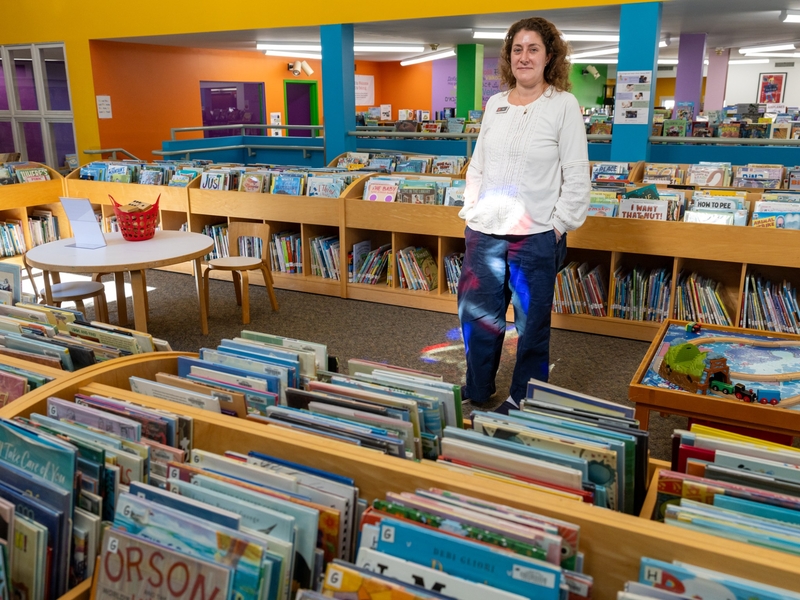
In seven years at Russell, she’s not received a formal challenge, which she credits in part to the formal review and reconsideration policy that the library has in place. But she’s watched them crop up across the state, from Colchester to Old Lyme to the Kent Memorial Library in Suffield just last year.
“What we do experience is ‘soft censorship,’” she said. At Russell, that’s looked like “direct pressure by patrons on staff,” from concerns about religious reading materials (for which there is a dedicated section) to requests to move a book from one section of the library to another.
Recently, she remembered, a parent came directly to her because they were concerned that their child was not ready for a book like Pan Cooke’s “Puzzled,” which was grouped with fiction appropriate for kids ages 9 to 12.
The parent had seen that the book, the protagonist of which is learning to navigate OCD, anxiety, and intrusive thoughts, references suicidality on the first page.
Slowik, who is a parent herself, took the concern seriously. She started reading about the book in context of what young adults were experiencing in their own, real lives. “All this research was coming out about kids dealing with anxiety,” she said. Not only did the book seem age-appropriate: it could be a mirror for a young person experiencing the same thing. She ultimately put it back on the shelf.
For her, there are two other kinds of soft censorship: instances where staff no longer feel confident in buying or reshelving a book, or when “controversial books simply disappear.” At Russell, as with national trends, those are often books with LGBTQ+ characters and characters of color.
“There were two theories,” Slowik said of books that disappear from the shelves. “People don’t want other people to take them, so they steal them, or people are afraid” to check them out, perhaps because they come from one of those marginalized identities themselves, or don’t want a book title to show up on their borrowing record.
At Russell, staff worked together to design bookmarks that remind patrons that if they steal a book, the library will replace it (not all libraries have the funds to do that, Slowik acknowledged), and if they are looking for a specific book but afraid to check it out, they can search for a digital copy, or work directly with a librarian to find a solution. Slowik credited librarians Stephanie Rush and Sue Honer with the final designs.
In recent years, Russell has also faced informal program challenges, including a drag queen story hour hosted with Middletown Pride that drew pushback from the community. In that case, the censorship worked: Russell hasn’t hosted one in several years.
“We still have censorship at Russell Library, but it doesn’t look the same way it does in the rest of the country,” she said.
Where Connecticut is within a national context
As she keeps one finger on the pulse of soft or quiet censorship, Lee and groups like the CLA are also tracking challenges to the freedom to read at the national level, where federal legislators have proposed multiple bills in Congress aimed at book bans and literary censorship.
One, H.R. 7661, would amend the Elementary and Secondary Education Act of 1965 to pull federal funding from public schools that allow books with “sexually oriented material.” In a testimony before Congress earlier this year, Sam Helmick, the 2025-2026 president of the ALA, called the legislation “a smokescreen,” intentionally broad enough to cut off funding to any school that brings in, or teaches from, books with LGBTQ+ content and characters.
Two other pieces of legislation, meanwhile, would expand protections for libraries and librarians on a national level. Lee said that these, S.4689 and H.R.6440, or the “READ Act” and the “Right To Read Act” respectively, “would help protect the right to read,” although neither has seen significant support from members of the Connecticut delegation in Congress.
Meanwhile, Lee knows to expect the challenges to keep coming, including those that may go unreported or underreported. In addition to her work at the CLA, Lee and a network of volunteers have also launched the New England Intellectual Freedom Helpline, which tracks challenges across Maine, New Hampshire, Vermont, Massachusetts, and Connecticut.
In the early hours of Wednesday morning, all of that seemed both urgent and a universe away, as the bookstore Possible Futures opened its doors on New Haven’s Edgewood Avenue a few hours early for a banned books reading group. On a table close to the door, a display of banned books invited readers to come closer, with titles for all ages that ranged from Allison Bechdel’s graphic novel “Fun Home” and Ray Bradbury’s frequently-challenged “Fahrenheit 451” to Sarah J. Maas’ “A Court of Thorns and Roses” (during the 2025-2026 school year, Maas’ books were banned 196 times, according to PEN America) to Jessica Herthel and Shelagh McNicholas’ “I Am Jazz.” Musician Emily King’s airy vocals drifted somewhere from a playlist and speaker at the back of the room.
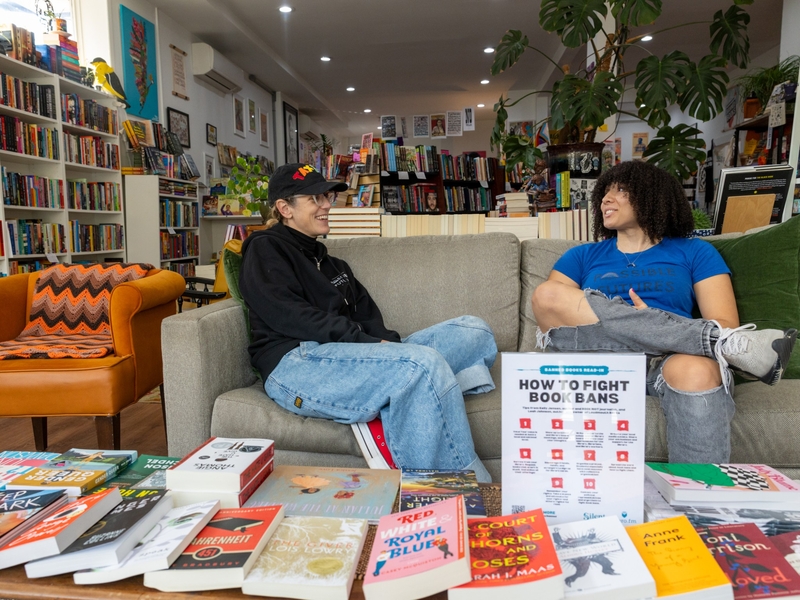
Bookseller Jada Boggs drifted around the sun-dappled space, shelving books and checking inventory as she waited for customers. Only when she was still behind the counter for a moment did she reflect on her own relationship with reading, which pulled her instinctively to Possible Futures after it opened four years ago.
When Boggs was still just a kid, she gravitated toward “The Lightning Thief,” a novel by Rick Riordan that tells the story of a mixed-race protagonist, Hazel Levesque, who is the daughter of Pluto. She became so enamored with the character that she ultimately named her first car, a 2018 Hyundai Elantra, after her.
“As a mixed girl, I got to see an interracial relationship where I could also see myself,” said Boggs. Riordan’s work “is goofy,” she said with a smile, but it gave her a place to think about her own lived experiences.
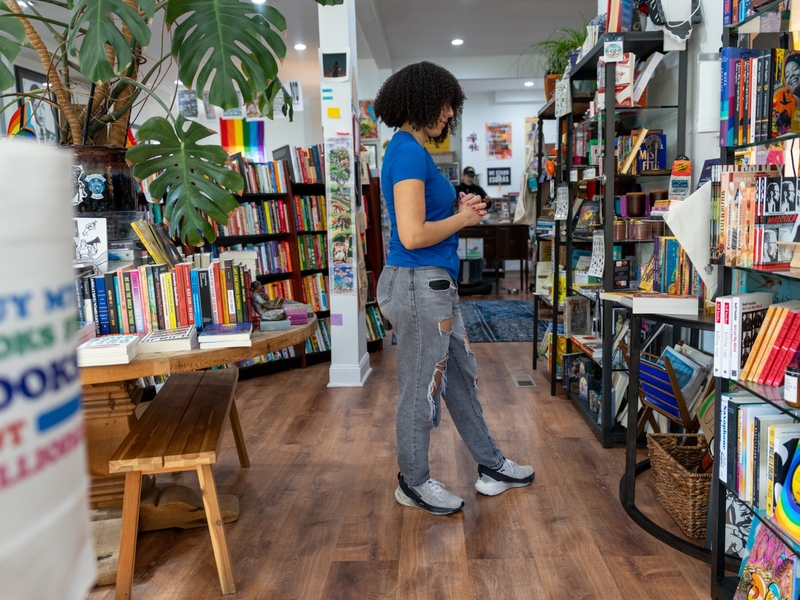
When she sees book bans, “we’re taking away kids’ opportunity to learn about other experiences,” she said. “Like somehow it’s [book are] this big looming threat that is just exposure to the information.”
Hartford, CT