UNC Board of Governors warned about financial sustainability of university athletics
Sep 16, 2026 | 4:41 pm ET
Description
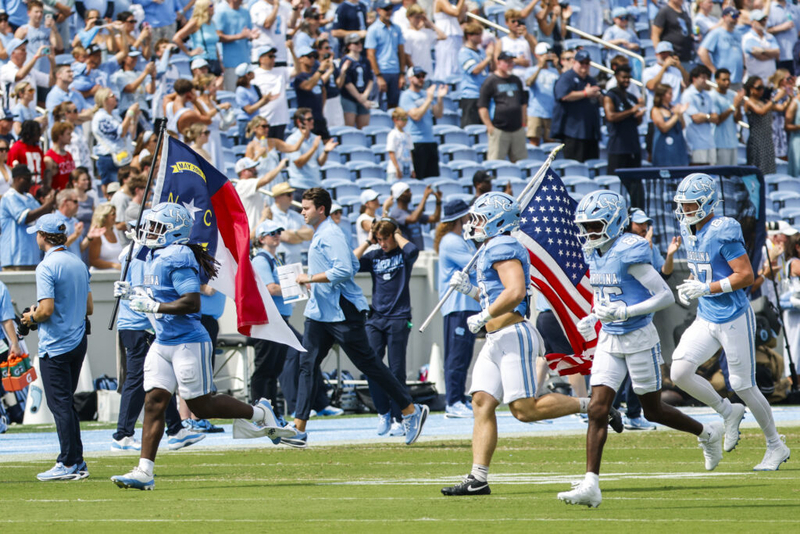
North Carolina Tar Heels players run out with flags before the first half of the game against East Tennessee State Buccaneers at Kenan Stadium on September 12, 2026 in Chapel Hill, North Carolina. (Photo by Jaylynn Nash/Getty Images)
It’s been 15 months since the landmark House v. NCAA settlement received final court approval, paving the way for Division I schools to compensate student-athletes directly. The revenue-sharing framework of that deal set a $20.5 million cap per school for university athletics in 2025-26. That figure is only expected to grow in the coming years.

Members of the UNC Board of Governors finance committee worried Wednesday that athletics spending is growing faster than the revenues the programs generate, and schools will have to cover the balance.
UNC System President Peter Hans said while athletics often represent the “front porch” of a university, the changing national landscape around athletics may be financially unsustainable.
“There’s a key paradox here, because most people would agree the college athletics model has never been more broken. And yet, it has never been more popular,” Hans told board members.
Hans said every university president and chancellor across the country that he has spoken with is feeling this new pressure.
“You don’t have to be an economist to figure out that those who spend the most will generally win the most games,” said Hans. “That’s why I’m hoping this will be the start of a conversation amongst the board members about how we can remain competitive in athletics, but not at the expense of the academic mission.”
Sustaining what matters
Kirk Bradley, who chairs the board’s committee on budget and finance, said before talking about cost, he wanted to be sure everyone was clear about the value athletic programs deliver.
“A few years ago, we documented how athletics generated more than $1.1 billion a year in estimated economic impact across North Carolina. That figure is likely closer to $1.5 billion today,” said Bradley.
He said athletics anchor alumni identity, open doors for philanthropy, and attract future students to UNC campuses.
“The question this board will wrestle with is never whether athletics matter,” said Bradley. “It is how we sustain what matters on a sound financial footing.”
Bradley said collectively, university athletics generated $412 million in the 2024 fiscal year for the UNC system through ticket sales, media and private giving, but they come with obligations and risks.
“We should be cautious about assuming that athletic success will produce sustained enrollment growth,” Bradley said. “Winning may increase visibility, but sustained enrollment gains are not guaranteed.”
Bradley said as financial pressures grow, universities may need to consider new fees, ticket surcharges, private equity, or separately organized entities.
Josh Lassiter, the UNC System’s vice president for financial health and strategy, said nationally, athlete compensation is projected to exceed $4.5 billion this year.
“Outside the power conferences, generated revenue did not keep pace with spending growth,” Lassiter warned. “That leaves institutions having to strategically decide how important a priority athletics is, and what other sources they’re going to fund it from.”
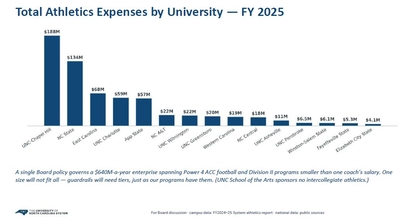
Jennifer Haygood, the UNC System’s senior vice president for finance and chief financial officer, said all 15 schools’ programs rely on subsidies from their schools. She said not a single North Carolina university fully covers its athletic expenses with generated revenue. NC State University and UNC-Chapel Hill come closest to paying their own way.
At the same time, those two schools have rapidly increased their spending. At Chapel Hill, total athletic expenses rose from $139 million in FY 2023 to $188 million in FY 2025. At NC State, total expenses rose from $119 million in FY 2023 to $134.5 million in FY 2025.
UNC-Chapel Hill hires Bill Belichick as head football coach in $50M deal
Haygood said the Board of Governors isn’t being asked to vote on any policy changes now, but members need to grasp the amount of money that is being spent.
Board member Philip Byer urged his colleagues on the finance committee not to be too quick to try to dial back the spending.
Byer said college athletics have been critically important to helping the mountains recover after Hurricane Helene in 2024.
“If you go to Western Carolina, they’re going to have 13,000 students every [football] game and bring in $5 million to the impact of that community, and App State will bring in $10 million, six times a year,” said Byer.
Harry Brown, a former state senator and current member of the board, said it’s clear that chancellors want to compete at the highest level, but the revenue sources that they can reliably generate on their own make it challenging.
“The NCAA has just botched the whole thing,” said Brown. “I do think it’s going to take some type of legislation to start to rein this thing in.”
Raleigh, NC