ERCOT CEO Pablo Vegas to make $6.4 million in 2027, nearly doubling his salary
Sep 15, 2026 | 7:57 pm ET
Description
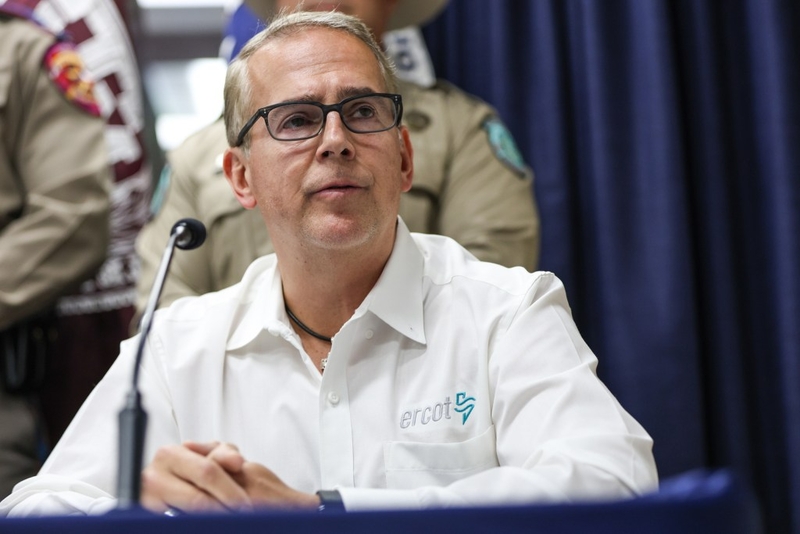
Pablo Vegas, president of ERCOT, speaks as Gov. Greg Abbott holds at a press conference Monday afternoon at the Texas Department of Emergency Management headquarters in Austin on Aug. 31, 2026. (Jacob Lujan/The Texas Tribune)
The president and CEO of the Electric Reliability Council of Texas will make $6.5 million next year, making him the highest paid executive of any independent system electric grid operator in the country.
Both ERCOT, which operates Texas’ energy grid, and the Public Utility Commission, which regulates the grid, approved a six-year contract extension for Pablo Vegas on Tuesday during ERCOT’s regular board meeting. Vegas will make the record salary in 2027 under the first year of the contract, which includes a final $1.4 million “make-whole” payment negotiated under the terms of Vegas’ first contract approved in 2022, the year he assumed the top role at the nonprofit, according to a board presentation of the terms of the contract.
Vegas’ pay in 2027 represents a more than 80% increase in his compensation from 2024, which was $3.6 million, according to ERCOT’s most recent 990 form filed in late 2025. ERCOT did not provide a reason for Vegas’ salary hike.
The next-highest paid CEO of a grid operator is John Bear, the head of Midcontinent Independent System Operator, who earned $3.7 million in 2024, according to the organization’s most recent 990 form filed in late 2025.
There are seven organizations in the continental U.S. that control and monitor the operation of an electric power grid, including ERCOT.
The new contract comes as ERCOT grapples with challenges surrounding the influx of data centers connecting to the state grid and accompanying political backlash. The organization has also faced controversial efforts to address transmission congestion in West Texas and the Houston area and rising energy bills for customers across the state driven by natural disasters, transmission congestion and increasing demand.
Statewide, electric rates have risen about 40% on average since 2020, up from an average residential rate of 11.50¢ per kWh in 2020 to 16.11¢ per kWh in 2026, according to data from independent electricity marketplace ElectricChoice.
ERCOT operates as a nonprofit and is funded mostly by an administration fee of $0.61 per megawatt-hour, which is paid directly by retail electric providers and municipal utilities and typically passed on to their customers. ERCOT reduced its administration fee from $0.63 per MWh at the start of the year.
ERCOT anticipates nearly $486 million in revenue in 2026, according to its 2026-2027 biennial budget.
Vegas’ base salary will be $1,162,716 under the new contract, but he can earn significantly more through short and long term incentives negotiated under the contract. Those incentives — 100% of Vegas’ base salary for the short term incentive and 180% of the base salary for the long term incentive — total about $3.3 million annually in additional pay, according to the contract presentation. The remaining amount of Vegas’ compensation is made up by a deferred compensation arrangement, known as a 457(f) plan, and benefits.
Without the make-whole payment, Vegas’ compensation in 2027 would be $5,085,398, according to the contract presentation.
The make-whole payment was negotiated under Vegas’ 2022 contract to make up for foregone bonuses from Vegas’ previous employer. That payment totals $6,684,000 spread across six years, the last of which will be paid in the first quarter of 2027, according to the contract presentation.
Vegas was hired after ERCOT’s last CEO, Bill Magness, was fired in the aftermath of the February 2021 power grid disaster, when the grid became overwhelmed during a strong winter storm that left millions of Texans without power. Hundreds of people died from the storm.
Vegas was the executive vice president of NiSource Inc. and group president of the Indiana-based company’s utilities prior to joining ERCOT in 2022. Vegas has long worked for energy companies and nonprofits, serving as president and chief operating officer for transmission company AEP Texas from 2008 to 2010. Vegas held a variety of other senior executive roles at AEP in addition to his two-year stint at the company’s Texas branch.
Both the Public Utility Commission and ERCOT did not immediately respond to a request for comment.
Austin, TX