Far offshore, scientists find fresh evidence of human harm to reefs
Sep 15, 2026 | 4:42 pm ET
Description
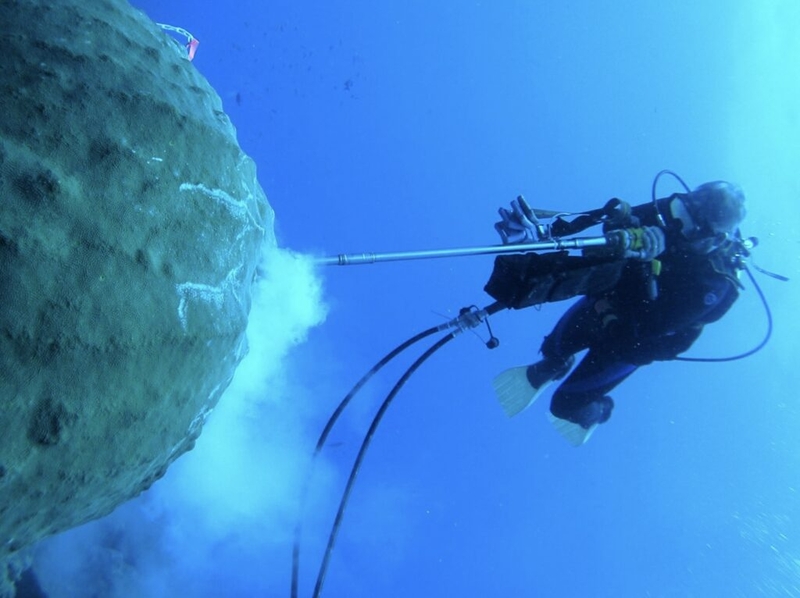
A scuba diver takes a core sample of coral from a reef in the Flower Garden Banks National Marine Sanctuary, located roughly 100 miles off the Gulf Coast of Louisiana and Texas. (Photo courtesy of National Oceanic and Atmospheric Administration)
An isolated reef off the coast of Louisiana and Texas holds within its corals a record of Earth’s history, and scientists are reading it to understand how nutrients from the Mississippi River are affecting the reef’s health amid rising threats to corals around the globe.
At 80 to 125 miles off the Gulf Coast lies a little-known, impressively healthy coral reef ecosystem known as Flower Garden Banks National Marine Sanctuary. It consists of 17 distinct inter-connected reef ecosystems to form a chain over 160 square miles, or over three and a half times the size of Disney World.
Hundreds of marine species, including manta rays, sharks and sea turtles, live amongst the sanctuary’s reefs. Boulder corals, some older than the United States, remain huge and healthy despite mass die-offs of reefs elsewhere on the planet driven by disease, nutrient pollution and the rising heat of climate change.
A new study examining nitrogen levels recorded within coral skeletons shows how nutrient pollution from the Mississippi River, combined with the hot tub-like underwater heat waves are undermining the health of this otherwise hearty reef.
Concentrations of high nitrogen, when combined with extreme heat, can harm and even kill corals.
“Coral reefs are kind of like deserts. It’s kind of weird to think of it that way, but there’s not a lot of nutrients in a coral reef because it needs that clear water,” said Kristine DeLong, professor at Louisiana State University’s Department of Geography and Anthropology and co-author of the new academic study published in Science Advances.
DeLong is a paleoclimatologist, someone who studies past climates, similar to how a paleontologist examines fossils to learn more about prehistoric life such as dinosaurs.
Corals are particularly vulnerable to changes in their environment, a kind of “Goldilocks” of creatures, said DeLong, so understanding past changes in climate can help scientists try to understand how picky life-forms like coral will — or won’t— adapt as the climate rapidly warms.
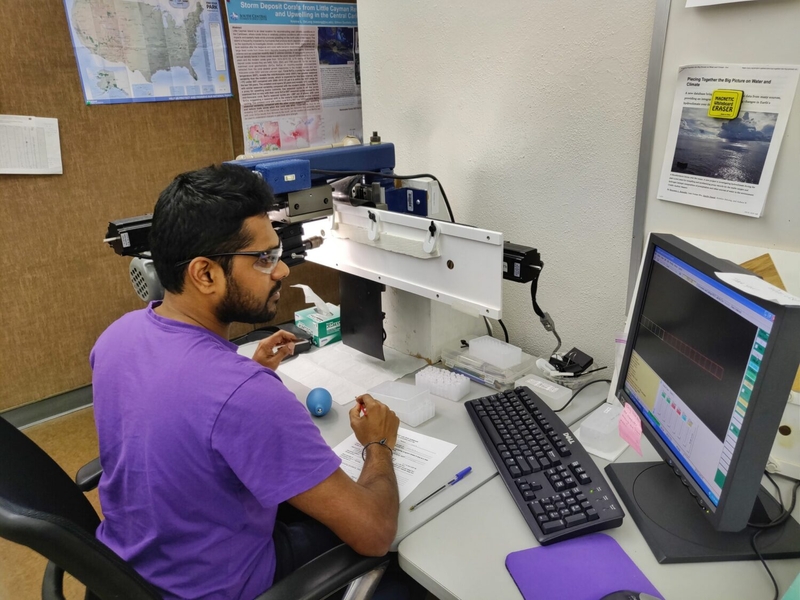
The research DeLong worked on at Flower Garden Banks shows that the combination of too much nitrogen from the Mississippi River undermines the health of coral, making it even more vulnerable to extreme heat and disease.
“The corals are getting stressed and as they get stressed, whenever you have disease, you’re gonna have problems,” said DeLong.
When nutrients like nitrogen enter the water, algae grows. Too much algae growth can harm corals.
“You don’t want a lot of algae in the water. The corals can’t grow because they’re photosynthesizers, and if they can’t get sunlight, they’re not gonna be able to grow,” she said.
Corals are also sensitive to heat. Water that gets too hot for too long, especially when combined with the stress from algae blocking sunlight, causes corals to bleach, become more susceptible to disease, or die.
“Flower Gardens is a healthy reef and it’s been healthy for a long time … but now it’s getting to that point where the water temperature is getting high enough that we’re starting to see disease outbreaks,” said DeLong.
“It’s not the best situation,” said Jonathan Jung, postdoctoral researcher at the Max Planck Institute for Chemistry in Germany and co-author on the study.
He worked on the chemical analysis of nitrogen in the coral samples from Flower Garden Banks, constructing a history of the changes in the Mississippi River going back to 1753 when European colonists first started to manage its channel and flow.
“What we can do now with these long and continuous records is we can contextualize what’s going on,” he said. “That’s what we’ve tried to do in this case, to show that when the temperature and nutrients kind of align, we see disease outbreaks.”
“Trees have tree rings, and you can count the rings to see how old the tree is … Corals have the same thing,” DeLong said. “They have layers in them that form every year, and so by looking at those layers we can tell what year it is.”
The researchers found that nitrogen levels in the coral skeletons increased around the same time artificial fertilizers became popular in U.S. agriculture, known as the Green Revolution, beginning in the early 20th century.
The Flower Garden Banks’ isolated location is likely what contributes to the astounding health and size of this reef, DeLong said. But the fact that nitrogen has been recorded this far out into the Gulf of Mexico speaks to the outsized impact humans have had on the environment from agriculture, engineering and pollution along the Mississippi River, she added.
Although skeptical at first because of the distance, the numbers showed DeLong that nitrogen from the Mississippi was reaching all the way out to Flower Garden corals.
“When we plotted it up against the nitrogen load data for the Mississippi River, I was just like, OK, yeah, this is definitely Mississippi River water.”
The data also showed that in years where corals at Flower Garden Banks experienced disease outbreaks or bleaching events — 2016, 2022 and 2023 — both heat and especially high nitrogen flows from the Mississippi River were recorded both in the corals and with human technology like thermometers. The research shows the connection between nitrogen, heat and coral demise, said DeLong.
“You get corals that are already sick, and then you stress them out, and yeah, that’s the problem,” she said. “That’s what we worry about with Flower Gardens.”
By understanding the past and how humans have changed it, scientists like Jung and DeLong hope to give important environmental information to those working to preserve and protect coral reefs from becoming a thing of the past.
“We know temperatures are gonna keep going up, but can we keep the corals healthy? Because if they’re healthy they can survive bleaching and they can survive some of these disease events that come through,” said DeLong.
“There’s all sorts of interesting reefs out there that are somewhat resilient,” said Jung, referring to places like Flower Garden Banks as “hope spots” for keeping corals and reef species from becoming extinct in an era of rapid climate change.
“You hope to kind of preserve them until you can figure out what exactly makes them resilient and whether you can help coral reefs,” said Jung.

Baton Rouge, LA