Iowa scientists push for more renewable energy to meet growing demands
Sep 15, 2026 | 3:32 pm ET
Description
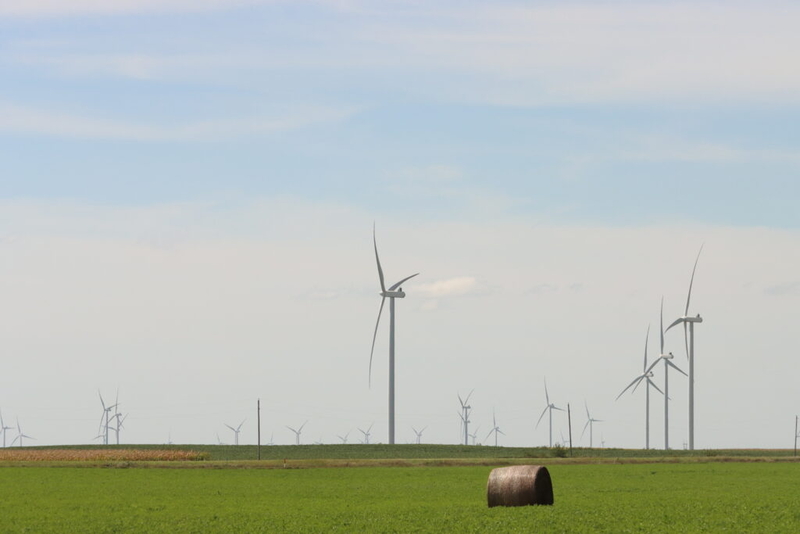
Wind turbines near Ogden, Iowa on Sept. 11, 2026. (Photo by Cami Koons/Iowa Capital Dispatch)
More than 180 Iowa scientists and sustainability scholars from universities and other organizations across the state have asked Iowans to advocate for the deployment of renewable energy systems to meet growing electricity demand.
The 2026 Iowa climate statement, published Tuesday, says Iowa is at a “fork in the road” with one path continuing to develop renewable energy sources and the other, building new fossil-fuel-generated power plants to meet growing energy demands.
“We have a choice to make, and we need to make it now,” the statement said. “Rapidly rising electricity demand calls for every stakeholder — from ordinary Iowans, to tech industry leaders, to local elected officials and utility company executives — to advocate for and adopt cheaper, cleaner, and more efficient ways of generating electricity and to push back against roadblocks designed to selectively hinder renewable energy.”
David Courard-Hauri, a professor of environmental science and policy at Drake University, said as the nation sees hotter summers, increasing patterns of drought, flooding and intense storm events and as the “proliferation” of data centers spreads through Iowa, it’s a “critical time to think carefully about how we want our energy future to look in Iowa.”
Trump EPA to strip greenhouse gas limits for power plants, a key Biden climate policy
“As we expand generation capacity, do we want our electric utilities and the corporations building independent data centers to continue the path that Iowa has blazed in renewable energy, or do we go back to fossil plants with climate and health risks as well as price volatility that we’ve all been suffering from recently?” Courard-Hauri said in a virtual news conference Tuesday.
Researchers on the call referenced a recently published report from the Iowa Environmental Council that found that the share of energy generated by coal increased in 2025 for the first time in several years.
The report similarly called for greater adoption of wind, solar and battery infrastructure to meet 2050 carbon neutral goals.
Utilities, which have continued to expand solar and wind projects in Iowa, said the Iowa Environmental Council report and climate goals don’t take into account the complex challenges of balancing electricity reliability, consumer cost and sustainability.
The Midcontinent Independent System Operator, or MISO, reported in 2024 that peak load to the grid remained essentially flat from 2009 to 2024, but now the “pace and scale” of industry trends have caused peak load forecasts to have a “significant increase.” MISO attributes the increase in demand to growth in artificial intelligence and data centers, new or onshored industrial activities, electric vehicles and building electrification.
The grid operator, which covers much of the Midwest and parts of the South, currently forecasts a 1.6% compound annual growth rate, which means by 2044, the annual coincident peak demand is forecast to be 38% higher than what it was in 2024.
Jacqueline Dowling, an assistant professor of civil and environmental engineering at the University of Iowa, said Iowa adopted “visionary policies” 20 years ago to make use of wind and solar energy. Iowa consistently ranks among the top states for renewable energy generation.
“Continuing along the pathway toward a wind- and solar-dominated system will lead to health benefits due to cleaner air, electricity affordability benefits due to zero fuel cost resources and global climate benefits due to reduced carbon emissions,” Dowling said. “If we need to build a lot more electricity generation quickly, we should seize the moment and build clean, cheap, and secure energy.”
Iowa is also home to one of several previously shuttered nuclear energy centers that is being restarted with support from the U.S. Department of Energy. More than 90% of the energy generated from the Duane Arnold Energy Center in Linn County is slated to go to Google who is expanding its data center footprint in Iowa.
Iowa utilities are also building new natural gas plants to help handle peak demand, though some energy groups fear the plants will need to operate more often to meet anticipated demands.
Dowling said right now, utilities are taking an “all of the above strategy.”
“They’re building everything,” Dowling said. “They’re building solar, restarting the nuclear power plant, also building new gas, and using our existing coal plants more.”
Dowling said nuclear energy has a “lot of pros and cons” but “it is carbon free, reliable power” that can provide “firming” capabilities to help fill the gaps when the wind doesn’t blow or the sun doesn’t shine.
“We would advocate for a wind and solar dominated system backed by carbon free, reliable power,” Dowling said.
This is the 16th annual climate statement signed by various scientists across the state. Last year, the group looked at climate change and its impact on rising insurance prices. In 2024, scientists urged individual action that would help solve the climate crisis and curb climate anxieties.
“As our climate continues to change, further investments in wind and solar power in Iowa will pay dividends in less expensive electricity and better health for generations to come,” the latest statement concluded.
A full list of supporting scientists, researchers and their affiliated universities or organizations can be found at the bottom of the statement.
Des Moines, IA